Best Depth to Troll for Walleye in Summer
One of the biggest head-scratchers for us walleye anglers, especially when the Nebraska summer sun is beating down, is figuring out just how deep those elusive fish are hiding. It’s frustrating to troll for hours, knowing walleye are out there somewhere, but not getting a single bite because your lure isn't swimming at their level. This comprehensive guide is here to unravel that mystery, helping you pinpoint the best depths for trolling walleye in Nebraska during the warmer months, ensuring your next trip is more productive and a lot less frustrating.
Understanding Walleye Behavior in Summer
As the water temperatures climb in Nebraska's lakes and reservoirs, walleye undergo a significant shift in their behavior and preferred habitat. They aren't going to be in the same shallow spawning grounds they were in the spring, that's for sure! Understanding this seasonal transition is key to consistently finding and catching them, especially when you're covering water with a trolling setup.
The Summer Thermal Stratification Effect
When summer really kicks in, many of Nebraska's deeper lakes like Lake McConaughy, Harlan County Reservoir, and Sherman Reservoir experience what's called thermal stratification. This means the lake water separates into distinct layers based on temperature. You've got the warm, oxygen-rich upper layer (epilimnion), a middle layer where the temperature changes rapidly (thermocline), and a deeper, colder layer (hypolimnion) that often has less oxygen.
Walleye, being cool-water fish, generally prefer temperatures between 60 and 70 degrees Fahrenheit. In summer, this comfort zone often aligns perfectly with the thermocline. It's their sweet spot – cool enough to be comfortable, but still rich enough in oxygen and teeming with baitfish. If you're trolling above or below this prime zone, you might be missing them entirely. Identifying the depth of this thermocline is crucial, and it can vary from lake to lake and even change throughout the summer. Using a good fish finder is invaluable here to literally see these layers.
Forage and Structure Migration
Another critical aspect of summer walleye behavior is their relentless pursuit of food. As baitfish like shad, smelt, and yellow perch also seek comfortable temperatures and oxygen-rich water, walleye will follow them. In summer, this often means walleye migrate to deeper, off-shore structures. Think about those sunken islands, deep rock piles, main lake points, and even old creek channels. These aren't just random spots; they're underwater highways and dining rooms for baitfish, which in turn attract walleye.
So, instead of patrolling the shallow flats you fished in spring, you'll want to focus your trolling efforts on those deeper contours and structures. Walleye might suspend over deep water, especially if there's a good bait ball, or they might hug the bottom transitions where structure provides ambush points. This is why knowing "How to Fish Deep Structure for Summer Walleye" is so vital. It's not just about a specific depth, but the type of depth and what's down there.
Factors Influencing Trolling Depth
There isn't a single magic number for the best trolling depth. Many variables come into play, and successful summer walleye anglers are constantly adjusting their approach based on these conditions. It's a bit like being a detective on the water, always looking for clues.
Water Clarity and Light Penetration
Water clarity is a huge factor. In Nebraska, some lakes can be crystal clear, while others might be more stained or even muddy, especially after heavy rains. In clear water, light penetrates much deeper, and walleye, being light-sensitive, will often retreat to deeper, darker water during the day to avoid the intense sunlight. They might come shallower during low-light conditions like dawn, dusk, or on cloudy days.
Conversely, in stained or muddy water, light penetration is limited, allowing walleye to feel comfortable at shallower depths even in broad daylight. This means your "deep" trolling depth might only be 10-15 feet in a turbid lake, whereas in a clear lake, you might need to be down 25-40 feet or more. Pay attention to the clarity. If you can see your prop at 5 feet, it's clear. If you can't see it at 1 foot, it's stained.
Baitfish Location and Preferred Depth
Ultimately, walleye are where the food is. Your fish finder isn't just for seeing walleye; it's also crucial for locating baitfish. If you're marking schools of shad suspended at 25 feet over a 40-foot bottom, chances are the walleye are going to be in that vicinity, either just below, within, or feeding on the edges of that bait ball.
Sometimes, baitfish will stack up on deep points or suspend in the middle of a reservoir. Knowing "What Walleye Eat in Nebraska Lakes" can help you understand these patterns. Matching your trolling depth to the depth of the baitfish is often the most effective strategy. If your electronics are showing baitfish at 20-30 feet, that’s where you want your crankbaits or crawler harnesses running.
Time of Day and Weather Conditions
Just like water clarity, the time of day and prevailing weather conditions can significantly impact where walleye will hold.
- Early Morning/Late Evening: These are prime low-light periods when walleye often move shallower, especially along breaks and points, to feed. You might find success trolling in 10-20 feet of water during these times.
- Mid-Day Sun: When the sun is high and bright, walleye typically drop deeper. This is when that thermocline or deep structure fishing becomes paramount. They'll seek refuge in deeper, cooler, darker water, sometimes as deep as 30-50 feet or more, especially in clearer lakes.
- Cloudy Days/Rain: Overcast skies or light rain can mimic low-light conditions, encouraging walleye to stay shallower for longer throughout the day. Don't be surprised to find them in 15-25 feet even at noon under heavy cloud cover.
- Wind: Wind can create current, push baitfish, and stir up water, often concentrating walleye on the wind-blown side of a structure or shoreline. It can also break up light penetration, potentially allowing walleye to move shallower. "How Wind Direction Affects Walleye Fishing" is a whole topic in itself, but suffice it to say, don't ignore it.
Techniques and Gear for Effective Deep Trolling
To consistently hit those specific depths, you need the right gear and a good understanding of how to deploy it. Trolling for walleye isn't just about putting a lure in the water; it's a calculated effort to present your bait exactly where the fish are.
Understanding Lure Dive Curves and Lead Core
One of the biggest hurdles for anglers is knowing how deep their lure is actually running. Crankbaits have published dive curves (e.g., a Rapala Deep Husky Jerk might dive to 15 feet on 10lb mono with 100 feet of line out). However, these are often just guidelines. Factors like line diameter, trolling speed, and water current will all affect the actual depth.
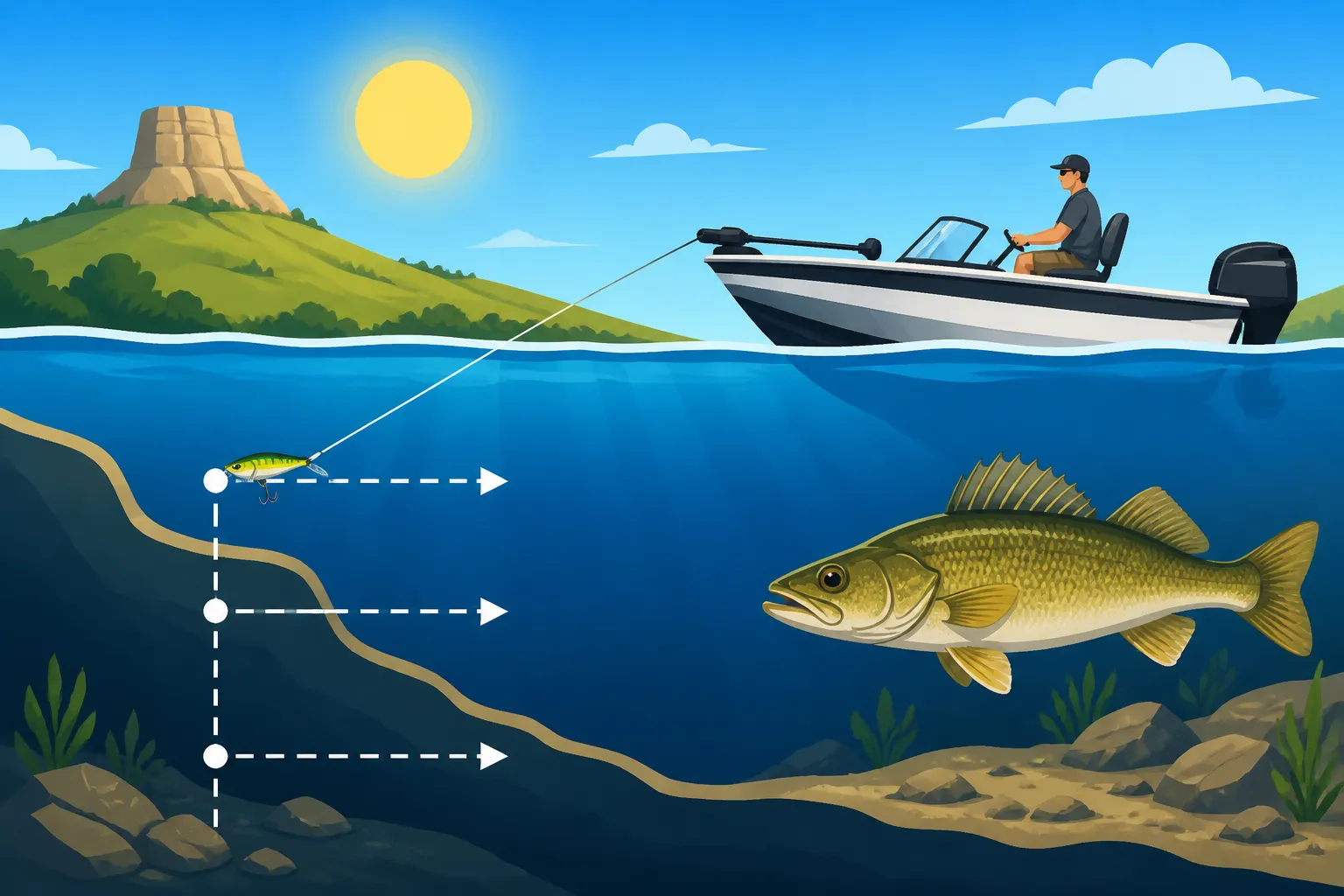
For precision, especially in deeper water, many Nebraska walleye anglers turn to lead core line. This specialized line has a lead weight woven into its core, causing it to sink. The general rule of thumb is that one color (each color is 10 yards) of lead core will get your lure down about 5 feet at typical trolling speeds (around 2 mph). So, if you want to hit 25 feet, you'd let out 5 colors of lead core, plus the diving depth of your lure. It's a bit of a learning curve, but incredibly effective for hitting specific depths over large areas. You can find various brands of lead core line readily available on Amazon.
Dive Curve Reference (Approximate)
| Lure Type / Line | Trolling Speed (1.5-2.5 mph) | Approx. Depth (100 ft out) | Notes |
|---|---|---|---|
| Deep Diving Crankbait (e.g., Berkley Flicker Shad Deep) | Moderate | 15-25 feet | Varies greatly by model and bill size. |
| Shallow Diving Crankbait (e.g., Rapala Shad Rap) | Moderate | 5-12 feet | Good for shallower edges or suspended fish. |
| Crawler Harness (with 1 oz bottom bouncer) | Slow to Moderate | 15-20 feet | Bottom bouncers help maintain contact with bottom. |
| Lead Core (1 color) | Moderate | ~5 feet | Add lure's dive depth for total. |
| Snap Weights (2 oz) | Moderate | 10-15 feet | Clip directly to mainline to add depth. |
| Downriggers | Any | Precision depth | Most accurate way to target specific depths. |
Essential Trolling Gear for Deep Walleye
To be effective at deep trolling for walleye, you'll need a few key pieces of equipment beyond just your rod and reel.
- Fish Finder/Sonar: This is non-negotiable. You need a good unit to mark the thermocline, locate baitfish, identify deep structure, and even spot individual walleye. Modern units like those from Humminbird or Lowrance offer side-imaging and down-imaging which give you incredible detail of the underwater world. "How to Read a Fish Finder for Walleye" is a skill worth developing.
- Trolling Rods: For lead core or heavy bottom bouncers, you'll want medium-heavy action trolling rods around 7-9 feet long, designed to handle the stress of multiple colors of line and a hard-fighting walleye. For standard crankbait trolling, a medium-action rod in the 7-foot range works well. Finding "Best Walleye Rods for Nebraska Reservoirs" can make a big difference.
- Line Counter Reels: These are incredibly helpful for repeatable depth control, especially with crankbaits or lead core. They tell you exactly how much line you've let out, allowing you to replicate successful depths. Brands like Daiwa and Okuma offer excellent line counter reels.
- Line: Beyond lead core, having a good low-stretch monofilament or fluorocarbon main line (10-12 lb test) is common for crankbait trolling. "Best Fishing Line for Nebraska Walleye" will often come down to personal preference and specific technique.
- Bottom Bouncers: When fishing near the bottom on rocky or irregular terrain, bottom bouncers are your friends. They allow your bait (often a crawler harness) to tick along the bottom without constantly snagging. Weights typically range from 1 to 3 ounces, depending on depth and speed.
- Snap Weights/In-line Weights: These are lead weights you can clip directly to your mainline at a set distance in front of your lure to achieve greater depth without using lead core or downriggers. They're a simple yet effective way to get those crankbaits down a bit deeper. You can often find a variety of snap weights on Amazon.
Adjusting Your Approach: Real-World Scenarios
The beauty of walleye fishing is that it's rarely static. What worked yesterday might not work today, and what works on one end of the lake might fail on the other. Being able to adapt is the mark of a seasoned angler.
Trolling on Major Nebraska Reservoirs
When you're out on big water like Lake McConaughy, Harlan County, or Sherman Reservoir, you're often dealing with vast expanses and deep water. These lakes are prime spots for "Summer Fishing in Nebraska", and specifically for walleye. Here's a common approach:
Start by identifying potential structure – deep points, humps, or old river channels using your marine electronics. Look for baitfish schools and the thermocline. If the thermocline is at 25 feet, and you're marking baitfish around 20-30 feet, you'll want to target that zone.
For example, if you're fishing Harlan County Reservoir and your electronics show walleye relating to a deep hump in 35 feet of water, and bait is suspended around 28 feet, you might deploy lead core with a diving crankbait. You could let out 4-5 colors of lead core (which gets you to 20-25 feet) plus the natural dive of your crankbait (which might add another 5-10 feet), putting your lure right in the strike zone. Don't be afraid to experiment with different depths, even just a few feet up or down, as walleye can be very finicky. Sometimes, they want it right in the bait, other times just below it.
Dealing with Suspended Fish
Not all walleye will be hugging the bottom or relating directly to structure. Sometimes, especially in large, deep lakes, walleye will suspend in open water, often following huge schools of baitfish. This is where precision trolling really comes into play. If your fish finder shows a distinct band of bait and walleye at 22 feet over 60 feet of water, you absolutely need your lure at that 22-foot mark.
In this scenario, techniques like using snap weights or even downriggers (if you have them) can be highly effective. A downrigger allows you to set your lure at an exact depth, regardless of line out or trolling speed. For snap weights, you might run a crankbait that dives 10-12 feet, then clip a 1- or 2-ounce snap weight to your line 50 feet in front of the lure to get it down to your target depth. This is a great way to fine-tune your presentation. Remember to check out your local tackle shop or browse Amazon for these handy accessories.
Fine-Tuning Your Speed and Lure Choice
Your trolling speed and lure choice are intrinsically linked to your depth. A faster speed will generally make your crankbait run deeper, while a slower speed will keep it shallower. Similarly, certain lures are designed to dive deeper than others. "How to Troll for Walleye in Nebraska" often involves a dance between these factors.
For summer deep trolling, you're usually looking for speeds between 1.5 and 2.5 mph. However, on some days, walleye might prefer a slower presentation, while on others, a faster retrieve might trigger a reaction strike. Experiment! Vary your speed, make S-turns (the inside turn lure will drop, the outside turn lure will rise) to see if a depth change triggers a bite.
When it comes to lures, deep-diving crankbaits like Berkley Flicker Shads, Rapala Deep Husky Jerks, or Reef Runner 800 series are excellent choices. Don't forget crawler harnesses, especially when fished with bottom bouncers, as they are deadly for walleye year-round. For more options, check out "Best Lures for Nebraska Walleye".
Finding that perfect depth for trolling walleye in Nebraska during the summer is a dynamic challenge, but it's one that rewards patience, observation, and a willingness to adapt. By understanding walleye behavior, paying attention to environmental factors, and utilizing the right gear and techniques, you’ll be well on your way to filling your livewell.
Disclaimer
Fishing conditions and regulations in Nebraska can change. Always consult the latest Nebraska Game and Parks Commission regulations before heading out. This guide provides general information and recommendations, but individual results may vary. Stay safe on the water and always practice responsible angling.