How to Fish a Missouri River Wing Dam
The Missouri River is a beast of a waterway, powerful and ever-changing, and for many anglers, fishing its wing dams feels like trying to crack a secret code. You know the fish are there, holding in those current breaks, but getting your bait down to them without immediately snagging and losing it to the river gods? That's the real challenge. It can be incredibly frustrating to spend more time re-tying than fishing. This guide is all about demystifying those tricky wing dams, giving you the practical know-how to approach them confidently, present your lures effectively, and, most importantly, bring more fish to the net.
Understanding Missouri River Wing Dams and Their Impact
Fishing wing dams on the Missouri River isn't just about dropping a line; it's about understanding a complex aquatic ecosystem engineered by humans. These rock structures, often extending from the bank into the river channel, were originally built to help maintain the navigation channel by concentrating the flow of water. But for us anglers, they've created some of the most dynamic and productive fishing grounds in the state. Ignoring them means missing out on some incredible opportunities.
What are Wing Dams and Why Are They Important for Fish?
Picture a long, submerged rock wall stretching out from the riverbank, often perpendicular to the main current. That's a wing dam. They're typically constructed from large rock riprap, designed to funnel water and scour out deeper channels. However, what this action creates is a smorgasbord of varied habitats that fish absolutely adore.
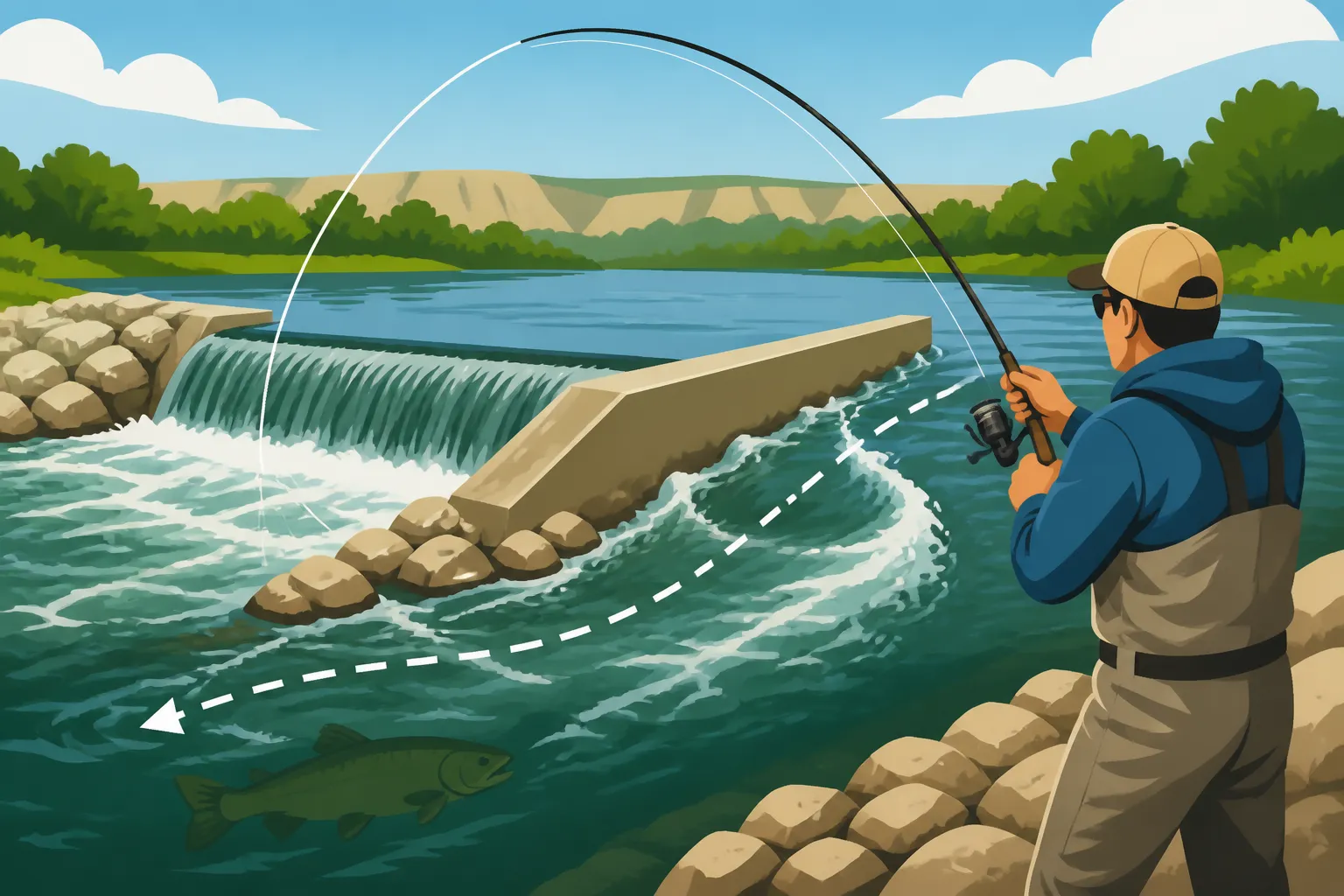
On the upstream side, where the current directly hits the dam, you'll often find a powerful eddy created by the deflecting water. Just behind the dam, downstream, there's usually a significant slack water area or a softer eddy. Where the fast current flows around the end of the dam, a deep scour hole is often carved out, providing a sanctuary for larger fish. These varied current speeds, depths, and structures offer fish everything they need: ambush points to wait for baitfish swept by the current, calmer areas to rest and conserve energy, and deep holes for refuge from predators or harsh weather conditions. Without these structures, the river bottom would be much more uniform, and fish would be far more dispersed and harder to locate. This makes wing dams prime real estate for species like walleye, sauger, and all kinds of catfish.
How Water Flow and Current Affect Fish Positioning Around Wing Dams
The Missouri River's current is the lifeblood of its wing dam fisheries, constantly dictating where fish will hold and how they feed. Understanding how this water flow interacts with the structure is your biggest advantage.
Think of fish as being lazy – they don't want to fight the current any more than they have to. So, they'll position themselves in spots where they can ambush prey with minimal effort while staying out of the strongest flow. This means looking for "seams" – the lines where fast current meets slower water. These seams are conveyor belts for baitfish and nutrients, and predatory fish will sit right on the edge, darting out to grab a meal.
- Upstream Side: On the leading edge of a wing dam, you'll find strong current. Fish here will typically hug the bottom, tucked behind larger rocks, or sit in small eddies that form. They're often feeding on items that get dislodged and swept over the dam.
- Downstream Side/Slack Water: This is often a calmer zone, a haven from the main current. Smaller baitfish will congregate here, attracting larger predators. Walleye and crappie frequently utilize these areas, especially during lower light conditions.
- The "Washout" or Scour Hole (Off the End): This is often the deepest part, where the river's energy has carved out a bowl-like depression. Big channel cats and flatheads love these deep, current-protected areas, as do larger walleye and sauger seeking refuge. The depth also offers thermal stability, which is crucial during extreme hot or cold snaps. The exact size and depth of these scour holes vary greatly depending on the wing dam's age, construction, and the river's flow at any given time.
The trick is learning to "read" the surface for subtle clues. Look for boils, swirling water, or slicks that indicate different current speeds below. Often, where you see a distinct line on the surface, there's a seam or a depth change underneath that's holding fish. Remember, current isn't static; it changes with river levels and even hourly. Always observe before you start fishing.
Essential Gear for Wing Dam Success
Fishing Missouri River wing dams demands gear that can stand up to the challenge. You're dealing with strong currents, abrasive rocks, and powerful fish, so this isn't the place for your ultralight panfish setup. Investing in the right tools will save you frustration and increase your chances of success.
Rods, Reels, and Line Choices for Battle
When it comes to rods and reels, think robust and reliable. You need equipment that can handle heavy weights, strong currents, and the powerful runs of a big catfish or a determined walleye.
- Rods: A medium-heavy to heavy action rod, typically 7 to 8 feet long, is ideal. Shorter rods can make it tough to handle the current and keep your line clear of the boat, while longer rods give you more leverage for casting heavy baits and fighting strong fish. A fast tip will give you the sensitivity to feel subtle bites, while a strong backbone is crucial for muscling fish away from snags and setting hooks into tough mouths. Look for rods designed for catfishing, salmon, or heavy-duty bass fishing. You can find some excellent, durable options on Amazon that won't break the bank.
- Reels: For most wing dam applications, a sturdy baitcasting reel is preferred, especially when fishing heavier jigs, bottom bouncers, or live bait rigs. They offer superior cranking power and line capacity. However, a robust spinning reel in the 4000-6000 size range can also work, particularly for lighter jigging or casting. Ensure your reel has a smooth, reliable drag system – you'll need it.
- Line: This is where you absolutely cannot skimp. Braided line is king for wing dam fishing. Its no-stretch property provides incredible sensitivity, allowing you to feel every tap and rock, which is critical for staying out of snags and detecting light bites in current. It also offers superior strength for its diameter, meaning you can run 30-50 lb test braid without it being overly bulky. The abrasion resistance is key for rubbing against rocks. You'll want to add a fluorocarbon or monofilament leader (15-30 lb test) of about 2-3 feet. The leader provides some stretch, acts as a shock absorber, and is less visible to fish in clearer water. Plus, if you do snag, you're more likely to break off the leader, saving your expensive braided main line. Many anglers will purchase bulk spools of quality braided line on Amazon for cost-effectiveness.
Lures and Baits That Get Down and Stay There
The challenge here is getting your offering to the fish that are hunkered down on the bottom, often in strong current, without getting immediately hung up.
- Heavy Jigs: Jigs in the 1/2 oz to 2 oz range are standard, depending on current speed and depth. Tipping them with a plastic grub, a minnow, or a piece of cut bait can be deadly. Colors like white, chartreuse, natural browns, and blacks are often effective. The key is to use enough weight to maintain bottom contact with a vertical presentation.
- Bottom Bouncers & Three-Way Rigs: These are fantastic for covering ground and keeping your bait near the bottom without constant snagging. A bottom bouncer lets you attach a leader with a hook (for live bait like crawlers or minnows) or a crankbait. Three-way rigs involve a heavy sinker on a dropper line, with a leader extending out to your bait or lure. These setups are great for drifting or slow trolling along the current seams.
- Crankbaits: Deep-diving crankbaits can be highly effective, particularly when retrieved slowly or trolled to "tick" the tops of the rocks. Choose models that are tough and have a good dive curve to reach the desired depth. Colors mimicking shad or crawfish are often winners. You can sometimes find multi-packs of popular crankbait styles on Amazon.
- Live Bait: For catfish, traditional live baits like shad, minnows, or cut bait (perch, sunfish, gizzard shad) fished on a slip-sinker rig or a three-way rig can be irresistible, especially in the scour holes. For walleye and sauger, fathead minnows, shiners, or nightcrawlers on a jig or bottom bouncer are always good bets. The key to success with live bait is fresh bait and proper presentation to keep it enticing.
Anchoring and Positioning Your Boat for Precision
Successfully fishing a wing dam often boils down to precise boat positioning. The current is constantly trying to push you off your mark, so a solid anchoring strategy is crucial.
- The Right Anchor: A heavy river anchor, like a mushroom anchor or a box anchor (often 20-30 lbs or more, depending on your boat size and current), is essential. Ensure you have plenty of anchor rope – at least 3-5 times the depth you're fishing, plus extra for current. For example, if you're in 20 feet of water, you'll need 60-100 feet of rope deployed to get a good hold.
- Dual Anchoring: For maximum stability and precision, consider using two anchors – one off the bow and one off the stern. This allows you to "stern tie" your boat directly over a specific spot or to angle it slightly into the current, minimizing boat swing and keeping your line more vertical.
- Electric Trolling Motor: A powerful electric trolling motor with GPS Spot-Lock capabilities is a game-changer for wing dam fishing. It allows you to precisely hold your position without traditional anchors, or to make micro-adjustments to drift along a seam. This gives you incredible control and significantly increases your fishing efficiency, especially when trying to follow a specific contour or current line. Using an electric motor means less time deploying and retrieving anchors, and more time fishing. Just remember to have enough battery power for a full day on the river.
Tactical Approaches to Fishing Wing Dams
Getting your bait to the fish is one thing; getting them to bite and then successfully landing them is another. Mastering wing dam tactics involves a mix of observation, precise bait presentation, and knowing how to deal with the inevitable snags.
Reading the Water and Identifying Key Spots
Before you even make your first cast, take some time to observe. This is where local knowledge and a good fish finder really pay off.
- Look for Current Breaks: These are the most obvious indicators of where fish might be. See where the main river flow hits the wing dam, creating a visible seam of turbulent water meeting calmer water. Fish will often stack up on the calmer side of this seam.
- Identify Eddies: Swirling pockets of water downstream of the wing dam or behind larger rocks are prime resting and ambush spots.
- Target the Scour Hole: Use your electronics to find the deepest part of the channel off the end of the wing dam. This is a common holding area for bigger fish. Note that the deepest point might not be directly at the very end; current can create the hole slightly downstream or to one side.
- Check Different Depths: Fish can be anywhere from just a few feet deep right on top of the dam to 20+ feet in the scour holes. Start by checking various depths around the structure until you find where fish are actively biting. Often, the current dictates how shallow fish can comfortably sit.
- Consider Time of Day and Year: Fish behavior around wing dams changes with light levels and seasons. Walleye, for example, might be on top of the dam during low light mornings or evenings, but retreat to deeper scour holes during bright midday sun. Catfish are often more active in the evenings and overnight. This is especially true during the Nebraska Fishing Seasons Explained when water temperatures are fluctuating.
Presenting Your Bait Effectively in Current
This is the make-or-break aspect of wing dam fishing. Getting your lure or bait to the fish's strike zone and keeping it there requires finesse.
- Vertical Presentation: The most common and often most effective method. Position your boat directly upstream of the wing dam, or slightly to one side of a current seam, and drop your jig or bottom bouncer straight down. The goal is to keep your line as vertical as possible, allowing your bait to bounce along the bottom without getting swept too far downstream into snags. Use just enough weight to maintain bottom contact; too little, and you'll be constantly swept away; too much, and you'll snag frequently.
- Controlled Drifting/Trolling: If the current isn't too strong, or you're working a longer section of a wing dam, a controlled drift can be productive. Use your trolling motor to slowly move parallel to the dam, letting your bottom bouncer or three-way rig tick the bottom. This allows you to cover more ground and find active fish. For deeper scour holes, a slow troll with heavy crankbaits can also be effective.
- Casting and Retrieving: For fish holding on top of the dam or in shallower eddies, casting a jig or a smaller crankbait can work. Cast upstream and across the wing dam, allowing your lure to sink and then slowly retrieve it as it washes downstream. This mimics baitfish being swept over the structure.
- Feel the Bottom: With any presentation, continuously focus on feeling the bottom. You want to feel the rocks, bumps, and changes in substrate. If you stop feeling the bottom, you're either too light, or your boat has drifted. If you feel a "thump" that's softer than a rock, set the hook!
Dealing with Snags and Break-offs
Let's be realistic: if you're fishing wing dams effectively, you're going to get snagged. It's part of the game. The goal isn't to avoid snags entirely, but to minimize them and know how to deal with them when they happen.
- Heavy Line: As mentioned, braided line helps immensely. When snagged, often a sharp, continuous pull in the opposite direction of how you got snagged can free your lure. Braided line's strength allows you to put more pressure on the snag.
- Leader Material: Using a slightly lighter leader (e.g., 20 lb test fluorocarbon) than your main line (e.g., 50 lb test braid) ensures that if you do have to break off, you typically only lose your leader and lure, not yards of expensive braid.
- Snag-Resistant Lures: Some jigs are designed with weed guards or have shapes less prone to wedging. However, ultimately, any bottom-contact lure can snag in these rocky environments.
- The "Pop" Technique: When you feel a snag, instead of pulling straight back, try reeling down to put slack in your line, then give a sharp, upward "pop" with your rod tip. This can sometimes dislodge a lure that's just wedged.
- Approach from the Opposite Side: If you're drifting downstream and snag, try to carefully maneuver your boat upstream of the snag and approach it from the opposite angle. Sometimes this can help unlodge the lure.
- Accept Your Losses: There will be times when you just can't get it back. Don't waste too much time or energy trying to retrieve a lost lure, especially if it puts you in a dangerous position. Cut your line, re-tie, and get back to fishing. Remember, lost tackle is a small price to pay for productive fishing. Having extra terminal tackle, like jigs and weights, is always a good idea. Consider stocking up on a variety of jig heads and weights from Amazon before your trip.
Targeting Species Around Missouri River Wing Dams
Wing dams are true multi-species hotspots. While walleye and catfish often get the most attention, you can encounter a variety of fish depending on the season and specific conditions.
Walleye Tactics on Wing Dams
Walleye are masters of using current breaks and structure, making wing dams prime territory for them, especially during key feeding periods.
- Location: Look for walleye in the current seams, behind the wing dam in the slower eddies, and often just on the edge of the deeper scour holes. During low light conditions (dawn, dusk, cloudy days), they may move up onto the tops of the dams in shallower water.
- Techniques: Vertical jigging with a heavy jig (1/2 to 1 oz) tipped with a minnow or plastic is very effective. Cast upstream and let the jig wash back, maintaining bottom contact. How to Jig for Walleye in Nebraska involves a rhythmic lift-and-drop. Bottom bouncers with a crawler harness or live minnow trolled slowly along the current breaks are also deadly. For more aggressive fish, a deep-diving crankbait retrieved to bounce off the rocks can trigger reaction strikes.
- Key Times: Spring and fall are often peak times for walleye on wing dams, as they are actively feeding before and after spawning. During summer, they tend to move deeper or concentrate more during dawn and dusk. Remember to check the Nebraska Walleye Daily Bag Limit before you head out.
Catfish Tactics on Wing Dams
Catfish, especially big channel cats and flatheads, are perfectly suited to the powerful environment of the Missouri River and absolutely thrive around wing dams.
- Location: Catfish love the deeper scour holes carved out by the current, both directly off the ends of the dams and sometimes right on the upstream face where they can hide behind large rocks. They'll also patrol the calmer, deeper eddies downstream.
- Techniques: For channel catfish, traditional cut bait (shad, perch), chicken liver, or prepared stink baits fished on a slip-sinker rig are highly effective. Cast these into the scour holes or the calmer eddies and let them soak on the bottom. For flathead catfish, live bait is almost always the key. A lively sunfish or carp rigged on a large circle hook with a heavy weight and left in a deep, current-protected hole will often draw a strike from a monster. Best Bait for Nebraska Catfish often emphasizes strong scents and natural forage.
- Key Times: Catfish are often most active during warmer months, and their activity frequently peaks in the evenings and overnight. Night fishing around wing dams can be incredibly productive for trophy-sized cats. Always be aware of the Nebraska Channel Catfish Daily Limit.
Other Species You Might Encounter
While walleye and catfish are the main draws, wing dams hold a variety of other fish, making every cast an exciting possibility.
- Sauger: These cousins to the walleye share similar habits and are often caught alongside them. They tend to prefer slightly muddier water and may sit a bit deeper than walleye. They respond well to jigs and minnows.
- White Bass: During their spring and fall runs, white bass will aggressively attack jigs, spinners, and small crankbaits around wing dams, especially when schools of baitfish are present.
- Paddlefish: While you're not targeting them with traditional hook-and-line methods, wing dams can be good areas for snagging paddlefish during their season, particularly in the deeper currents adjacent to the structures. Always be aware of specific Nebraska Paddlefish Snagging Season Dates.
- Drum (Freshwater Drum): Often overlooked, drum are powerful fighters and are commonly caught on bottom rigs with worms or cut bait. They inhabit similar areas to catfish.
- Other Panfish: Crappie, bluegill, and even some perch can be found in the calmer eddies behind wing dams, especially during warmer months. Small jigs and live minnows or worms are effective for these species.
No matter what you're targeting, always prioritize safety on the Missouri River. The currents are powerful, and boat traffic can be significant. Make sure you have all your Nebraska Boat Safety Equipment Requirements in order and wear your life jacket. Also, check to ensure your boat is compliant with the Nebraska Aquatic Invasive Species Stamp for Boats regulations.
Common Fish Found Near Missouri River Wing Dams & Their Preferred Spots
Knowing what fish might be lurking and where they prefer to hang out can significantly increase your success rate.
| Fish Species | Preferred Wing Dam Location | Best Time to Target | Common Baits/Lures |
|---|---|---|---|
| Walleye | Current seams, downstream eddies, scour hole edges, dam tops (low light) | Spring, Fall, Low Light | Jigs (minnows/plastics), Bottom Bouncers, Crankbaits |
| Channel Catfish | Deep scour holes, downstream eddies, behind large rocks on upstream face | Warmer Months, Evenings, Night | Cut Bait, Stink Bait, Worms |
| Flathead Catfish | Deep scour holes, large boulders on upstream side, protected deep current | Warmer Months, Evenings, Night | Live Bait (sunfish, carp, large minnows) |
| Sauger | Deep scour holes, current seams (often deeper than walleye) | Spring, Fall, Winter | Jigs (minnows), blade baits |
| White Bass | Main current seams, upstream face (during runs) | Spring, Fall | Small Jigs, Spinners, Small Crankbaits |
| Freshwater Drum | Deep scour holes, downstream eddies | Year-round | Worms, Cut Bait |
Disclaimer
Fishing on the Missouri River, particularly around wing dams, presents inherent risks due to strong currents, variable river conditions, and submerged hazards. Always prioritize safety, wear appropriate personal flotation devices, and be aware of changing weather and river levels. Consult the Nebraska Game and Parks Commission for the latest regulations, licensing requirements, and advisories before heading out. This guide is for informational purposes only and does not replace official guidance or personal judgment regarding safety.