How to Cast Farther From Shore
Shore fishing in Nebraska can be incredibly rewarding, but there's nothing quite as frustrating as watching that perfect fishing spot just out of reach because your cast falls short. You know the fish are there, hugging that distant drop-off or cruising just past the weed line, but your bait just won't make it. This comprehensive guide is here to help you conquer that challenge, breaking down the essential techniques, gear choices, and practice methods you need to cast farther from shore and finally reach those elusive fish in Nebraska's beautiful lakes and rivers.
Understanding the Fundamentals of Distance Casting
Achieving significant casting distance isn't just about raw power; it's a delicate balance of physics, proper gear selection, and refined technique. Think of it like a golfer trying to hit a long drive – every element plays a crucial role in getting that ball down the fairway. For us anglers, it's about getting our bait into the strike zone far from the bank.
The Right Rod and Reel Combination
Your rod and reel are the foundation of your casting setup. A mismatch here can drastically limit your potential. You wouldn't use a fly rod to cast heavy lures, just as you wouldn't use a heavy offshore trolling rod for panfish.
When we talk about casting distance from shore, especially in places like Lake McConaughy or Harlan County Reservoir, a longer rod is often your best friend. Rods in the 8 to 12-foot range, sometimes even longer for specialized surf or carp fishing, provide a longer lever arm. This extra length allows for greater tip speed, which translates directly into more velocity for your lure or bait. Think about swinging a baseball bat – a longer bat, when swung correctly, can generate more power. The action of the rod also matters. A fast or moderate-fast action rod will load and unload energy efficiently, acting like a spring that propels your rig forward. A too-slow action might feel like a noodle and won't give you the necessary snap, while a too-fast action might be too stiff to properly load with lighter weights.
For reels, spinning reels generally excel for distance casting with lighter baits, especially for those who are still honing their technique. Their open-face design allows line to peel off smoothly with minimal resistance. Look for reels with larger spools and excellent line lay systems, which prevent tangles and ensure an even retrieve. Baitcasting reels, while capable of incredible distance in experienced hands, require more finesse to avoid frustrating backlashes, especially with the lighter weights often used for shore fishing. However, if you're comfortable with a baitcaster and using heavier lures, they offer exceptional power and accuracy.
Choosing the Ideal Fishing Line
The type and diameter of your fishing line might seem like a small detail, but it makes a huge difference in casting distance. Line diameter directly impacts air resistance and how smoothly it flows off your spool.
Braided line is often the top choice for distance casting due to its incredibly thin diameter for its breaking strength and its lack of stretch. A 15-pound test braided line might have the same diameter as a 4-pound monofilament. This thin profile cuts through the air with less resistance and allows more line to fit on your spool, which is crucial if you're targeting fish far from shore. The lack of stretch also means better sensitivity, which is a bonus when trying to detect subtle bites at a distance. However, braid can be more visible in clear water, so many anglers opt to tie a fluorocarbon leader to the end of their braid. Fluorocarbon offers excellent abrasion resistance and is nearly invisible underwater, making it a great choice for finicky fish. You can learn more about specific line choices in a guide on Best Fishing Line for Nebraska Walleye. Monofilament, while being the most economical and easy to handle, has a thicker diameter and more stretch, which can hinder maximum casting distance, though it's perfectly fine for many situations.
It's also essential to spool your reel correctly. Overfilling your spool can lead to frustrating wind knots and tangles, cutting your cast short and potentially causing a bird's nest. Underfilling, on the other hand, creates more friction against the spool lip, reducing distance. Aim to fill your spool to about 1/8 inch from the lip for optimal performance. Many reels, including popular models you can find on Amazon, provide a fill line or a recommendation to help you get this just right.
Weighting Your Rig for Maximum Distance
The weight of your lure or bait setup is paramount for casting far. Too light, and it won't have the momentum to travel; too heavy, and it could overload your rod or even snap your line mid-cast.
Every fishing rod has a "lure weight" rating printed on its blank, usually in ounces or grams. This rating indicates the optimal weight range the rod is designed to cast effectively. Sticking within this range is critical. For instance, if your rod is rated for 1/4 to 3/4 ounce lures, trying to cast a 1/16 ounce jig will feel like you're throwing nothing, and it won't go far. Conversely, attempting to hurl a 2-ounce weight might damage your rod or cause your line to break. When selecting your terminal tackle, whether it's a simple sinker and hook setup for bait fishing or a weighted lure, consider the aerodynamics. Bullet sinkers, teardrop weights, or slender jigs cut through the air more efficiently than bulky, irregular shapes. For bait fishing, a slip sinker rig or a Carolina rig with an aerodynamic weight can offer excellent casting characteristics while still presenting your bait naturally.
The goal is to find the heaviest weight your rod can comfortably handle within its rating, as this will typically give you the most distance. However, you also need to ensure the weight is appropriate for the bait presentation you're trying to achieve. For example, if you're using live bait like nightcrawlers or minnows, you'll need enough weight to cast them, but not so much that it rips them off the hook or makes the presentation unnatural. Experimenting with different weights within your rod's recommended range at your local lake, like Branched Oak Lake, can help you dial in the perfect setup.
Mastering Casting Techniques for Increased Range
Having the right gear is only half the battle; knowing how to use it effectively is where the real magic happens. Good casting technique transforms your rod's stored energy into pure distance. Forget simply slinging your arm; this is about leverage, timing, and smooth power.
The Overhead Cast: Power and Precision
The overhead cast is the most common and versatile cast, and mastering it is fundamental for achieving good distance from shore. It’s the bread and butter for many anglers, whether you're targeting Walleye Fishing in Nebraska or trying to reach a distant school of white bass.
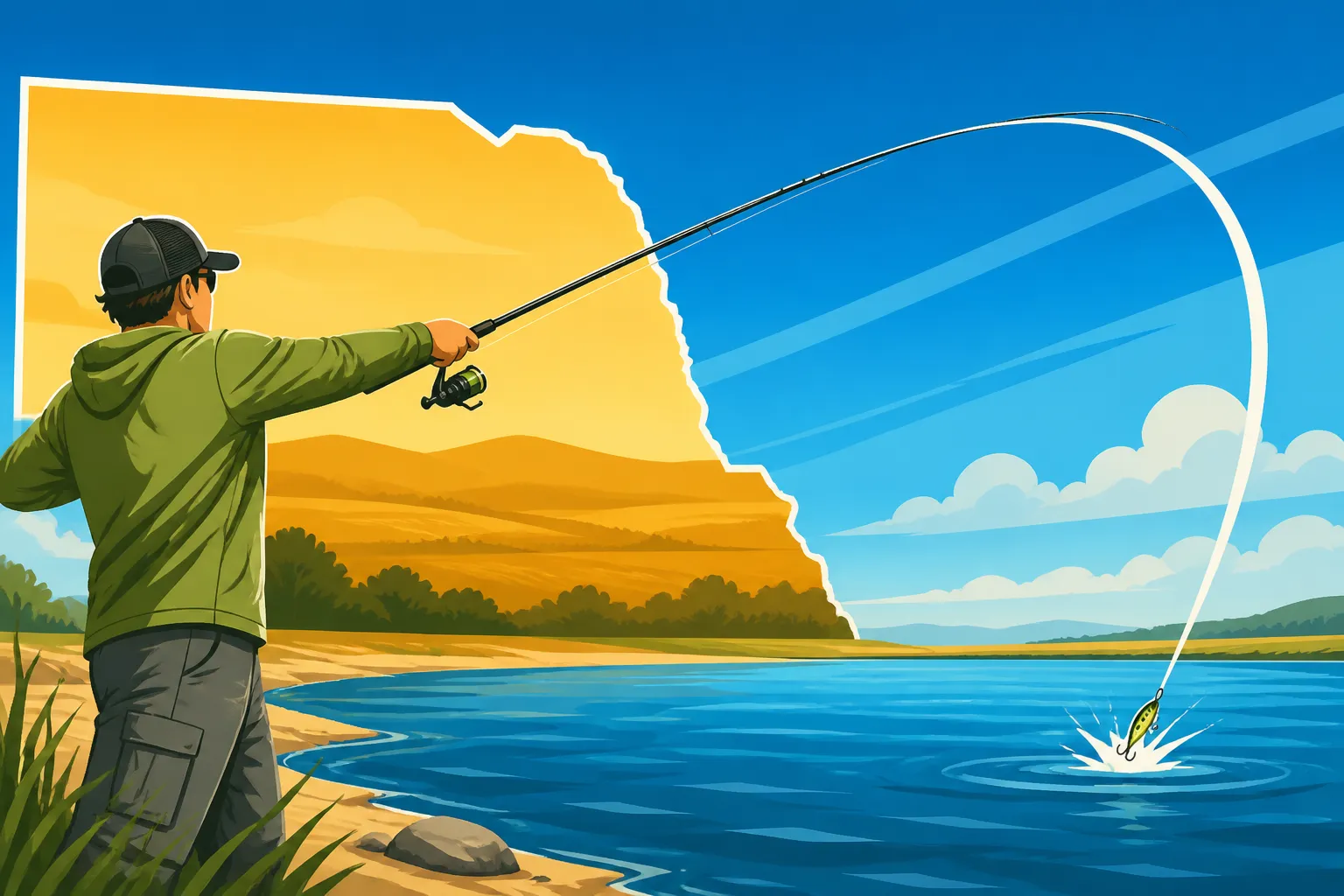
Start by holding your rod with both hands if it's a longer rod, or one hand for shorter ones, with your dominant hand above the reel. Position your lure or bait about six to twelve inches from the rod tip. This short tag end gives you the necessary pendulum effect for loading the rod. Begin with the rod tip pointed towards your target. Then, in a smooth, fluid motion, bring the rod straight back over your shoulder, stopping when the rod is just past vertical, around the 1 or 2 o'clock position if you imagine a clock face. You should feel the weight of your lure "load" the rod tip – that bend in the rod is stored energy. Without pausing, immediately drive the rod forward in a powerful, straight line towards your target. The key is to accelerate smoothly, not jerk, throughout the forward motion. Just before the rod reaches the 10 or 11 o'clock position, release the line from your index finger (for spinning reels) or thumb (for baitcasters). Your eyes should be fixed on your target, and your rod tip should follow through in that direction, almost as if you're pointing at where you want the lure to land.
A common mistake is trying to "muscle" the cast with your arms. Instead, engage your core and use your whole body, rotating your shoulders and hips to generate power. Think of it as a golf swing or throwing a baseball; the power comes from a coordinated body movement, not just arm strength. Maintaining a smooth, controlled motion prevents wobbles and allows the rod to do its job.
The Pendulum Cast: Advanced Distance
For those looking to eke out every last foot of distance, especially with heavier rigs, the pendulum cast is an advanced technique worth learning. It’s often used in surf fishing but can be adapted for very long casts from open shorelines in Nebraska's larger reservoirs.
This cast maximizes the amount of "load" on the rod by using a longer drop of line (the distance between the rod tip and your lure). Instead of the usual 6-12 inches, you might have several feet of line out, allowing the lure to swing like a pendulum. To execute, stand sideways to your target. Hold the rod with both hands, extending it away from your body at about a 45-degree angle, allowing the weight to hang freely. Begin a gentle swing of the weight away from your body, then bring it back in an arc towards your target. As the weight passes its lowest point and begins to rise, you initiate your powerful forward cast, loading the rod with the momentum of the swinging weight. The timing of the release is even more critical here than with an overhead cast, as you're trying to time it with the peak velocity of the pendulum swing.
The pendulum cast requires significant practice and is best learned with lighter weights initially to get the timing down. It’s not suitable for all situations, especially if you have obstructions behind you, but when executed correctly, it can add significant yards to your cast. Always ensure your surroundings are clear before attempting this powerful cast, as the longer swing arc poses a greater safety risk to anyone nearby. For more advanced techniques, consider delving into specific methods like How to Cast Farther From Shore.
Optimizing Your Release Point and Follow-Through
The release point and your follow-through are often overlooked but are absolutely critical for maximizing distance and accuracy. A fraction of a second too early or too late can turn a potential long bomb into a pathetic splash just feet from shore.
For an overhead cast, the ideal release point is typically when the rod is pointing at about the 45-degree angle in front of you. Releasing too early will send your lure high into the air, losing valuable forward momentum and distance. Releasing too late will drive the lure straight into the water or the bank directly in front of you. It's a sweet spot that feels almost intuitive once you've practiced it enough. Your eyes should be on your target throughout the cast, which helps your brain automatically adjust the release timing. Think of it like throwing a football or shooting a basketball; you track the target, and your body naturally times the release.
The follow-through is equally important. Once you've released the line, don't stop your motion abruptly. Continue to sweep your rod tip smoothly towards your target. This smooth follow-through prevents shockwaves from traveling up the rod and destabilizing the line's trajectory. It ensures that all the energy you've generated is transferred efficiently into the cast. After the cast, allow the line to peel off the spool freely. For spinning reels, you might briefly feather the line with your finger as the lure approaches the water to straighten out any loops and prepare for a quick retrieve or to detect a bite on the drop. For baitcasters, you'll need to lightly thumb the spool to prevent backlashes as the lure slows down. Practicing in an open field without a hook, using just a practice weight, is an excellent way to hone your release point and follow-through without the frustration of lost lures or tangled lines.
Essential Gear Upgrades for Shore Anglers
While technique is king, having the right tools can certainly give you an edge. Think of it as an investment in your fishing success, helping you cover more water and reach those prime spots that others can't. You don't always need the most expensive gear, but understanding what makes a difference can help you make smart choices.
Specialized Long-Casting Rods
When serious about casting distance from shore, especially on vast bodies of water like Lake McConaughy or the sprawling Lewis and Clark Lake, a specialized long-casting rod is a game-changer. These aren't your typical 6-foot bass rods.
Long-casting rods are typically longer, ranging from 9 to 15 feet, sometimes even more for dedicated surf fishing. Their extra length allows for greater tip speed and more leverage. They often feature a moderate-fast to fast action, designed to load deeply with the weight of the lure or bait and then unleash that stored energy like a catapult. The butt section of these rods is often longer too, allowing you to use both hands for maximum power and leverage, especially important when executing a powerful two-handed cast. Look for rods with guides that are spaced and sized to minimize line friction during the cast. Many feature larger-diameter stripper guides close to the reel that quickly funnel the line, reducing resistance. Brands like Okuma, Daiwa, and Penn make excellent long-casting rods that can often be found on platforms like Amazon or at specialty tackle shops. Investing in a rod designed for this purpose can significantly increase your casting potential, allowing you to easily reach structures far from the bank.
Reels Designed for Distance
Just like rods, some reels are specifically engineered with distance casting in mind. These reels focus on minimizing line friction and optimizing line flow.
For spinning reels, look for models with large, shallow spools that are designed to minimize line-to-spool lip contact during the cast. Features like "long cast" spools, often found on higher-end models, are a dead giveaway. The oscillation system that lays the line onto the spool is also critical. A slow oscillation system will lay the line in a perfectly parallel manner, reducing digging and improving line flow on the cast. A good drag system is also essential, not directly for casting distance, but for fighting big fish you might hook once you've achieved that long cast. Quality bearings ensure smooth operation, which translates to less friction. For baitcasting reels, the focus is on a finely tunable braking system (magnetic or centrifugal) that prevents backlashes while allowing the spool to spin freely. Magnetic brakes are easier to adjust on the fly, while centrifugal brakes offer a consistent level of control. High-speed gear ratios can also be beneficial for quickly retrieving line once your lure lands, preparing for the next cast or fighting a fast-running fish. Both types of reels benefit from being kept clean and well-lubricated to ensure maximum performance. You'll find many suitable options when exploring Best Fishing Gear for Nebraska Anglers.
Terminal Tackle for Better Aerodynamics
Your terminal tackle – the hooks, sinkers, swivels, and lures – can dramatically affect how far your rig flies through the air. Bulky, odd-shaped components create drag, while streamlined designs soar.
When choosing sinkers for bait fishing, opt for more aerodynamic shapes like pyramid, teardrop, or bullet sinkers. These shapes cut through the wind with less resistance than round or egg sinkers. For lures, look for designs that are compact and dense. Spoons, slender jerkbaits, and heavy jigs generally cast better than large, bulky crankbaits or spinnerbaits, especially into a headwind. Even small details like the type of swivel can matter. A small, compact barrel swivel will cast better than a large, clunky snap swivel. Minimize anything that dangles or creates unnecessary drag. If you're using a leader, keep the knot as small and streamlined as possible, ensuring it passes smoothly through your rod guides. Every little bit of reduced drag adds up to extra distance. Consider pre-tying a few different rigs with various weights and terminal tackle configurations and test them out to see which ones perform best with your specific rod and reel setup. This systematic approach can often reveal surprising differences in casting efficiency.
Environmental Factors and Practical Tips
Even with the best gear and technique, Mother Nature has a say in how far your cast goes. Understanding and adapting to environmental conditions can turn a challenging day into a productive one, and consistent practice is what ties everything together.
Harnessing Wind and Water Conditions
The wind can be your greatest ally or your fiercest foe when casting from shore. Learning to read and use it to your advantage is a crucial skill.
A tailwind, where the wind is blowing from behind you towards your target, is a gift for distance casting. It will literally push your lure further. On such days, you can sometimes get away with slightly lighter tackle or a less aggressive cast, letting the wind do some of the work. However, a headwind or crosswind can be incredibly frustrating, catching your line and creating huge belly in your cast, dragging your lure back towards you or off target. When facing a headwind, try to cast with a lower trajectory, keeping your lure closer to the water's surface to minimize wind resistance. This is where those aerodynamic weights and lures really shine. A crosswind requires you to aim slightly into the wind, allowing the wind to push your line back onto your intended target. This takes practice to gauge correctly, but it's essential for maintaining accuracy over distance. Understanding How Wind Direction Affects Walleye Fishing can give you a significant advantage.
Water conditions also play a role, albeit a more subtle one for casting distance directly. However, if the water is very clear, opting for a fluorocarbon leader will increase your chances of a bite after that long cast, as fish won't easily see your line. If the water is choppy, a slightly heavier lure might be needed to maintain contact with the bottom or to achieve your desired depth quickly after a long cast. Remember to check local regulations concerning Nebraska Fishing Season Dates and Limits, as these can impact your approach.
Practicing for Perfection
Like any skill, distance casting improves with practice. You wouldn't expect to hit a home run on your first swing, and you shouldn't expect record-breaking casts without putting in the time.
The best place to practice is an open field, like a local park or an unutilized sports field. This removes the pressure of fishing and the risk of snagging or losing expensive lures. Use a casting plug or a simple practice weight without a hook. This allows you to focus purely on your technique, timing, and follow-through. Start with lighter weights and a shorter drop, then gradually increase the weight and line drop as your confidence grows. Pay attention to how the rod loads and unloads. Experiment with different amounts of power – sometimes, a smoother, less forceful cast can surprisingly go farther than a wild, all-out heave. Record yourself if possible, and watch back to identify areas for improvement in your form. Many experienced anglers will spend time practicing before heading to fishing spots like Merritt Reservoir Fishing Guide or Calamus Reservoir Fishing.
Consistency is key. Regular, short practice sessions are more effective than sporadic, long ones. Just like any athlete, muscle memory is built through repetition. Over time, the correct mechanics will become second nature, allowing you to effortlessly send your bait exactly where you want it.
Safety Considerations for Powerful Casting
While the goal is distance, safety should always be your top priority, especially when making powerful casts. A long cast involves a significant amount of kinetic energy, and a misdirected lure can be dangerous.
Before every cast, always, always look behind and around you to ensure no one is in your casting path. This includes fellow anglers, bystanders, children, and even pets. The force generated by a long cast, combined with a weighted lure, can cause serious injury if it strikes someone. If you're fishing with others, establish clear casting zones and communicate your intentions. Be particularly mindful of overhead power lines, tree branches, and other obstructions that could snag your line, cause a backlash, or conduct electricity. If you're using live bait with a heavier sinker, ensure your hook is firmly embedded in the bait to prevent it from flying off during the cast.
When fishing from elevated positions, such as docks or river banks, be aware of your footing to prevent falls. If you are using particularly long rods, ensure you have ample clearance. And remember, a properly executed, smooth cast is not only safer but also more effective than a violent, uncontrolled whip. Prioritize precision and safety, and the distance will follow.
Here's a quick comparison of common casting rods for shore fishing:
| Rod Type | Length Range (feet) | Action | Typical Lure Weight Range (oz) | Best For | Pros | Cons |
|---|---|---|---|---|---|---|
| Standard Spinning | 6-8 | Medium-Fast | 1/8 – 1/2 | General purpose, smaller baits | Versatile, easy to use | Limited distance for heavier setups |
| Heavy Spinning | 8-10 | Moderate-Fast | 1/4 – 1 | Larger lures, longer casts | Good balance of power and feel | Can be tiring for extended use |
| Surf/Distance | 10-15+ | Moderate-Heavy | 1 – 6+ | Extreme distance, heavy baits/lures | Maximum casting range, handles heavy gear | Less sensitive, challenging in tight spots |
| Baitcasting (Heavy) | 7-9 | Fast-Heavy | 3/8 – 1.5 | Precision with heavy lures, strong fish | Excellent control, powerful | Requires skill, prone to backlashes |
Always check the specific lure weight and line ratings printed on your individual rod before making a purchase, as these can vary even within rod types.
Disclaimer
This article is for general informational purposes only and does not constitute professional advice. Laws, prices and regulations vary by location and change over time. Consult a qualified professional for guidance on your specific situation.