Best Fish Finder Under $300 for Nebraska Lakes
It's a familiar feeling, isn't it? You've spent countless hours on Nebraska's beautiful lakes and rivers, maybe on a quiet reservoir like Branched Oak or battling the wind on Lake McConaughy, and you just know there are fish down there. But where? The idea of a fish finder sounds amazing, but the thought of spending hundreds, even thousands, on a complicated piece of electronics can be daunting. This guide is here to tell you that you absolutely don't need to break the bank to gain a significant advantage on the water. We'll explore how to find the best fish finder for Nebraska's diverse waters, all while staying comfortably under that $300 mark, giving you the tools to turn those "maybe" days into "definitely" days.
Why a Fish Finder is a Game-Changer for Nebraska Anglers (Even on a Budget)
Let's be real: fishing without a fish finder in many Nebraska waters is like trying to navigate a new city without a map. You might stumble upon some good spots, but you're missing a huge piece of the puzzle. Even an affordable fish finder can instantly transform your fishing experience, offering insights into the underwater world that your eyes alone can't provide. It’s not about cheating; it’s about understanding the environment and becoming a more efficient angler.
Beyond Just Seeing Fish: Understanding Structure
When most folks think of a fish finder, they imagine seeing little fish icons on a screen. While that's certainly a part of it, the real magic, especially in Nebraska, comes from its ability to reveal hidden underwater structure. Our lakes, whether they're massive reservoirs like Lewis and Clark Lake or smaller, often overlooked sandpits, are full of features that attract fish. These could be anything from old creek beds that wind through the bottom, submerged timber and brush piles left from land clearing, rock reefs, or even subtle changes in depth that you'd never know were there otherwise.
Imagine you're targeting walleye on Lake McConaughy. Walleye are notorious for hugging tight to structure, often congregating along submerged points or humps. Without a fish finder, you're just casting blind, hoping your lure crosses paths with a fish. With one, even a budget model, you can actively scan the bottom, identify those crucial contours, and pinpoint exactly where those walleye might be lurking. The same goes for crappie, which love to hide in brush piles. A fish finder lets you "see" those brush piles and drop a jig right into the strike zone. It changes your approach from random casting to targeted, strategic fishing.
No More Guessing Games: Depth and Bottom Composition
One of the most frustrating things about fishing an unfamiliar body of water is the constant guessing game about depth. Are the fish deep today, or shallow? What's the bottom like here? Is it soft mud where catfish might be grubbing, or a hard, rocky bottom that appeals to bass and walleye? A fish finder eliminates this guesswork almost instantly, giving you crucial information that helps you choose the right bait and technique.
Knowing the exact depth is paramount for many species. If you're chasing suspended white bass in Harlan County Reservoir, a fish finder can show you exactly what depth they're holding at, allowing you to present your lure at the perfect level. For bottom-dwelling species like catfish or walleye, understanding the transition areas between different bottom types can be key. A hard bottom, often indicated by a thick, intense line on your sonar, might be a preferred feeding ground. Conversely, a soft, muddy bottom might be better for finding channel catfish that are sifting for food. This knowledge empowers you to make informed decisions about where to cast and how to present your bait, making your time on the water far more productive. You can stop wondering if you're fishing too deep or too shallow and start connecting with fish.
Key Features to Look For in a Sub-$300 Fish Finder for Nebraska Lakes
Alright, so you're convinced a fish finder is worth it, even on a budget. But with so many options out there, how do you choose? When you're looking at units under $300, it's all about smart compromises and prioritizing the features that will give you the most bang for your buck on Nebraska's waters. You won't get all the bells and whistles of a top-tier unit, but you can absolutely get something highly effective.
Display Size and Resolution: Clarity on a Budget
When you're out on the water, especially under the bright Nebraska sun, seeing your screen clearly is non-negotiable. It doesn't matter how advanced your sonar is if you can't read the display. In the sub-$300 range, you'll typically find screens ranging from 3.5 inches up to around 5 or 7 inches. While a bigger screen is always nice, a smaller, high-resolution screen can often be more useful than a large, pixelated one.
Resolution (measured in pixels, like 480×272) dictates how much detail the screen can show. A higher resolution will give you clearer fish arches and better definition of underwater structure. Many budget-friendly units will feature a bright, high-contrast color display, which is a huge step up from older monochrome screens. Color helps differentiate between fish, baitfish, and various types of structure, making interpretation much easier. Look for a unit with good screen brightness and contrast settings that you can adjust for different lighting conditions. This is crucial whether you're fishing a sunny afternoon on Lake McConaughy or targeting crappie at dusk on Branched Oak Lake.
Sonar Types: Down Imaging and Traditional 2D
This is where budget fish finders really shine, often offering powerful technology that was once exclusive to much more expensive units. You'll primarily be looking at two main types of sonar in this price range: traditional 2D sonar and Down Imaging.
Traditional 2D sonar is the classic view most people associate with fish finders. It uses a conical beam to show you fish arches, bait balls, and the overall contour of the bottom directly beneath your boat. This is incredibly effective for general searching and understanding depth. It's great for spotting those individual walleye or schools of white bass.
Down Imaging (often called ClearVü by Garmin or DownScan Imaging by Lowrance) is a game-changer. Instead of a conical beam, it uses a very thin, high-frequency beam that essentially "photographs" the bottom directly below your transducer. This gives you incredibly detailed, picture-like views of submerged trees, brush piles, rock formations, and even individual fish hiding within that structure. For fishing Nebraska's reservoirs and their abundant submerged cover, Down Imaging is a massive advantage. While Side Imaging (which scans out to the sides of your boat) is usually beyond the $300 budget, Down Imaging provides plenty of detail for finding those fish-holding spots. Combining both 2D and Down Imaging on a split screen gives you the best of both worlds.
Transducer Power and Cone Angle: The Heart of the Unit
The transducer is often called the "eye" of your fish finder, and its performance is directly tied to the unit's power and the cone angle it uses. Don't gloss over these specs; they are critical for getting clear readings in Nebraska's sometimes deeper or murkier waters.
Transducer Power (Watts RMS): This refers to the strength of the sonar signal. A higher wattage means the signal can penetrate deeper and provide clearer returns, especially in deeper water or when there's a lot of interference. While you won't find super high wattage in this budget, look for models that offer respectable RMS power. More power equals better target separation and less clutter on your screen. This is particularly important for deeper lakes like Lake McConaughy or Merritt Reservoir where fish might be holding at significant depths.
Cone Angle: This describes how wide the sonar beam spreads as it travels through the water. A wider cone angle (e.g., 45-60 degrees) covers a larger area but offers less detail. This is excellent for quickly scanning broad areas to locate schools of fish or large pieces of structure. A narrower cone angle (e.g., 10-20 degrees) covers a smaller area but provides much finer detail, allowing you to distinguish individual fish or subtle bottom features. Many budget fish finders offer dual-beam transducers that can switch between a wide and narrow cone or even display both simultaneously, giving you versatility for different fishing scenarios. Consider the typical depths you'll be fishing; a wider cone is generally better for shallower water, while a narrower one is more effective in deeper water. How to Find Walleye on Deep Humps and Points is a great example of where understanding cone angle can really help.
| Feature Category | What to Look For Under $300 | Why it Matters for Nebraska Fishing |
|---|---|---|
| Display | 4-7 inch color screen, decent resolution (e.g., 480×272) | Clear visibility in sun, easy to differentiate fish/structure. |
| Sonar Type | Traditional 2D CHIRP sonar, Down Imaging (DI) | CHIRP for better target separation; DI for detailed views of structure. |
| Power (RMS) | 200W-500W RMS (or higher if lucky) | Better depth penetration and clearer returns in diverse waters. |
| Cone Angle | Dual-beam (wide for scanning, narrow for detail) | Versatility for shallow ponds to deep reservoirs. |
| GPS (Basic) | Simple GPS for marking waypoints and basic navigation | Essential for saving hotspots and finding your way back. |
| User Interface | Intuitive menu, easy-to-use buttons | Less time fumbling, more time fishing. |
Top Budget-Friendly Fish Finder Brands and Models for Nebraska
Okay, let's talk brands. In the sub-$300 market, a few names consistently rise to the top, offering excellent value and features that are highly relevant to Nebraska anglers. While specific models change and prices fluctuate, these brands generally offer solid options within your budget. Remember to always check the latest pricing from retailers like Bass Pro Shops or on online platforms such as Amazon.
Garmin Striker Series: Simplicity and Performance
Garmin has become a powerhouse in the fishing electronics world, and their Striker series is particularly well-suited for budget-conscious anglers. These units are renowned for their user-friendliness and reliable performance. You'll often find models in the Striker series that fall well within the sub-$300 price point, offering a fantastic combination of features.
Many Striker models feature Garmin's excellent CHIRP traditional sonar, which provides crisper, more clearly defined fish arches and better target separation than older sonar technologies. Crucially, most also include ClearVü scanning sonar – Garmin's version of Down Imaging. This means you get those photo-like images of what's directly below your boat, perfect for picking out submerged timber or rock piles that walleye and crappie love to call home. A huge bonus with many Striker units is the built-in, high-sensitivity GPS. This isn't full-blown chartplotting GPS, but it allows you to mark waypoints for your favorite fishing spots, create routes, and check your speed. Imagine finding a promising brush pile in Branched Oak Lake; with a Striker, you can mark it and come back to it with precision every time. This simple GPS functionality is invaluable for navigating and revisiting productive areas on Nebraska's larger lakes.
Humminbird Piranhamax & HELIX Series (Entry-Level): Reliable Choices
Humminbird is another respected name, particularly known for its powerful sonar technology. While their higher-end HELIX units can get quite pricey, their entry-level HELIX series models or the more straightforward Piranhamax series often offer excellent performance that fits the under-$300 budget.
The Piranhamax series is generally geared towards simplicity and ease of use, making them a great choice for beginners or those who prefer a no-fuss approach. They typically feature reliable traditional 2D sonar that effectively displays fish and bottom contours. If you step up to an entry-level HELIX model, you might find options that include Humminbird's Down Imaging, providing that added detail for structure identification. Humminbird units are known for their rugged construction and clear displays. Whether you're fishing from a small jon boat on the Platte River or a kayak on a smaller Sandhills lake, these units offer dependable performance. Their intuitive menu systems mean you'll spend less time fiddling with settings and more time fishing.
Lowrance HOOK Series: Feature-Rich for the Price
Lowrance has a long history in marine electronics, and their HOOK series often packs a lot of features into a budget-friendly package. In the sub-$300 range, you'll want to look at the HOOK Reveal series. These units are designed to give anglers powerful tools without the hefty price tag.
One of the standout features of many HOOK Reveal models is their FishReveal technology. This innovative feature combines the target separation of Lowrance CHIRP sonar with the high-resolution images of DownScan Imaging (Lowrance's Down Imaging). What this means for you is that you can see fish arches clearly overlaid on top of the detailed structure images. So, instead of just seeing a brush pile and a fish, you see the fish within the brush pile, making it much easier to pinpoint your cast. Like Garmin, many HOOK Reveal units also come with built-in GPS, allowing you to create custom maps, mark hotspots, and navigate effectively. For exploring the hidden depths of reservoirs like Sherman or Johnson Lake, a Lowrance HOOK Reveal can give you a significant advantage, helping you identify structure and the fish holding tight to it. You can often find these versatile units through major retailers and online.
Setting Up and Maximizing Your Budget Fish Finder in Nebraska
Getting a great fish finder is only half the battle. To truly unlock its potential on Nebraska's waters, you need to set it up correctly and, perhaps more importantly, learn how to interpret what it's telling you. Even a budget-friendly unit can perform exceptionally well with a little attention to detail and practice.
Proper Transducer Installation: It Matters More Than You Think
The transducer is the unsung hero of your fish finder. It sends and receives the sonar signals, and if it's not installed correctly, even the most expensive unit will give you poor readings. This is a common frustration for many new fish finder owners, so don't feel bad if you're struggling. Proper placement is paramount to avoid interference from your motor, turbulence, or even other electronics.
For most small boats, kayaks, and jon boats used on Nebraska lakes, a transom mount is the most common. Ensure the transducer is mounted firmly to the transom, submerged slightly below the hull, and away from any obstructions or areas of turbulent water created by the boat. It should be level with the bottom of your boat, not angled up or down. For kayak anglers, a scupper mount, in-hull mount (shooting through the hull), or a dedicated pole mount for the trolling motor are popular options. If you're using a trolling motor, a trolling motor mount keeps the transducer deep and clear of turbulence. Poor installation can lead to "streaky" or incomplete readings, often appearing as clutter on your screen. Don't be afraid to experiment with slight adjustments after your initial install; a little fine-tuning can make a huge difference in the clarity of your sonar image. Always refer to your unit's manual for specific instructions, but remember the goal: clear, uninterrupted water flow over the transducer face. For kayak fishing specifically, check out Best Kayaks for Nebraska Fishing for ideas on compatible setups.
Understanding Your Readings: Interpreting the Screen
This is where the magic happens and where many beginners feel overwhelmed. But don't worry, it's easier than you think, and practice makes perfect. Your fish finder isn't just showing you random lines and colors; it's painting a real-time picture of the underwater world.
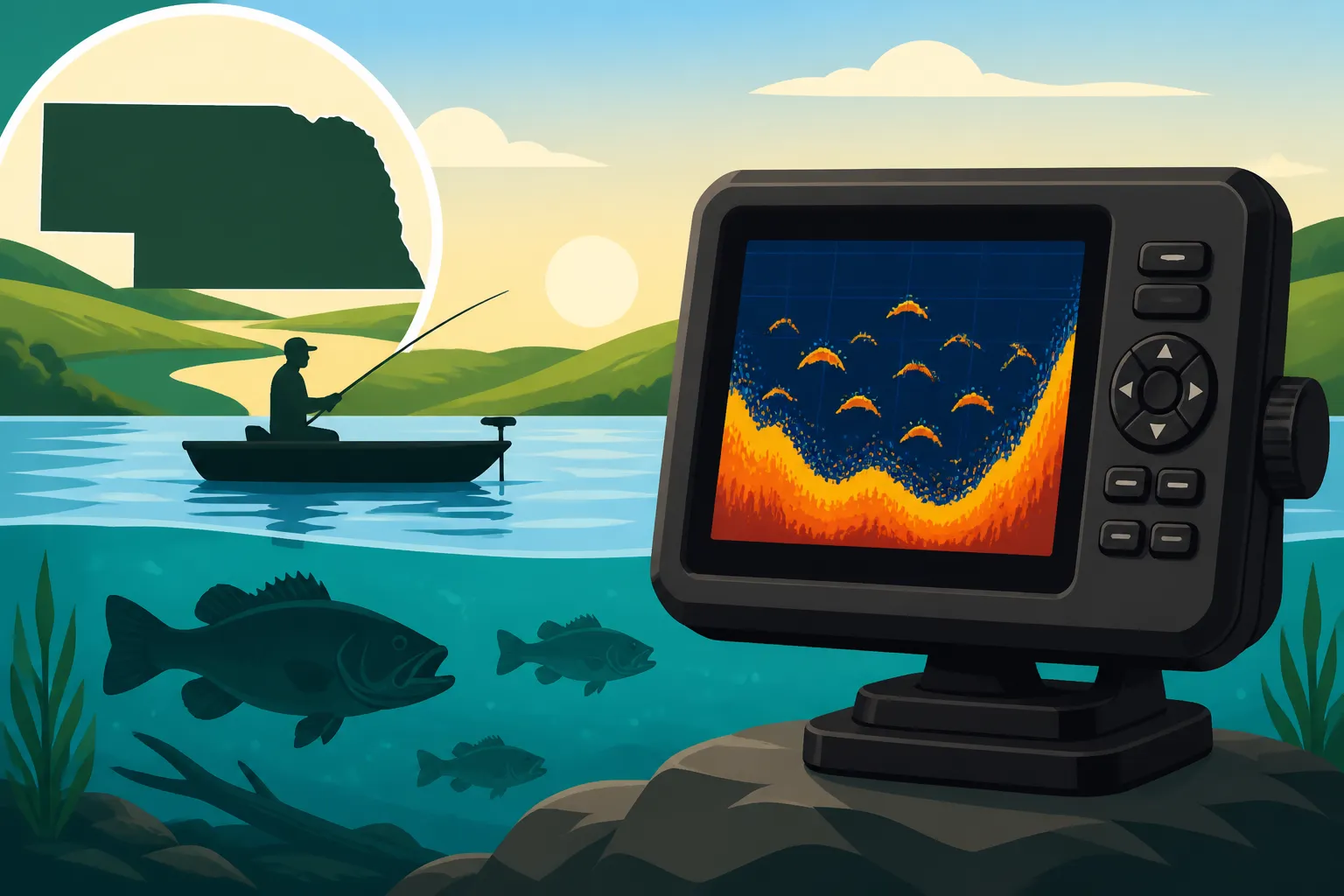
Traditional 2D Sonar: On a traditional 2D screen, the bottom will appear as a solid line, with its thickness and intensity indicating hardness (thicker/brighter usually means harder). Fish will often show up as "arches." A full arch means the fish passed through the entire sonar cone; a half arch or a slash means it passed through only part of it. The size and thickness of the arch can give you a clue about the size of the fish. Schools of baitfish often appear as dense clouds. You'll also see structure: humps, drop-offs, and submerged trees will have distinct shapes. Don't forget that adjusting your sensitivity (sometimes called "gain") can help reduce clutter or enhance weaker signals. If your screen is too noisy, lower the sensitivity; if you're not seeing much, try increasing it.
Down Imaging: When viewing Down Imaging, think of it like a black and white (or shades of grey) photograph. Structure like timber, brush piles, or even individual rocks will appear with incredible detail. Fish will often show up as bright dots or streaks, especially if they are sitting above or within the structure. The key is to look for anomalies – anything that doesn't look like the general bottom contour. If you're on Branched Oak Lake, a Down Imaging view will clearly show you individual branches of a submerged tree that crappie are hiding in. By running both 2D and Down Imaging on a split screen, you can see the traditional fish arches alongside the detailed structure, helping you confirm if those arches are actual fish or just part of the structure.
Practical Applications on Nebraska Lakes and Rivers
Now, let's put it all together with some real-world scenarios on Nebraska's waters. This is how your budget fish finder will become your best fishing buddy.
Scenario 1: Finding Walleye on Lake McConaughy: You're out on the "Big Mac," notoriously known for its vast, often featureless bottom in many areas. You know walleye relate to subtle structure. Your fish finder, even a sub-$300 model with a basic GPS, is scanning the bottom. You see a slight rise, a subtle hump, and as you pass over it, a few distinct arches appear near the top of the hump on your 2D sonar, while your Down Imaging shows some scattered rocks. With a quick button press, you mark that spot as a waypoint on your GPS. You can then turn around and precisely cast to that structure, confident that you've found a potential walleye hangout. This is a game-changer compared to just drifting aimlessly. Lake McConaughy Walleye Fishing could provide more insights into fishing this particular lake.
Scenario 2: Locating Crappie in a Brush Pile at Branched Oak Lake: Branched Oak is known for its crappie, and they love to hide in cover. You know there's a submerged timber pile somewhere, but finding it with just a depth sounder is tough. Your fish finder, using its Down Imaging, paints a clear picture as you slowly motor over the area. Suddenly, a distinct image of a tree trunk and branches appears on your screen, and nestled within those branches, you see bright specs – those are crappie! You mark the waypoint, then vertically jig a small minnow or jig right over that brush pile. Without the fish finder, you might have spent hours searching. How to Fish Standing Timber for Crappie goes hand-in-hand with this technique.
Scenario 3: Identifying Channel Catfish on the Platte River: When fishing the Platte River, current breaks and subtle depth changes are key for channel catfish. While a fish finder might not be as useful in fast, shallow currents, it's invaluable in slower stretches or deeper holes. As you drift or anchor, your sonar shows you a depression in the riverbed, perhaps an old scour hole. Your 2D screen shows a softer bottom in the center of the hole, perfect for catfish. You can then target that specific depression with your cut bait or prepared baits, knowing you're putting it right where those hungry catfish are likely to be. Remember that Nebraska Channel Catfish Daily Limit regulations apply here!
Even with a budget fish finder, the key is to learn its capabilities, understand its limitations, and trust what it's telling you. It's an investment that will pay dividends in more fish, more fun, and a deeper understanding of Nebraska's incredible fishing opportunities.
Disclaimer
This article is for general informational purposes only and does not constitute professional advice. Laws, prices and regulations vary by location and change over time. Consult a qualified professional for guidance on your specific situation.