How to Anchor a Kayak for Still Fishing
There’s nothing quite as frustrating as finally paddling your kayak into that perfect fishing spot, lining up your cast to the sweet-looking structure you just spotted, only to find yourself slowly but surely drifting away before your bait even settles. It’s a battle against current, wind, and your own patience, and it can turn a potentially great day on the water into a constant struggle to stay put. This guide is all about helping you conquer that drift by mastering the art of anchoring your kayak for still fishing, ensuring you can focus on the fish, not the fight against nature.
Why Anchoring Your Kayak is a Game Changer for Still Fishing
For us kayak anglers, the freedom of being able to quietly glide into shallow coves or navigate tight river bends is a huge draw. But that same freedom can quickly become a hindrance when you've found the ideal hideaway for a lunker, only to be constantly pushed off target. Anchoring changes everything, turning your nimble craft into a stable fishing platform.
The Frustration of the Drift
Picture this: you've spent an hour working your way to a secluded bend on the Elkhorn River, spotted a massive log jam that just screams "catfish," and you're ready to drop your perfect cut bait right next to it. You make a flawless cast, your line goes slack, and then you feel that familiar, unwelcome tug as your kayak subtly shifts downstream. Before you know it, you’re 20 feet past your target, and you have to reel in, paddle back upstream, and try again. It’s a cycle that exhausts you and, frankly, ruins the serenity of being on the water. This constant battle against the elements is precisely why a reliable anchoring system isn't just a luxury; it's a necessity for serious still fishing.
Precision and Presentation
When you're able to hold your position, your fishing strategy completely transforms. Instead of chasing your bait, you can meticulously work a specific piece of structure. Imagine you're targeting crappie suspended around a brush pile at Branched Oak Lake. With an anchor, you can cast to every side of that pile, vary your retrieve depths, and let your jig soak exactly where you want it. This precision is absolutely critical for species that hug cover or feed in very localized areas, like bass tucked into lily pads or walleye holding tight to a rocky point. Being able to repeat accurate presentations increases your chances exponentially, giving you the confidence that your bait is where the fish are.
Hands-Free Fishing and Enhanced Enjoyment
Let's be honest, trying to paddle or pedal while also managing your rod, reeling in a fish, or even just re-tying a knot is a juggling act that few master gracefully. Anchoring liberates your hands. You can bait hooks without fear of drifting into a snag, set your rod in a holder while you sip coffee, or, best of all, give your full attention to fighting a big fish without worrying about bumping into the bank or other boats. This shift from constant maneuvering to focused fishing profoundly enhances your overall enjoyment. It allows you to relax into the rhythm of the water, observe your surroundings, and truly savor the fishing experience without the underlying stress of maintaining position. It’s about making your time on the water more productive and more peaceful.
Choosing the Right Anchor System for Nebraska Waters
Selecting the right anchor system for your kayak isn't a one-size-fits-all situation. Nebraska's diverse waters, from the sandy bottoms of Lake McConaughy to the rocky, snag-laden rivers, demand different approaches. Understanding your options is the first step to staying put.
Anchor Types for Kayaks
The type of anchor you choose will depend heavily on the kind of bottom you're trying to hold in and the conditions you expect.
Grapple or Folding Anchor
These are arguably the most popular choice for kayak anglers, and for good reason. A grapple anchor, often called a folding anchor, has four prongs that fold out, making it incredibly compact for storage. Once deployed, these prongs dig into various bottom compositions – be it rocky, sandy, or weedy.
- Pros: They offer decent holding power in diverse conditions, are easy to store, and relatively inexpensive. You can find many reliable options on Amazon that are perfectly sized for kayaks. Their ability to grab onto rocks and weeds makes them versatile for many Nebraska lakes and rivers.
- Cons: While versatile, they can get snagged very easily in heavy brush or rocky crevices, leading to lost anchors. Lighter models might struggle to hold in stronger currents, so always size up if you fish rivers frequently. They also don't penetrate soft, muddy bottoms as well as some other types.
Mushroom Anchor
Mushroom anchors are designed specifically for soft, muddy, or silty bottoms. They get their name from their mushroom-like shape, which creates suction once it settles into the mud.
- Pros: They are excellent for holding in the thick mud often found in smaller ponds, slow-moving river sections, or the quieter bays of reservoirs like Pawnee Lake. They are less likely to snag on rocks or submerged timber once settled.
- Cons: Their holding power is significantly reduced in current or on hard, rocky, or sandy bottoms. They rely on suction, which won't develop on firm ground. They are also relatively bulky and heavy for the amount of holding power they provide compared to a grapple anchor in more challenging conditions.
Stake-Out Pole
A stake-out pole isn't a traditional anchor but a specialized tool that's incredibly effective in shallow water. It's essentially a long, sturdy pole that you push directly into the lake or riverbed to hold your kayak in place.
- Pros: Extremely quiet and quick to deploy, making it ideal for sneaking up on wary fish in shallow areas. There's no anchor line to manage, and it's virtually impossible to get stuck like a traditional anchor. Perfect for fishing shallow flats at places like Wagon Train Lake.
- Cons: Limited strictly to shallow water, typically less than 8-10 feet deep, depending on the pole's length. It requires a soft-to-medium bottom to penetrate and hold; it won't work on solid rock or very hard clay.
Anchor Line Considerations
The anchor itself is only half the system; the line you attach it to is just as important.
Length is Crucial: Understanding Scope
"Scope" refers to the ratio of your anchor line length to the depth of the water plus the height of your kayak's bow from the waterline. A good rule of thumb for effective anchoring is a 3:1 to 7:1 scope. This means if you're in 10 feet of water, you'll want to deploy at least 30 to 70 feet of line. More line allows the anchor to lie flatter on the bottom and dig in more effectively, greatly increasing its holding power. Many kayak anchor kits you find on Amazon will come with a pre-cut length of rope, but always ensure it's sufficient for the depths you typically fish.
Line Type: Strength and Stretch
- Nylon: This is the most common and recommended material for anchor lines. Nylon has excellent elasticity, which acts as a shock absorber against waves and current, preventing harsh jerks on your kayak. It's strong and durable.
- Polypropylene: While cheaper and it floats, polypropylene line has very little stretch and is generally less strong than nylon. The floating aspect can be a pro if you want to avoid snags, but the lack of stretch can make your kayak feel less stable in chop.
Attachment and Quick Release
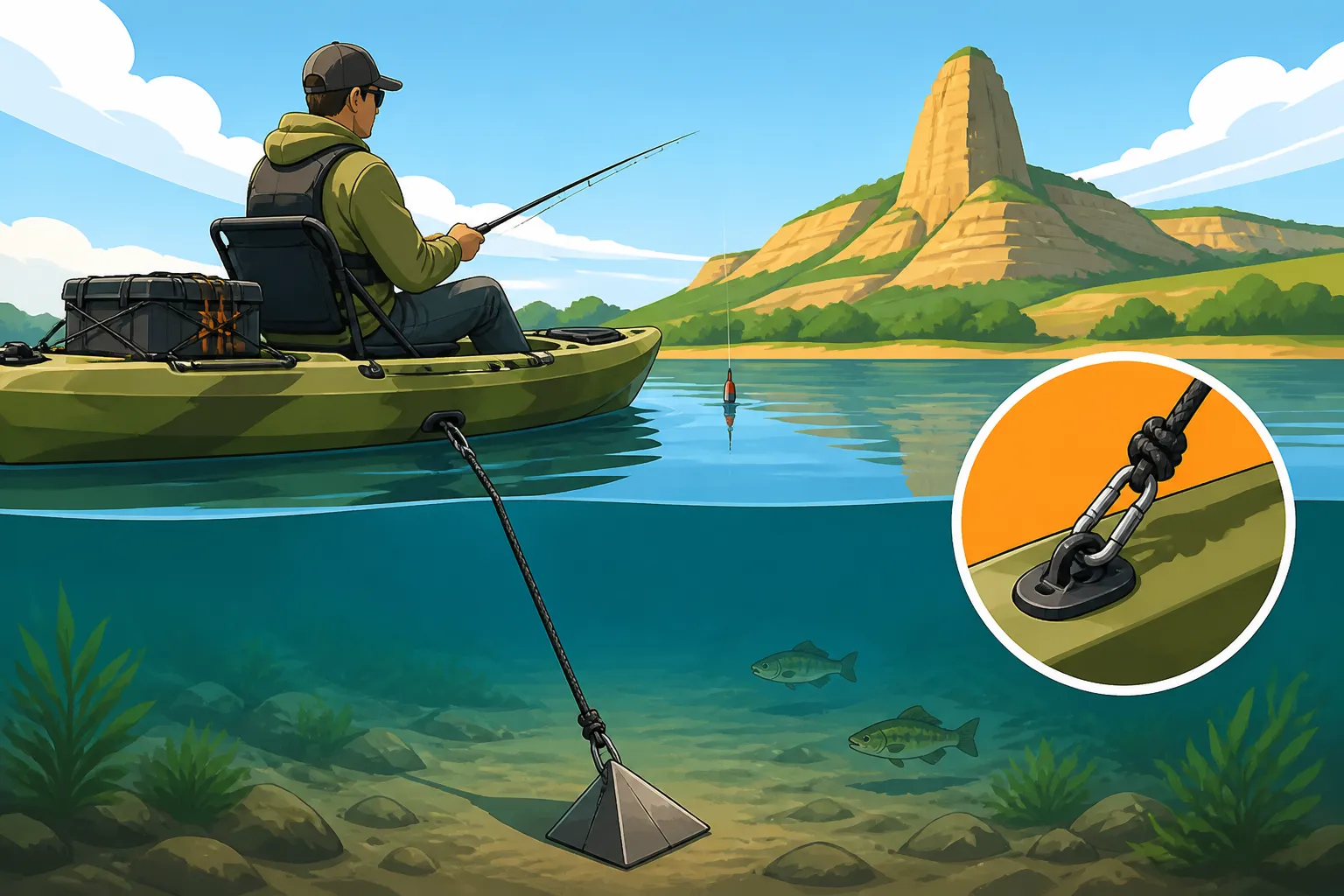
Always use a strong carabiner or shackle to connect your anchor to the line. More importantly, ensure your system incorporates a quick-release mechanism. This is a non-negotiable safety feature, allowing you to instantly detach your anchor line in an emergency (like getting stuck in strong current or an unexpected snag). Often, a simple ziptie on your anchor trolley or a dedicated quick-release cleat will do the trick.
DIY vs. Store-Bought Systems
While some anglers enjoy the challenge of rigging their own systems, for anchoring, a purpose-built kayak anchor trolley system is often the safest and most effective choice. These kits come with all the necessary pulleys, cleats, and ropes to create a smooth system that runs the length of your kayak. Trying to jury-rig something can lead to snagged lines, difficult deployments, or, worst of all, an inability to release your anchor when needed. Look for complete anchor trolley kits on Amazon or at specialty kayak shops. They’re a wise investment in both safety and fishing efficiency, especially when considering the Essential Gear Checklist for a First Kayak Fishing Trip.
Mastering Kayak Anchoring Techniques for Different Conditions
Once you've got your anchor system, it's time to learn how to use it effectively. Proper technique makes all the difference in whether you stay put or just drag your anchor across the bottom.
The Anchor Trolley System: Your Best Friend
For kayak anglers, the anchor trolley system is hands-down the most valuable piece of equipment for anchoring. It makes deploying and adjusting your anchor safe and efficient.
What an Anchor Trolley Is and Why You Need It
An anchor trolley is a rope loop that runs from the bow to the stern along one side of your kayak, typically through a couple of pulleys. Your anchor line, usually attached to a ring or carabiner, clips onto this loop. The genius of it is that once your anchor is deployed, you can pull on the trolley rope to slide your anchor line attachment point anywhere along the length of your kayak – from the very front to the very back. This means you can anchor from either the bow or the stern without ever having to dangerously reach or turn your kayak around in potentially unstable conditions.
How to Use It: Deploying and Adjusting
- Preparation: Before you reach your spot, ensure your anchor is easily accessible, your line is untangled, and your quick-release is ready.
- Approach: Paddle slightly past your intended fishing spot, usually a boat length or two, depending on depth and current. You'll deploy the anchor, then drift back to your target.
- Deployment: Clip your anchor line (with the anchor attached) to the ring on your anchor trolley. Drop the anchor slowly and quietly into the water.
- Pay Out Line: As you drift back, let out plenty of anchor line. Remember that scope! For example, if you're in 15 feet of water at Lake McConaughy, you might let out 45-75 feet of line.
- Set the Anchor: Once you've let out enough line and drifted to your spot, give a gentle tug on the anchor line to help the anchor dig in.
- Adjust Trolley: This is where the magic happens. Pull the anchor trolley rope to position your anchor attachment point. In most situations, especially in wind or current, you’ll want to anchor from the bow to face into the elements, providing maximum stability. If you're fishing a river, you'll generally want your bow pointing upstream.
Advantages of a Trolley System
The primary advantages are safety and flexibility. You can shift your anchor point to best suit the conditions, keeping your kayak stable and aligned for optimal casting and fighting fish. This is critical when you're targeting specific areas like those deep holes for Nebraska Channel Catfish Fishing or the structure at Branched Oak Lake Catfish Fishing.
Anchoring in Rivers and Currents
Rivers, even slower ones like the Platte, present unique anchoring challenges due to constant current.
Facing Upstream for Stability
Always, always deploy your anchor from the bow (front) of your kayak and allow your boat to face directly upstream into the current. This presents the smallest profile to the current, making your kayak much more stable. If you anchor from the stern in a strong current, the current will push against the broader back of your boat, making it very unstable and increasing the risk of taking on water or capsizing. This is a crucial safety rule.
Using Two Anchors for Maximum Hold
In particularly strong currents or when you need absolute immobility for precise fishing, consider a two-anchor system. Deploy one anchor upstream from the bow, then slowly paddle or drift downstream, deploying a second anchor from the stern. This creates a "spread" that locks your kayak firmly in place, preventing any swing. This is an advanced technique but incredibly effective for targeting very specific holes or eddies.
Current-Breaking Structure
Look for natural current breaks like large rocks, log jams, or eddies behind points. These spots often hold fish looking for a break from the main current and can also provide a bit of shelter for your kayak, making anchoring easier. Don't be afraid to anchor just outside the strongest current and cast into it.
Anchoring in Lakes and Reservoirs
Lakes and large reservoirs like Lake McConaughy Fishing Guide have different considerations, primarily wind and bottom composition.
Wind Considerations
Wind can be just as challenging as current. When anchoring in open water, deploy your anchor from the bow and allow your kayak to settle facing directly into the wind. This minimizes your kayak's exposure to the wind, keeping you much more stable and preventing the wind from catching your broadside and pushing you around. Strong crosswinds can still be tricky, but facing into the wind is your best bet for comfort and control.
Bottom Composition Matters
- Sandy/Muddy: Mushroom anchors or small grapple anchors with plenty of scope work well here. The suction or the digging power of the prongs will hold.
- Rocky/Gravel: Grapple anchors shine on these bottoms, as their prongs can wedge into crevices. Be prepared to lose an anchor occasionally if it gets irretrievably snagged.
- Weedy: Grapple anchors can work, but sometimes the weeds are so thick they prevent the anchor from digging into the bottom. In very thick weeds, a stake-out pole in shallower water or a heavier grapple anchor might be needed.
Stealthy Deployment
Fish in still water, especially in clear lakes, can be easily spooked by sudden noises or movements. Deploy your anchor slowly and quietly. Don't just heave it overboard; gently lower it until it touches the bottom, then let out line. A silent approach can mean the difference between a bite and an empty cast. You’ll also want to practice How to Catch Fish From a Kayak in Nebraska with minimal disturbance.
Adjusting and Retrieving Your Anchor
Anchoring isn't just about dropping and forgetting. You'll need to adjust and retrieve effectively.
- Getting Unstuck: If your grapple anchor is snagged, try motoring or paddling directly over the anchor and pulling straight up. Sometimes this changes the angle and frees the prongs. If that fails, a "breakaway" anchor system (where the anchor line attaches to the bottom of the anchor, with a weak link to the top) can save your anchor.
- Managing Line: Always coil your anchor line neatly in a bucket or bag to prevent tangles and keep your deck clear. This is part of responsible Best Fishing Gear for Nebraska Anglers management.
- Smooth Retrieval: When retrieving, pull your kayak slowly towards the anchor, coiling the line as you go. Once directly over the anchor, pull straight up. Avoid dragging your anchor across the bottom for long distances, as it can damage habitat and stir up sediment.
Safety First: Essential Considerations for Kayak Anchoring
While anchoring significantly enhances your fishing experience, it introduces new safety considerations that kayak anglers absolutely cannot ignore. Your well-being on the water is paramount, especially when you're tethered to the bottom.
Quick Release is Non-Negotiable
This point cannot be stressed enough. Your anchor system must have a reliable and easily accessible quick-release mechanism. This means you can instantly detach your anchor line from your kayak with minimal effort, even in a panic situation.
- Why it's critical: Imagine you're anchored in a river, and a large log or debris suddenly comes rushing down current towards your kayak, threatening to swamp or pin you. Or perhaps the current picks up unexpectedly, and your anchor gets irretrievably snagged on something immovable, potentially pulling your kayak under. In these scenarios, being able to quickly jettison your anchor is the difference between a close call and a serious emergency.
- How it works: This can be a dedicated quick-release cleat, a simple carabiner on your anchor trolley that you can unclip, or even a heavy-duty zip tie that you can quickly cut with a knife. Practice using it until it's second nature. Always have a sharp knife readily accessible on your PFD or kayak, just in case.
Understanding Scope and Anchor Hold
We talked about scope earlier, but it's worth reiterating its importance for safety. A properly set anchor holds your boat securely, while an anchor with insufficient scope will drag, making your kayak unstable and potentially leading to dangerous situations if you lose control.
- The consequences of poor scope: If your anchor is dragging, your kayak will constantly shift, making fishing difficult and potentially putting you in the path of other boaters or obstacles. In strong winds or currents, a dragging anchor provides no real hold, leaving you at the mercy of the elements. It's a recipe for frustration and, at worst, an unsafe drift into hazards.
- How to ensure good hold: Always err on the side of more scope, especially in wind or current. After deploying your anchor and paying out sufficient line, feel for the anchor to "set" – you'll often feel a distinct tug as it digs in. If you still feel yourself drifting or swaying excessively, let out more line.
Knowing Your Water Conditions
Before you even think about dropping an anchor, you need to have a clear understanding of the water you're fishing and the conditions around you.
- Submerged hazards: Be aware of underwater structures like old bridge pilings, submerged trees, or rock fields where your anchor could get hopelessly stuck. While grappling anchors are good for varied bottoms, getting them too stuck is a problem.
- Current and flow: For rivers, understand the strength of the current. If it looks too fast or turbulent, it might be safer to drift fish or choose a calmer section. You don't want to anchor in a spot where the current could overwhelm your kayak or your anchor. This knowledge is key for understanding Nebraska Fishing Regulations Explained related to certain areas.
- Weather changes: Always check the weather forecast before heading out, especially for wind. Strong, unexpected winds can quickly turn a calm lake into a choppy, dangerous environment, making anchoring a challenge and potentially unsafe. If the wind is forecast to pick up significantly, consider rescheduling or fishing a more sheltered area.
Personal Flotation Devices (PFDs)
This might seem basic, but it's paramount. Always, always wear your PFD when kayak fishing, particularly when anchoring. Fiddling with anchor lines, leaning over the side, or dealing with unexpected snags can all lead to capsizing.
- Immediate safety: If you fall out, a PFD keeps you afloat, giving you time to recover your kayak or swim to shore. It's not just a legal requirement; it's a lifesaver. Ensure your PFD fits properly and is easily accessible and comfortable to wear for your entire trip. This falls under the general Required Safety Equipment on a Nebraska Boat.
Avoiding Obstacles and Navigation Channels
When choosing an anchor spot, be mindful of your surroundings.
- High-traffic areas: Avoid anchoring in busy boating lanes or near boat ramps where motorboats are constantly moving. Your kayak, being low to the water, can be hard for larger boats to see, and you don't want to become a navigation hazard.
- Navigation channels: These are often deeper and have stronger currents. Anchoring here is generally unsafe and can impede navigation for others. Give yourself plenty of space from any marked channels.
- Aquatic Invasive Species: Remember the importance of checking your anchor and line for any aquatic invasive species before leaving a body of water. Clean, Drain, Dry is the mantra, especially with your anchor which comes into direct contact with the bottom. This also ties into the Nebraska Aquatic Invasive Species Stamp for Boats requirements for boat owners.
By prioritizing these safety measures, you'll not only fish more effectively but also ensure every trip to Nebraska's beautiful waters is as safe and enjoyable as possible.
Comparing Kayak Anchor Systems
To help you make an informed decision, here's a quick comparison of the common kayak anchor types for still fishing in Nebraska.
| Anchor Type | Ideal Bottom Composition | Pros | Cons | Best For |
|---|---|---|---|---|
| Grapple/Folding | Rocky, Sandy, Weedy | Compact, versatile, good holding in varied conditions. | Can get snagged easily, lighter models may struggle in strong current. | All-around use, most Nebraska lakes and medium current rivers. |
| Mushroom | Soft Mud, Silt | Excellent hold in soft bottoms, less prone to snagging on hard objects. | Poor holding power in current, ineffective on hard/rocky bottoms, bulky. | Quiet coves, small muddy ponds, very slow river sections. |
| Stake-Out Pole | Shallow Soft Mud, Sand | Silent, fast deployment, no line management, impossible to get stuck. | Limited to shallow water (typically <10 ft), won't work on hard bottoms. | Skinny water fishing, stalking flats, stealthy approaches. |
| Drift Sock/Sea Anchor | Open Water (for controlled drift) | Slows kayak significantly for controlled drift fishing. | Not a "still fishing" anchor, will not hold stationary. | Trolling or covering large areas slowly, not for staying put. |
This table provides a quick reference to help you decide which anchor type, or combination, will best suit your typical Nebraska fishing adventures. Considering your target species, typical fishing locations, and the wind/current you expect to encounter will guide you to the perfect setup.
Disclaimer: This article is for general informational purposes only and does not constitute professional advice. Laws, prices and regulations vary by location and change over time. Consult a qualified professional for guidance on your specific situation.