Best Crankbait Depth for Summer Bass
Oh, the Nebraska summer! While beautiful, it often brings a unique challenge for us bass anglers: where did all the fish go? It’s a common frustration to hit your favorite spots only to find them empty, especially as the sun climbs high and the temperatures soar. Many assume the bass just stop biting, but in reality, they've often just relocated. This guide is all about cracking the code of summer bass behavior, specifically focusing on how to choose and effectively fish crankbaits at the depths where these elusive lunkers are hiding out during the dog days of summer.
Understanding Summer Bass Behavior in Nebraska's Heat
Summer in Nebraska can get downright hot, and just like us, bass seek comfort when the mercury rises. They don't just disappear; they simply adjust their routines and move to more favorable environments. Understanding why they move is the first step to figuring out where they've gone, and subsequently, what crankbait depth will reach them.
The Deep Dive: Why Bass Seek Cooler Waters
As surface temperatures climb into the 80s and even 90s, the shallow waters that were so productive in spring become less hospitable for bass. Warm water holds less dissolved oxygen, and while bass are resilient, they prefer cooler, more oxygenated environments. This is where the concept of a "thermocline" becomes crucial. In many deeper Nebraska lakes and reservoirs, layers of water form with distinct temperature differences. The thermocline is that sweet spot, a transition layer where cooler, oxygen-rich water from below meets the warmer surface water. Bass often suspend right in or just above this layer, finding the perfect balance of comfort and available oxygen. If you're fishing a lake like Lake McConaughy or Branched Oak Lake, understanding these thermal layers is paramount.
Following the Food: Baitfish Movements and Bass Location
It’s not just about comfort; it's also about dinner. Where the baitfish go, the bass often follow. In the summer, many schools of shad, minnows, and other forage species also move deeper to find cooler water and plankton blooms. When these baitfish congregate around submerged structure or suspend in open water, the bass will be right there with them, ready to ambush. If you can locate schools of baitfish on your electronics, you're halfway to finding bass, and then it's just a matter of presenting your crankbait at the right depth. Remember that bass are opportunistic predators, and a crankbait mimicking a fleeing baitfish at their depth can be irresistible.
Prime Habitat: Where Summer Bass Hold Deep
So, where exactly are these deep-water havens? Nebraska's reservoirs and larger lakes offer plenty of options. Think about areas that provide both depth and structure. Ledges, humps, points that extend far out into the lake, old creek channels, and even large areas of submerged timber are all magnets for summer bass. These features provide ambush points, shade, and access to deeper, cooler water. A long, tapering point might have bass holding at 10 feet early in the morning, but by midday, they could be pushed down to 20 feet or more along the same structure. Your goal is to identify these deep-water highways and residences, then present a crankbait that can reach them accurately. For targeting these zones, techniques like those described in How to Fish Deep Structure for Summer Walleye can also be adapted for bass.
Cracking the Code: How Crankbaits Achieve Their Dive Depths
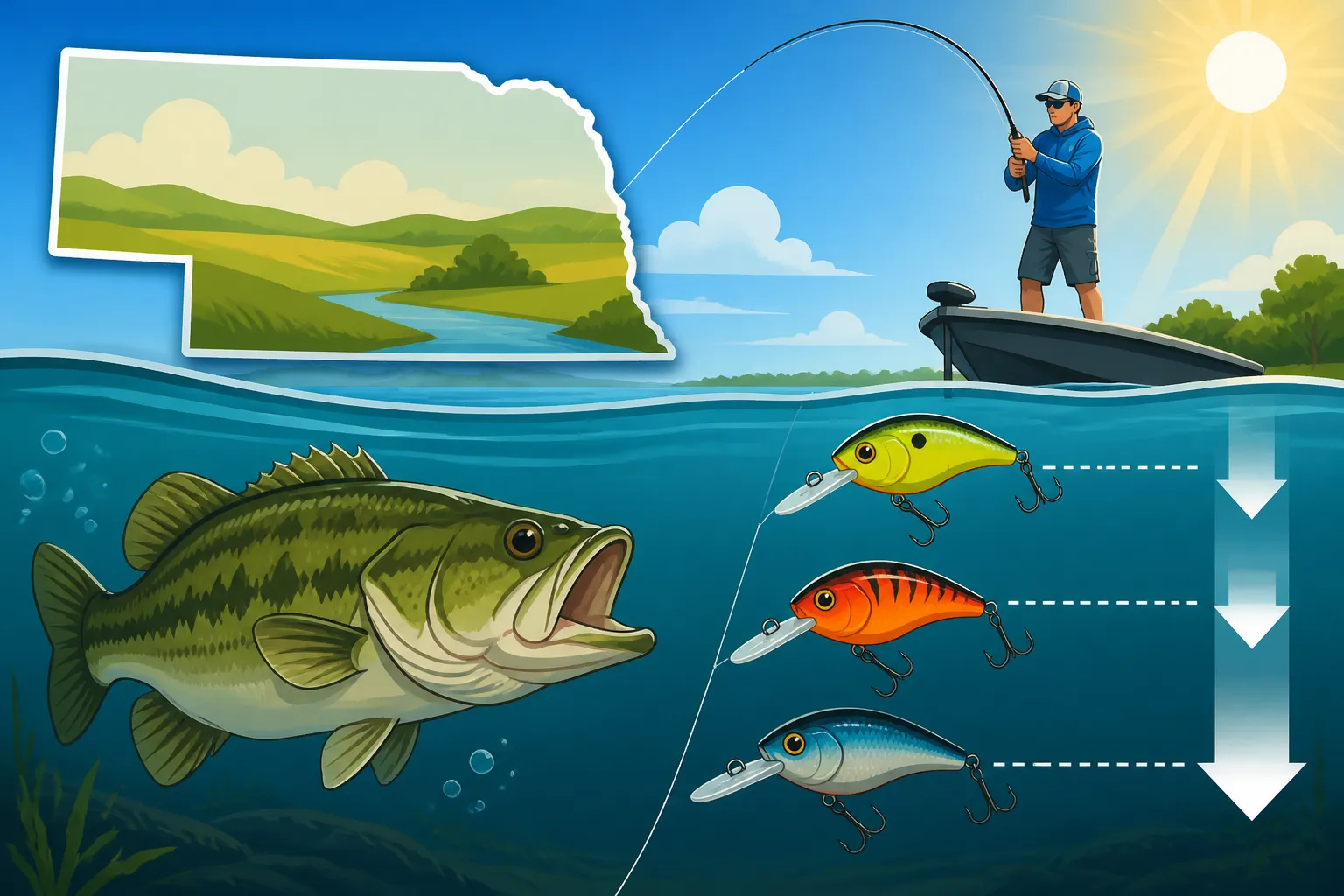
Crankbaits are fantastic tools for summer bass, but they're not all created equal when it comes to depth. Each crankbait is designed to run at a specific range, and several factors influence how deep it actually goes. Getting this right is critical for putting your lure in the strike zone.
Lip Service: The Anatomy of a Diving Lip
The most distinguishing feature of a crankbait is its bill, or "lip." This small piece of plastic or fiberglass is the primary determinant of how deep the lure will dive.
- Angle: A steeper, more downward-pointing lip will cause the bait to dive more aggressively and often deeper. A lip that is more parallel to the bait's body will result in a shallower dive.
- Size and Shape: Larger lips generally mean deeper dives. A wide, round lip is common on many deep-diving crankbaits, designed to grab a lot of water and pull the lure down quickly. Narrower, square-bill crankbaits, on the other hand, are known for shallower dives and their ability to deflect off cover without snagging. This deflection is often key to triggering strikes.
Understanding these design differences helps you quickly assess a crankbait's potential depth range even before tying it on.
Line Matters: Diameter, Type, and Its Impact on Depth
Believe it or not, your fishing line plays a significant role in how deep your crankbait will actually run.
- Line Diameter: Thicker line creates more drag in the water, preventing your crankbait from reaching its maximum potential depth. Conversely, thinner line has less resistance and allows the bait to dive deeper. If a crankbait is rated to hit 15 feet, but you're using heavy 20-pound test monofilament, you might only get it down to 10-12 feet. Dropping to a 10 or 12-pound test can make a noticeable difference.
- Line Type: Different line materials have different densities and properties:
- Monofilament: Floats, offering some resistance, but can be a good all-around choice.
- Fluorocarbon: Sinks, has less stretch, and is less visible, making it an excellent choice for deep crankbaiting as it helps the lure get down faster and stay down. Many experienced anglers prefer 10-12 lb fluorocarbon for deep cranking.
- Braided Line: While incredibly strong and sensitive, it floats, which can hinder deep diving. However, its lack of stretch offers amazing sensitivity for feeling subtle bites or bottom contact. If using braid, you might need a longer fluorocarbon leader to help with dive depth and stealth. For specific recommendations, check out Best Fishing Line for Nebraska Walleye which has crossover advice for bass.
The Pull Factor: Retrieve Speed and Rod Angle
How you present your crankbait also dictates its depth.
- Retrieve Speed: Generally, a faster retrieve will make a crankbait dive deeper, up to its maximum design potential. A slower retrieve might keep it slightly shallower, especially if it's a floating model. However, there's a point of diminishing returns; too fast, and the bait might blow out or become less effective. Experiment to find that sweet spot where the bait runs true and deep.
- Rod Angle: Keeping your rod tip low to the water during the retrieve helps direct the line downwards, assisting the crankbait in reaching its maximum depth. Holding your rod tip high will pull the line upwards, causing the bait to run shallower. This might seem like a small detail, but it can make a difference of several feet when you're trying to hit a specific depth range.
Selecting the Right Crankbait for Summer Bass Depth
Now that we understand the mechanics, let's talk about choosing the right crankbait for the job. You wouldn't use a wrench for a hammer, and you shouldn't use a shallow crankbait when the bass are 20 feet down.
Shallow Divers (<5 feet): When and Where They Still Shine
Even in the dog days of summer, there are times when bass will venture into shallower waters.
- Low Light Conditions: Early morning, late evening, or on heavily overcast days, bass might move up onto shallow flats, riprap banks, or into sparse cover to feed. This is when a shallow-diving crankbait, like a square-bill, really shines.
- Shallow Cover: Think about stump fields, rock gardens, or docks in 3-5 feet of water. A shallow diver can be worked through these areas effectively, deflecting off cover to trigger reaction strikes. Bass Pro Shops carries a wide range of these versatile lures.
- Post-Frontal Conditions: Sometimes, after a cold front, bass can become lethargic and might hold tight to shallow cover, preferring a slow-moving, shallow presentation.
Medium Divers (5-12 feet): The Versatile Workhorses
This is often the sweet spot for many summer bass scenarios, especially as fish transition from shallow to deep, or hold on primary and secondary points.
- Transition Areas: These crankbaits are perfect for fishing the edges of flats, humps, or points that drop off into deeper water. They can effectively cover the middle depths where bass are often cruising or relating to structure.
- Moderate Depth Cover: Submerged brush piles, rock formations, or channel swings in the 5-12 foot range are ideal targets for medium divers. They're designed to reach these depths without constant hang-ups like deeper baits might encounter.
- Searching Tool: When you're not sure exactly where the bass are holding, a medium diver can be a great search bait, allowing you to cover a wide range of depths and structures quickly.
Deep Divers (12+ feet): Reaching the Bottom-Hugging Bass
When the sun is high and the bass are truly hunkered down, deep-diving crankbaits are your best friend.
- Main Lake Structure: These are designed for targeting deep ledges, offshore humps, deep points, and submerged creek channels in large reservoirs. A good deep diver will reach depths of 15-25 feet, sometimes even more, depending on the model and your setup.
- Thermocline Fishing: If you've identified the thermocline at 18 feet, for example, a crankbait that can consistently run at 18-20 feet will put your lure right in the strike zone where those bass are comfortable and feeding.
- Heavy Tackle Considerations: Because of the water resistance and potential for snagging at these depths, you'll often need a slightly heavier rod and reel setup than with shallower baits. Look for specific crankbait rods designed for deep diving.
Reading the Package: Manufacturer Ratings and Real-World Performance
Every crankbait package will have a depth rating, but it’s important to understand these are usually optimal, not absolute. They typically represent the maximum depth the lure can reach with ideal conditions: thin fluorocarbon line, a long cast, a fast retrieve, and a low rod tip. In real-world fishing situations, especially with heavier line or a slower retrieve, your crankbait might not quite hit that advertised depth. It’s always a good idea to test new baits in clear water or watch them on your fish finder to see their actual running depth with your setup. You can find a huge selection of crankbaits on Amazon with various depth ratings and customer reviews to guide your choices.
Here’s a quick overview of common crankbait dive depths and their applications:
| Crankbait Type | Dive Depth Range (Approx.) | Ideal Applications | Key Features |
|---|---|---|---|
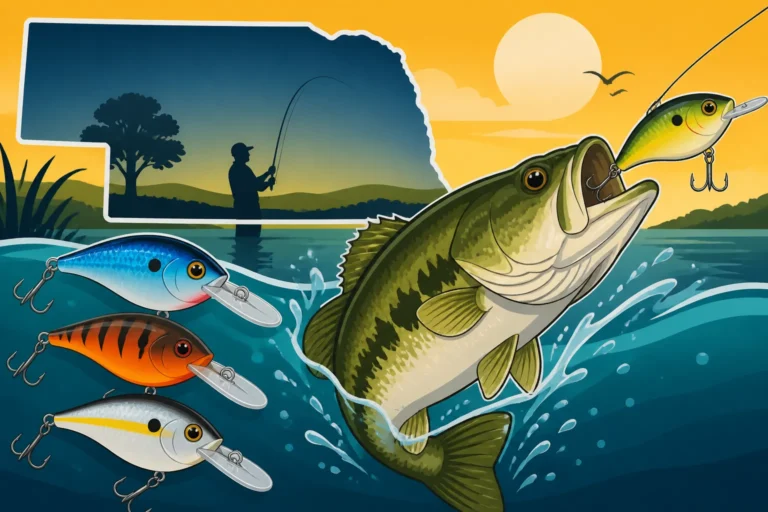
| Shallow Runner | 0-5 feet | Shallow flats, riprap, docks, emergent grass lines, top of submerged cover, low light | Small/short lip, often square-bill |
| Medium Runner | 5-12 feet | Transition zones, secondary points, mid-depth humps, channel edges, moderate cover | Medium-sized, often rounded lip |
| Deep Runner | 12-25+ feet | Offshore ledges, main lake humps, deep points, creek channels, thermocline depths | Large, elongated, aggressive diving lip |
| Flat-Sided | Varies, usually 3-10 feet | Clearer water, cold fronts, pressured fish, subtle vibration required | Flat body profile, tighter wobble, often medium diver |
| Lipless Crankbait | Varies, any depth | Vertical jigging, ripping through grass, covering open water, fast retrieves, schooling fish | No external lip, internal weight, casts far |
Mastering Deep Crankbait Techniques for Nebraska Waters
Once you’ve got the right crankbait tied on, it’s all about presentation. Getting a crankbait down to the bass is one thing; making them bite it is another entirely.
Contact is Key: Bouncing Off Structure and Deflection
Deep crankbaiting is not about avoiding snags; it's often about creating them – or rather, deflecting off them. When a crankbait "crashes" into a rock, stump, or ledge, it creates an erratic, fleeing action that often triggers an instinctual reaction strike from bass that might otherwise ignore a steadily retrieved lure. Don’t be afraid to feel your crankbait digging into the bottom or bumping off submerged structure. That sudden change in direction or speed is a powerful trigger. Many anglers even intentionally choose crankbaits that dive slightly deeper than the structure they are fishing, ensuring regular contact. This technique is similar to what you might use when fishing for Nebraska Walleye Bag Limits in deeper water.
The Stop-and-Go: Pauses, Twitches, and Reaction Strikes
While a steady retrieve can be effective, varying your retrieve is often the secret sauce for deep cranking.
- Stop-and-Go: Reel steadily for a few cranks, then pause for a second or two, letting the crankbait float up slightly (if it's a floating model) or just hover. Many strikes occur on the pause as the bait appears vulnerable.
- Speed Changes: Mix up your reeling speed. Go from a moderate retrieve to a burst of speed, then slow it down again. These sudden changes can mimic a struggling baitfish, making it an easy meal for a bass.
- Rod Twitches: Subtle twitches of the rod tip can impart extra action, especially when you feel the bait getting close to cover.
Trolling vs. Casting: Covering Water Effectively
Both casting and trolling have their place in deep crankbait fishing, and the choice depends on the situation.
- Casting: Ideal for pinpointing specific pieces of structure like a single hump, a small rock pile, or a precise section of a ledge. It allows for more precise lure placement and working the bait through cover. This is often the preferred method for targeting Nebraska Largemouth Bass Length Limit fish relating to specific spots.
- Trolling: Excellent for covering large areas quickly and efficiently, especially when you're searching for schools of bass or want to follow a long, extended contour line. Trolling allows you to present a crankbait at a consistent depth over a significant distance. When trolling, pay close attention to your speed and the amount of line you have out to ensure your bait is running at the desired depth. This can be especially effective on vast bodies of water like Lake McConaughy or Harlan County Reservoir.
Location, Location, Location: Using Electronics to Pinpoint Deep Bass
Modern fish finders are indispensable tools for deep crankbaiting.
- 2D Sonar: Helps identify bottom contours, schools of baitfish, and often larger fish (bass) suspended in the water column. You can also see your crankbait on the screen, allowing you to fine-tune your depth.
- Side Imaging/Down Imaging: These technologies provide incredibly detailed views of the bottom and submerged structure, helping you identify brush piles, rock formations, and ledges that hold bass. Being able to "see" these features before you cast allows for much more accurate presentations. Learning How to Use Side Imaging Sonar for Structure can dramatically improve your success.
- Mapping: GPS mapping systems help you stay on course, follow contour lines, and mark productive spots for future reference. Without electronics, deep crankbaiting becomes much more of a guessing game. Utilizing these tools will help you identify the deeper waters where you might find a Nebraska State Record Largemouth Bass Weight hiding.
Essential Gear and Tips for Deep Crankbaiting
Having the right crankbait is only part of the equation. Your entire setup, from rod to line, contributes to your ability to effectively fish deep for summer bass.
Rod, Reel, and Line for Max Depth
Optimizing your gear can make a noticeable difference in how deep your crankbaits run and how effectively you can fish them.
- Rod: Look for a medium-heavy to heavy power rod, typically 7 to 7.6 feet long, with a moderate to moderate-fast action. This action is crucial because it allows the rod to load up properly on the cast for long distances (key for deep dives) and provides enough give to absorb the shock of a strike without tearing the hooks out. Longer rods also aid in achieving maximum casting distance.
- Reel: A baitcasting reel with a gear ratio in the 5.1:1 to 6.4:1 range is often preferred. This moderate retrieve speed is ideal for maintaining contact with deep-diving crankbaits and working them effectively without overtiring yourself. A high-quality reel with a smooth drag is essential, especially when battling a big bass that inhales a deep diver. Best Baitcasting Reels for Bass Fishing provides some great options.
- Line: As discussed earlier, 10-12 pound test fluorocarbon is often the top choice for deep cranking due to its sinking properties, low stretch for sensitivity, and excellent abrasion resistance (important when bouncing off structure). If you're using heavier gear or fishing exceptionally snaggy areas, you might bump up to 15-pound test, but be aware it will slightly reduce your maximum diving depth.
Reading Your Electronics for Optimal Depth
Your fish finder is your window into the underwater world. Learning to interpret what it's telling you is paramount.
- Bottom Contour: Look for changes in depth – ledges, humps, sharp drop-offs. These are prime areas where bass will congregate.
- Baitfish Schools: Locate dense clouds of baitfish. Where the bait is, the predators usually are too.
- Individual Fish Arches: Learn to distinguish baitfish from larger fish arches, which often represent bass or other gamefish. Pay attention to the depth at which these arches appear.
- Thermocline: On many advanced units, you can visually identify the thermocline as a distinct line or band on your sonar screen. This instantly tells you the "comfort zone" for deeper-holding fish. Reading your electronics effectively, as explored in articles like How to Read a Fish Finder for Walleye, will enhance your deep cranking success.
Practical Tips for Success
Beyond gear and technique, a few extra considerations can help you put more summer bass in the boat.
- Color Selection: While natural colors (shad, bluegill) are always a good starting point, don't be afraid to experiment. In stained or cloudy water, brighter colors like chartreuse or fire tiger can be more visible. In clear water, more natural patterns often prevail. Consider factors like light penetration at depth and water clarity when choosing.
- Sharpen Your Hooks: Deep cranking often involves making contact with hard bottom and structure, which can dull hooks quickly. Keep a hook sharpener handy and regularly check your hooks for any nicks or bends. Sharp hooks are critical for positive hooksets, especially when dealing with the limited stretch of fluorocarbon line.
- Patience and Persistence: Deep crankbaiting can be a grind, especially when you're searching for fish. Don't get discouraged if you're not getting bites immediately. Keep moving, keep trying different depths, retrieve speeds, and crankbait colors until you crack the code. The reward of a big summer bass from deep water is well worth the effort.
Summer bass fishing with crankbaits is a fantastic way to tackle those tough mid-season conditions in Nebraska. By understanding bass behavior, mastering your crankbait choices, and honing your presentation, you'll be well on your way to consistent success even when the temperatures soar. So, grab your deep divers, scout those ledges, and get ready to feel that satisfying thump!
Disclaimer
This article is for general informational purposes only and does not constitute professional advice. Laws, prices and regulations vary by location and change over time. Consult a qualified professional for guidance on your specific situation.