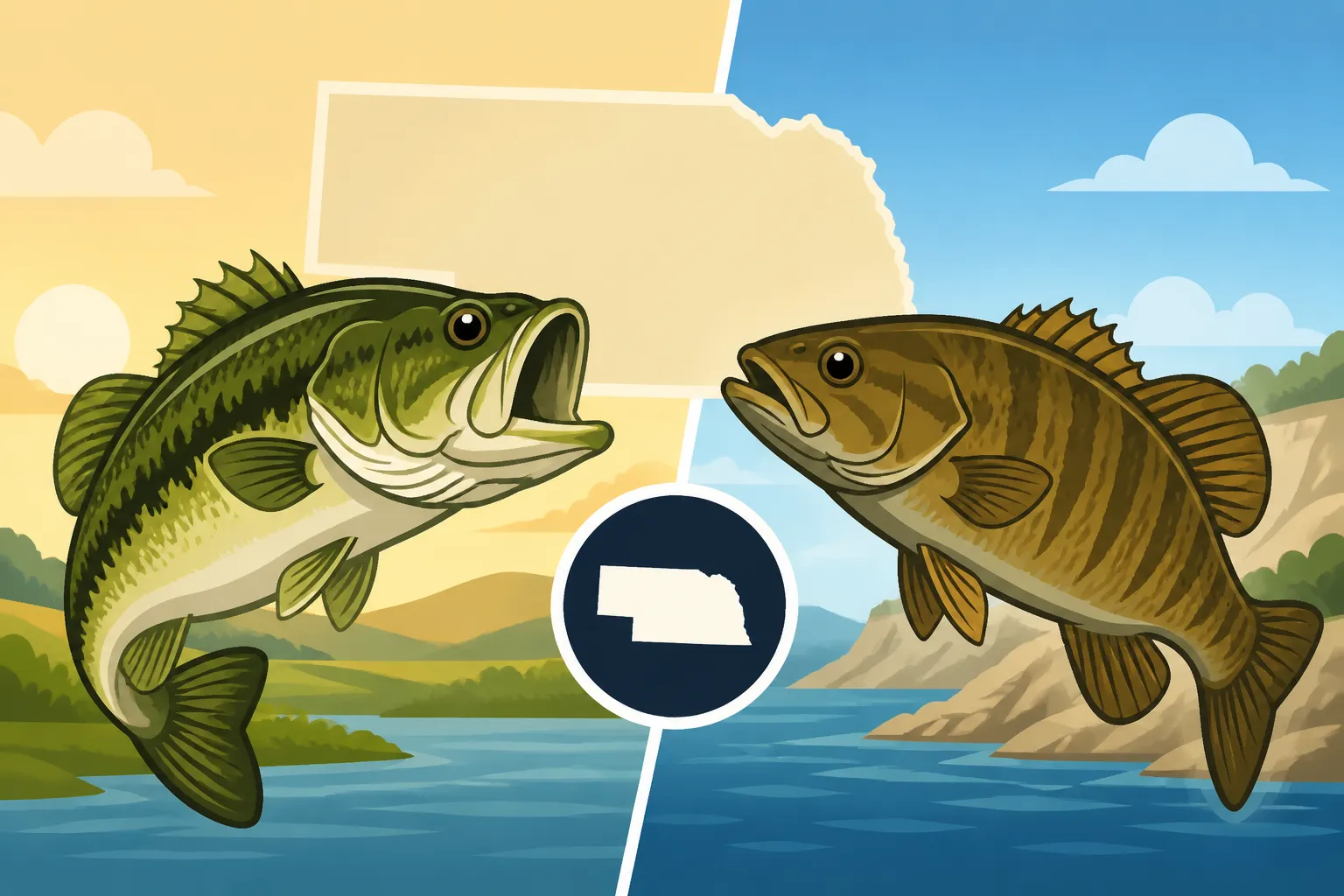
How to Tell a Largemouth From a Smallmouth Bass
Many of us have been there: reeling in a feisty bass in a Nebraska lake or river, only to pause and wonder, "Is this a largemouth or a smallmouth?" The two can look remarkably similar at first glance, especially to an excited angler. This guide is here to clear up that confusion once and for all, providing you with the definitive characteristics and practical tips to confidently identify a largemouth from a smallmouth bass in any Nebraska water.
The Basics: What Makes a Bass a Bass?
Sometimes it feels like distinguishing between different types of fish, even within the same family, can be a real head-scratcher. It's especially true with black bass in Nebraska. You hear anglers talking about "bass fishing," and it often implies a whole range of experiences, from quiet farm ponds to roaring river currents. But before we dive into the specific differences, let's establish what generally defines a "bass" in the black bass family that calls Nebraska home. Understanding these foundational traits will make it much easier to pinpoint the nuances between its two most popular members: the largemouth and the smallmouth.
General Characteristics of Black Bass
Black bass, a group within the sunfish family, are incredibly popular sport fish across North America, and Nebraska is no exception. They're known for their aggressive strikes, powerful fights, and generally delicious table fare. You'll find them in a variety of aquatic environments, from the slow, murky waters of a farm pond to the swift, rocky currents of a clear river. Common traits include their distinctive, spiny dorsal fin followed by a soft-rayed dorsal fin, typically joined together (though we'll soon see a key difference there!). They also have a laterally compressed body, meaning they're somewhat flat from side to side, and a relatively large mouth designed for ambushing prey. Their diet is incredibly varied, ranging from smaller fish and crawfish to insects and even small rodents or amphibians, depending on their size and environment.
Why the Confusion is So Common in Nebraska
It's completely understandable why anglers, even seasoned ones, might mix up largemouth and smallmouth bass, especially here in Nebraska where both thrive in different, sometimes overlapping, habitats. Imagine you're fishing a large reservoir like Lake McConaughy. You might catch a largemouth in a shallow, weedy cove one hour and then a smallmouth off a rocky point the next. Both are dark-backed, light-bellied fish with a similar overall shape. The lighting conditions, water clarity, and even the individual fish's age or mood can subtly alter its appearance, making quick identification tricky. Plus, unless you're specifically looking for those key differences, it's easy to just see "bass" and move on. Many fishing guides or Nebraska Fish Species Identification Guide might show diagrams, but when you've got a live, flopping fish in your hand, those diagrams can feel miles away! The trick is knowing exactly which details to zoom in on for a positive ID.
Largemouth Bass: The Green, Gape-Mouthed Powerhouse
The largemouth bass is probably what most people picture when they think of "bass fishing" in Nebraska. These green giants are the undisputed kings of many of our warmer, shallower, and often weedier waters. They’re called largemouth for a reason, and once you know what to look for, that mouth becomes your primary clue. These fish are ambush predators, often hiding in cover and exploding out to strike their prey. Understanding their physical traits and preferred habitats will not only help you identify them but also make you a more successful angler.
Key Physical Identifiers of a Largemouth
Let's get down to the nitty-gritty. The most famous and undeniable characteristic of a largemouth bass is right there in its name: its mouth. When you close the fish's mouth, the hinge of the jaw (the maxilla) extends noticeably beyond the rear edge of its eye. Think of it like a truly wide, generous grin. Another prominent feature is the lateral line, which is typically a dark, sometimes broken, horizontal stripe running down the side of its body. This stripe can vary in intensity, sometimes being very pronounced and other times fading into a series of blotches, especially on older, larger fish. The coloration itself tends to be a deeper green on the back, fading to lighter green or white on the belly, often with a somewhat mottled or patchy appearance rather than distinct vertical bars. Finally, take a close look at the dorsal fin. On a largemouth, the spiny front portion and the soft-rayed back portion are almost completely separated by a deep notch, sometimes appearing as two distinct fins. This can be a very clear indicator.
Habitat and Behavior Clues for Largemouth
Knowing where largemouth bass prefer to live is almost as good as knowing their physical traits for identification purposes. These fish are lovers of warmer, slower-moving water. In Nebraska, you'll find them in abundance in farm ponds, shallower reservoirs like Branched Oak Lake, and slow stretches of rivers where there's plenty of vegetation, submerged timber, or other structure. They're drawn to cover – think lily pads, cattails, brush piles, fallen trees, and even boat docks. They're ambush predators, meaning they'll sit patiently, often camouflaged by their green coloration, waiting for an unsuspecting minnow, frog, or crawfish to swim by. This behavior dictates how many anglers target them, often pitching lures right into thick cover. If you're pulling a bass out of a dense weed bed in a warm pond, chances are, you've got yourself a largemouth. They thrive in environments where the water might be a bit murkier, as their vision is adapted to these conditions. When you're fishing for Largemouth Bass Fishing in Nebraska, these habitat clues are gold. They spend a lot of time tucked away, waiting for their next meal.
Fishing Tips and Gear for Largemouth
Catching a largemouth bass is often an explosive experience, and having the right gear can make all the difference. Given their preference for heavy cover, you'll want a medium-heavy to heavy action rod, typically 6'6" to 7'6" long, paired with a baitcasting reel spooled with braided line (30-65 lb test) or stout fluorocarbon (15-20 lb test). This setup provides the power needed to pull fish out of thick vegetation and resist abrasion. Lures that mimic their prey are ideal: plastic worms, jigs, spinnerbaits, crankbaits, and topwater frogs are all highly effective. For example, if you're working a Texas-rigged plastic worm into a brush pile, you're fishing classic largemouth territory. You can find a fantastic selection of these specific baits and heavy-duty gear for Best Lures for Nebraska Bass on platforms like Amazon, making it easy to stock up before your next outing. Remember, when a largemouth bites, set the hook hard and prepare for a powerful fight!
Smallmouth Bass: The Bronze Bruiser of Clear Waters
While the largemouth might be the poster child for many, the smallmouth bass holds a special place in the hearts of anglers who appreciate a fierce fight and the challenge of fishing clearer, rockier waters. Often called "bronzebacks" or "brown bass," smallmouth are known for their incredible strength pound-for-pound, often leaping clear out of the water during a battle. They prefer different environments and have distinct physical traits that set them apart from their larger-mouthed cousins.
Key Physical Identifiers of a Smallmouth
The smallmouth's most telling feature, as its name suggests, is its mouth. Unlike the largemouth, when a smallmouth bass's mouth is closed, the hinge of its jaw does not extend beyond the rear edge of its eye. In fact, it typically aligns directly underneath or slightly in front of the center of the eye. This is a crucial distinction. Their coloration is also a strong indicator: smallmouth are generally bronze, brown, or goldish-green on their backs, fading to a creamy white on their bellies. They lack the distinct horizontal stripe of the largemouth, instead often displaying subtle, broken vertical bars or tiger stripes along their sides, which can be more prominent in certain water conditions. Another key difference lies in the dorsal fin: on a smallmouth, the spiny front portion and the soft-rayed back portion are typically joined, with little to no deep notch separating them. It appears as one continuous fin. Looking for these three clues – mouth, coloration, and dorsal fin – will quickly help you identify a smallmouth.
Habitat and Behavior Clues for Smallmouth
Smallmouth bass have a distinct preference for cooler, clearer water with rocky bottoms. You'll find them thriving in Nebraska's deeper, rockier reservoirs, clear streams, and rivers with current. Think of places like the Niobrara River Fishing or the clearer, rocky sections of the Platte River Fishing Guide. Unlike largemouth, they aren't as keen on dense vegetation, preferring structure like rock piles, boulders, gravel flats, ledges, and current breaks. They're more nomadic than largemouth, often cruising open water or patrolling rocky areas in search of crawfish, baitfish, and insects. Their bronze coloration helps them blend in perfectly with these rocky environments. If you're fishing an area with clear water, strong current, and plenty of rocks, and you hook a bass that fights like a torpedo, chances are it's a smallmouth. Understanding these preferences is vital for successful Smallmouth Bass Fishing in Nebraska.
Fishing Tips and Gear for Smallmouth
Targeting smallmouth requires a slightly different approach than largemouth. While they'll still hit many of the same general lures, their preference for rocky habitats and clearer water often means lighter lines and more finesse presentations can be highly effective. Medium-light to medium action spinning rods (6' to 7' long) paired with spinning reels spooled with 6-10 lb fluorocarbon or monofilament are common setups. Lures like tube jigs, small crankbaits, grubs, jerkbaits, and drop shot rigs are excellent choices for tempting these feisty fish. Smallmouth are also voracious eaters of crawfish, so any lure that imitates a crawfish will often be a winner. When fishing for How to Catch Smallmouth Bass in Rivers, focus on casting around current breaks, eddies, and rocky points. You can easily find a huge range of smallmouth-specific lures and tackle, including those hard-to-find tube jigs, on Amazon to ensure you're ready for any situation on the water.
Side-by-Side Comparison: Spotting the Differences
Sometimes, it's not enough to just know the individual characteristics; you need a direct comparison to really solidify the identification. When you have both types of bass in mind, spotting the key distinctions becomes much easier. Let's put them head-to-head and highlight the absolute must-know differences. This direct comparison, especially focusing on a few critical features, will make you a confident bass identifier.
Mouth Size: The Easiest Clue
Without a doubt, the mouth is the most reliable and easiest way to tell a largemouth from a smallmouth bass. It’s almost foolproof. Imagine you've just landed a bass. Before you even look at its color or fins, gently close its mouth.
- Largemouth Bass: The corner of its mouth, or the hinge of its jaw (the maxilla), extends beyond the back edge of its eye. It's truly a "largemouth."
- Smallmouth Bass: The corner of its mouth typically lines up with or in front of the center of its eye. It's a noticeably smaller, more proportionate mouth.
This single characteristic alone will resolve 90% of your identification dilemmas. It's the first thing I look for when I'm holding a bass, especially if it's a particularly colorful one that might be throwing me off due to water conditions or diet.
Dorsal Fin Separation
Another critical, and often overlooked, physical difference lies in the dorsal fin, that fin along the fish's back. All black bass have two dorsal fins that are somewhat joined, but the degree of separation is key.
- Largemouth Bass: The spiny front dorsal fin and the soft-rayed rear dorsal fin are almost completely separated by a deep notch. It often looks like two distinct fins, barely connected by a low membrane.
- Smallmouth Bass: The two dorsal fins are clearly joined, with only a shallow depression between the spiny and soft-rayed portions. It appears as one continuous fin.
This is a great secondary indicator, especially if you're still getting the hang of judging mouth size, or if the fish is uncooperative with its mouth. You can observe this feature with the fish still in the water or quickly once you've landed it.
Coloration and Markings
While mouth and fin structure are definitive, coloration and markings offer strong, though sometimes variable, clues. Water clarity, diet, and even the fish's mood can influence its exact hue. For instance, a smallmouth caught from exceptionally clear water might have more vibrant bars than one from slightly stained water.
- Largemouth Bass: Generally greener, often with a prominent, dark, horizontal lateral line that can appear as a solid stripe or a series of blotches. Their bodies can sometimes have a mottled or patchy appearance, especially if they've been hiding in varied cover like wood and weeds.
- Smallmouth Bass: Typically bronzier, browner, or golden-green. They lack the distinct horizontal stripe, instead often displaying faint or distinct vertical bars or "tiger stripes" along their sides. These bars can be very striking on some fish.
Think of the largemouth as the "green bass with a stripe" and the smallmouth as the "bronze bass with bars." This rule of thumb often holds true in Nebraska waters, helping to quickly narrow down your identification.
Here's a quick comparison table to help you keep these distinctions straight:
| Feature | Largemouth Bass | Smallmouth Bass |
|---|---|---|
| Jaw Extends Past | Rear edge of the eye | Center of the eye (or just before) |
| Dorsal Fin | Deep notch, almost separated into two distinct fins | Shallow depression, appearing as one continuous fin |
| Body Color | Usually darker green, lighter belly | Bronze, brown, or golden-green, creamy belly |
| Lateral Markings | Prominent dark horizontal stripe or blotches | Vertical bars or "tiger stripes" |
| Preferred Habitat | Warm, vegetated, slower water, structure | Cooler, clear, rocky water, current |
| Fight Style | Powerful dives, head shakes, likes cover | Aerobatic leaps, strong runs, open water fights |
Knowing these distinct features will not only make you a more informed angler but also help you abide by local regulations, as Nebraska Bass Length Limits or Nebraska Largemouth Bass Length Limit might differ slightly depending on the species and water body. It's all part of the fun of fishing in Nebraska! If you're looking to refine your bass identification skills further, consider picking up a regional fish identification book – many excellent ones are available on Amazon.
Disclaimer
This article is for general informational purposes only and does not constitute professional advice. Laws, prices and regulations vary by location and change over time. Consult a qualified professional for guidance on your specific situation.