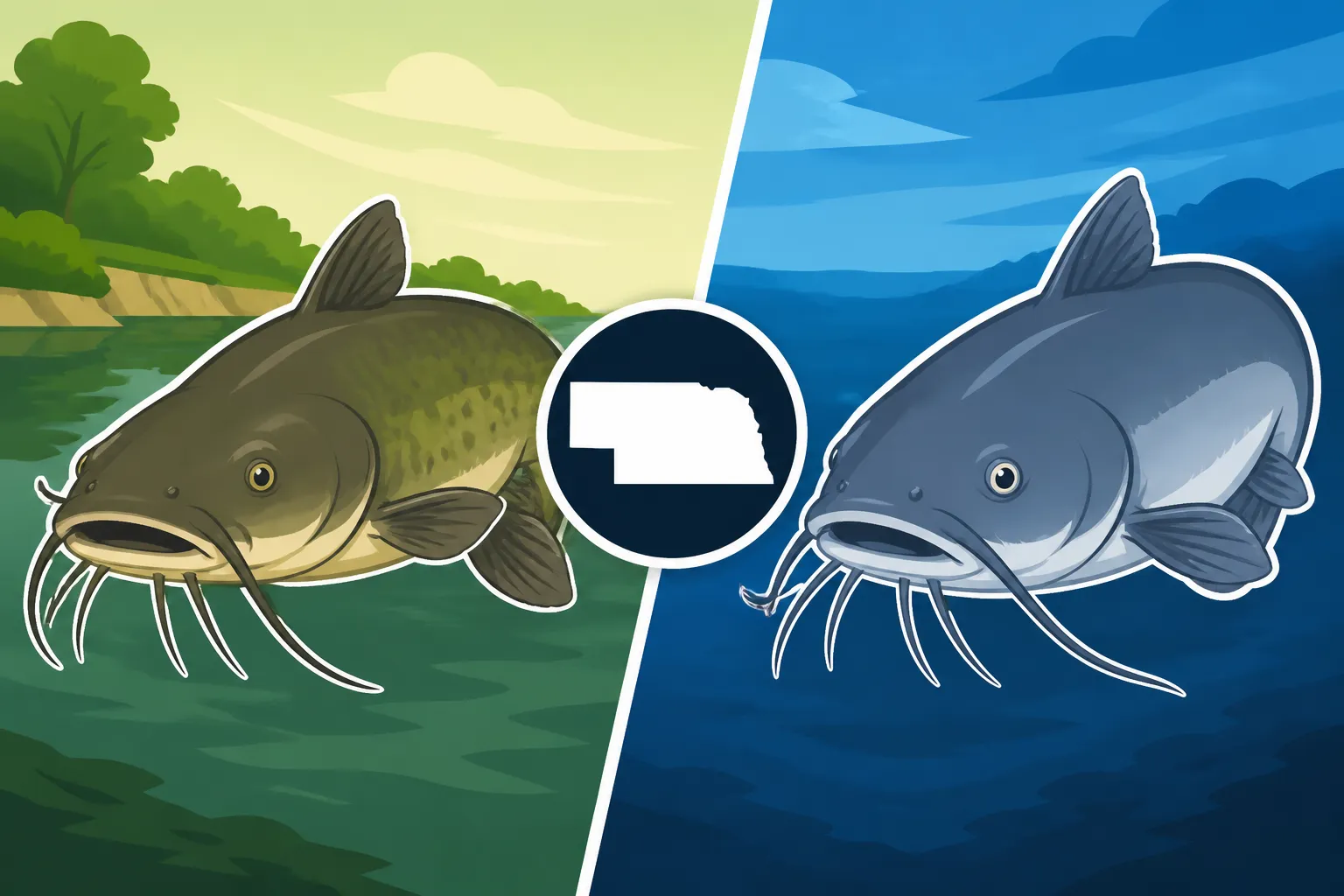
How to Tell a Channel Catfish From a Blue Catfish
Anglers in Nebraska often face confusion when trying to correctly identify different catfish species, particularly the channel catfish and the blue catfish. While both are prized catches, they have distinct characteristics that are crucial for proper identification, not just for bragging rights, but for adhering to regulations. This guide will meticulously break down the distinguishing features, habitat preferences, and behavioral patterns to help you confidently tell these two popular Nebraska game fish apart, ensuring you stay within limits and truly understand your catch.
Why Precise Catfish Identification is Crucial for Nebraska Anglers
It might seem like a small detail to differentiate between two types of catfish, especially when you're just excited about a bend in your rod. However, knowing exactly what kind of catfish you've landed is more than just academic curiosity; it's a fundamental part of responsible angling in Nebraska. The consequences of misidentification can range from a missed opportunity to a serious violation, affecting both your fishing trip and the state's conservation efforts.
Understanding Bag and Length Limits
Here's the rub: in Nebraska, different species often come with different rules. The Nebraska Game and Parks Commission sets specific bag limits and sometimes even length limits that vary by species and by waterbody. Imagine spending a glorious day on the water, pulling in what you think are several impressive channel catfish, only to find out later they were actually blue catfish, and you've exceeded the daily possession limit for that particular species. That's not just a bummer; it can lead to fines and penalties for fishing violations.
This isn't an uncommon scenario, especially when you're targeting big catfish and the excitement is high. Anglers need to be diligent about checking the current Nebraska Fishing Regulations Explained and understanding the specific Nebraska Catfish Bag Limits before they even cast a line. These regulations are put in place for a reason – to protect fish populations and ensure sustainable fishing for everyone. Misidentifying a fish species can inadvertently undermine these conservation goals, whether you're over-harvesting a species that has tighter restrictions or releasing one that you were legally allowed to keep because you mistakenly thought it was off-limits. It's a key part of the angling ethic to know your catch.
Enhancing Your Fishing Strategy
Beyond the legal aspect, knowing your catfish species intimately can significantly enhance your fishing success. Channel catfish and blue catfish, while both part of the Ictaluridae family, have distinct preferences and behaviors. Understanding these differences allows you to tailor your techniques, bait, and even your chosen fishing spots for optimal results. You wouldn't use the same exact approach for a smallmouth bass as you would for a walleye, and the same principle applies here.
For instance, channel catfish are incredibly adaptable and often scavengers, readily taking a wide variety of baits in diverse environments. Blue catfish, on the other hand, tend to be more predatory as they grow larger, often preferring fresh cut bait and holding in different types of river structure. If you're consistently targeting deep holes with strong currents using large chunks of cut bait, and you're catching primarily channel cats, a better understanding of blue catfish habits might steer you toward slightly different depths or current breaks where those big blues are more likely to ambush prey. This knowledge becomes a powerful tool in your angler's arsenal, transforming a generic "catfish trip" into a targeted pursuit, whether you're after a feisty channel cat or a massive blue. Knowing the species you're after can directly influence your choice of Best Bait for Nebraska Catfish.
Key Visual Differences: The Definitive ID Guide
When you've got a catfish in hand, and you're trying to figure out if it's a channel or a blue, there are several key visual cues that will quickly give you the answer. It's not always about size or spots, as those can be deceiving. Instead, focusing on specific anatomical features will provide the most reliable identification. Think of it like a detective looking for irrefutable evidence.
The Anal Fin: Your First Clue
Without a doubt, the most reliable and consistent way to tell a channel catfish from a blue catfish is by examining its anal fin. This fin runs along the bottom of the fish, between the anus and the tail. Once you know what to look for, it's almost impossible to confuse the two.
For a channel catfish, the anal fin has a distinctly rounded, convex shape. If you were to draw a line along the edge of this fin, it would curve outwards. More importantly, count the rays – the bony spines that support the fin. A channel catfish will typically have between 24 and 29 rays in its anal fin. The fin will appear somewhat short and stubby compared to its body size.
Now, for a blue catfish, the anal fin is a game-changer. It has a much straighter, almost flat or slightly concave, leading edge, giving it a more angular appearance. It's often longer and deeper than a channel cat's fin, and crucially, it will have a higher ray count, typically between 30 and 35 rays. This difference is so pronounced that once you've seen it a few times, you can often tell them apart at a glance, even without counting. This is the single best field identifier you can use.
Mouth and Head Shape: Subtle but Telling
While the anal fin is your go-to, the shape of the mouth and head can offer additional, albeit more subtle, clues, especially for larger specimens where other features might be less obvious.
A channel catfish typically has a head that is relatively smaller and more slender in proportion to its body. Its mouth is often described as slightly "inferior," meaning the upper jaw extends ever-so-slightly over the lower jaw. This gives it a somewhat pointed snout, and it looks a bit less aggressive. Their feeding habits, often involving bottom-feeding and scavenging, are reflected in this mouth structure.
The blue catfish, particularly the bigger ones, earns its "bulldog" reputation from its head. They possess a much broader, more robust, and generally larger head in proportion to their body. Their mouth is "terminal," meaning the jaws meet evenly at the very front. This gives them a more formidable, blunt-nosed appearance, indicative of their more predatory nature, allowing them to engulf prey effectively. When you're wrestling a really large catfish, the sheer size and bluntness of a blue cat's head will often stand out immediately.
Coloration, Spots, and Tail Fin
Coloration and spots can be a bit trickier because they can vary with water clarity, diet, age, and even the individual fish. However, they still provide useful supporting evidence.
The channel catfish gets its name partly from the distinctive dark spots often present on its olive to grayish body. These spots are usually most prominent on younger, smaller channel cats and can fade significantly or disappear entirely on older, larger fish. This is why relying solely on spots can be misleading. Their overall body color tends to be a bit more varied, from almost black in clear, deep water to a lighter, muddier olive in turbid conditions. Their tail fin is deeply forked, a characteristic common to both species, but sometimes the channel cat's fork might appear slightly less pronounced than a blue's.
The blue catfish generally has a more uniform, silvery-blue to slate gray coloration on its back and sides, fading to a white belly. Crucially, they typically do not have any spots, even as juveniles. This lack of spots is a consistent distinguishing feature for most blues. Their tail fin is also deeply forked, often appearing more prominently V-shaped than that of a channel catfish. This sleek, unblemished appearance, combined with the other features, helps to paint a clear picture.
Here's a quick comparison table to help visualize these key differences:
| Feature | Channel Catfish | Blue Catfish |
|---|---|---|
| Anal Fin | Rounded, 24-29 rays | Straight-edged, 30-35 rays |
| Body Color | Olive to grayish, often with dark spots (especially younger fish) | Silvery-blue to slate gray, no spots |
| Head Shape | More slender, smaller in proportion | Broader, more robust, "bulldog" appearance |
| Mouth Position | Slightly inferior (upper jaw extends slightly over lower) | Terminal (jaws meet evenly at the front) |
| Tail Fin | Deeply forked | Deeply forked (often more prominent) |
| Average Size | Typically 1-10 lbs, up to 20-30 lbs | Typically 5-50 lbs, can exceed 100 lbs |
| Preferred Habitat | Warm, murky water; diverse habitats (rivers, lakes, ponds) | Large, deep rivers with strong currents; deep reservoirs |
Habitat Preferences and Behavioral Traits in Nebraska Waters
Knowing where each species prefers to live and how they behave can offer strong contextual clues, helping you anticipate what you might catch and confirm your visual identification. Nebraska's diverse waterways cater to both, but they certainly have their favorite haunts.
Where Each Species Calls Home
When it comes to habitat, channel catfish are the ultimate opportunists and generalists. They are incredibly adaptable and thrive in a vast array of environments across Nebraska. You can find them in nearly every type of waterbody imaginable: slow-moving rivers, large reservoirs, smaller lakes, and even farm ponds. They tolerate warmer, murkier water better than many other species and are often found in areas with some current but also in stagnant backwaters. If you're fishing almost anywhere in Nebraska that holds fish, there's a good chance you'll encounter a channel cat. This adaptability is one reason why Channel Catfish Fishing in Nebraska is so popular and widespread.
Blue catfish, however, are a bit more particular about their living arrangements. While their range is expanding, especially in larger river systems, they primarily prefer large, deep rivers with strong, consistent currents. Think of the mighty Missouri River in Nebraska – that's prime blue cat territory. They also do well in deeper reservoirs that mimic these riverine conditions, especially near dam outflows or substantial river channels. Blue cats often hold in deep holes, scour channels, and around significant structure like submerged timber or rocky ledges where they can ambush prey that's swept along by the current. They're less common in smaller, shallower impoundments and are generally not found in small farm ponds. If you're specifically targeting Blue Catfish Fishing in Nebraska, you'll likely focus your efforts on these larger, more dynamic waterbodies.
Size Expectations and Growth Patterns
The size of a catfish can also be a helpful, though not definitive, indicator, especially when you're dealing with truly large specimens. While both species can grow quite large, there's a significant difference in their average and maximum potential sizes.
Channel catfish are a fantastic sport fish, and while they can grow to impressive sizes, they typically range from 1 to 10 pounds in most Nebraska waters. In prime habitats with abundant food, they can certainly reach 20 to 30 pounds, offering a formidable fight. Anglers often refer to these larger channel cats as "trophy" fish within their species. If you want to get an idea of what to expect, guides like How Big Channel Catfish Get in Nebraska provide a good overview of their growth potential in the state.
Blue catfish, on the other hand, are the true giants of the freshwater world in North America. In systems where they thrive, they commonly weigh between 5 and 50 pounds, with many anglers specifically targeting them for their sheer size. These fish have the potential to grow much, much larger, with some truly massive specimens tipping the scales well over 100 pounds in various river systems. Catching a blue catfish over 30 pounds in Nebraska is certainly not unheard of in the right waters, making them a top target for trophy anglers. The general rule of thumb is: if you've caught a catfish that's pushing into the truly enormous category for a freshwater species, especially from a large river, there's a higher probability it's a blue catfish rather than a channel cat.
Practical Tips for Confident Catfish Identification
Even with all this knowledge, in the heat of the moment, or when dealing with a borderline fish, it's easy to second-guess yourself. Having a few practical tips and resources at your disposal can make all the difference, ensuring you make the correct identification every time you pull a whiskered warrior from the water.
Bringing Tools to the Bank or Boat
Never underestimate the value of a few simple tools to aid in identification. A reliable, clear photograph is a wonderful thing, but sometimes you need to confirm things on the spot.
First, always have a good quality measuring tape and, ideally, a portable scale with you. While these don't directly identify the species, they are critical for ensuring you comply with Nebraska Fishing Daily Bag and Possession Limits, which often include length restrictions for certain species. Being able to measure and weigh your catch can help confirm if a fish is indeed exceptionally large for a channel cat (suggesting it might be a blue) or if it's within a legal slot limit. You can easily find durable, waterproof measuring tapes and compact digital scales on reputable online retailers like Amazon, which are perfect for a day on the water.
Second, consider carrying a waterproof field guide or a laminated fish identification card specific to Nebraska. These handy resources often feature clear illustrations or photographs highlighting the key distinguishing features, like that crucial anal fin ray count. It's a quick, tangible reference you can pull out right when you need it. Many anglers find excellent, durable options for these guides on Amazon, making them a worthwhile addition to your tackle box. Comparing your catch directly to a clear image can be incredibly helpful when you're unsure.
Consulting Official Resources and Local Experts
When in doubt, always turn to official resources and the collective wisdom of the local angling community. The Nebraska Game and Parks Commission (NGPC) is your primary source for all regulations and species information. Always check their latest fishing guide or website, as regulations can change. Their publications often include detailed species identification sections, sometimes even specific to areas where confusion between species is common. For a more comprehensive look at all the different fish you might encounter, check out the Nebraska Fish Species Identification Guide.
Don't hesitate to engage with local bait and tackle shop owners. These folks are often incredibly knowledgeable, spending countless hours on the water or hearing reports from anglers who do. They've seen thousands of fish and can often offer insights into local variations or common misidentifications. They might even have laminated posters or taxidermy mounts that illustrate the differences perfectly.
Finally, if you're still unsure after reviewing all your resources, take a clear, well-lit photograph of the fish, paying special attention to its head, anal fin, and overall body shape. Then, release the fish if you're uncertain about its identity or legal status. You can later consult with NGPC staff or experienced anglers by showing them the photo. It's always better to err on the side of caution and ensure the health of the fish and your compliance with regulations.
Disclaimer
This article is for general informational purposes only and does not constitute professional advice. Laws, prices and regulations vary by location and change over time. Consult a qualified professional for guidance on your specific situation.