Best Kayak Anchors for Still Fishing
There's nothing quite like the tranquility of still fishing from a kayak on a serene Nebraska lake or a slow-moving river bend. However, the dream quickly turns into a paddling nightmare when the wind picks up, or a gentle current nudges you away from that perfect submerged brush pile. This guide is all about helping you conquer that challenge, diving deep into the world of kayak anchors to keep you exactly where the fish are biting.
Why Kayak Anchoring is Crucial for Still Fishing in Nebraska
Kayak fishing offers an unparalleled sense of intimacy with the water, allowing you to sneak into spots larger boats can only dream of. But that stealth comes with a trade-off: stability and holding your position. Imagine finally drifting over that perfect weed line or a hidden rock pile, only for a subtle current or a sudden gust of wind to whisk you away before you can even get your lure wet. It's incredibly frustrating, and it's a common issue for many kayak anglers in Nebraska's diverse waters, from the broad expanse of Lake McConaughy to the winding Platte River. Anchoring isn't just about stopping; it's about control, safety, and maximizing your fishing time.
Safety and Stability in Nebraska Waters
Nebraska's weather can be unpredictable, and even a small change in wind speed can turn a calm morning into a choppy afternoon. For a kayak, which is inherently light and nimble, this can mean being pushed rapidly off your desired fishing spot or, worse, into potentially hazardous situations. An effective anchor system provides that much-needed stability, allowing you to focus on fishing instead of constantly battling the elements.
Think about it: when you're casting, setting the hook, or even just retying a lure, having a stable platform is paramount. Without it, you're constantly adjusting, often sacrificing precious fishing time and even risking a capsize if you lose your balance. A well-deployed anchor gives you the confidence to stand up and stretch if your kayak allows, or simply relax knowing you won't drift into shallow snags or other boat traffic. It’s an essential piece of your Nebraska Boat Safety Equipment Requirements for any serious still fishing endeavor.
Targeting Specific Structures and Holding Your Spot
The beauty of kayak fishing often lies in your ability to access tight cover and specific fishing structures that other boats can't reach. Whether it's a small pocket of lily pads in a quiet cove on Branched Oak Lake, a submerged timber pile in the backwaters of Sherman Reservoir, or a precise current seam in the Elkhorn River, these spots are often tiny and require pinpoint positioning. Drifting past them repeatedly just won't cut it.
An anchor allows you to precisely position your kayak and hold it there, giving you ample time to work your lures through the strike zone. You can make repeated casts to the same log, hover over a specific depth contour, or target that one little eddy where you know the walleye are holding. This precision fishing is where many kayak anglers truly shine, and it’s almost impossible to achieve without a reliable anchoring system. It’s the difference between hoping to hit a spot and knowing you can sit on it for as long as you need, thoroughly exploring its potential. This can be particularly vital when you are practicing How to Fish Deep Structure for Summer Walleye or trying to pick apart a brush pile for crappie.
Understanding Different Types of Kayak Anchors
When you start looking into kayak anchors, you'll quickly realize there's more than just one option. Each type has its strengths and weaknesses, making some more suitable for specific fishing situations and environments you'll encounter across Nebraska. Choosing the right anchor isn't just about weight; it's about matching the anchor's design to the water conditions and bottom composition you expect to face.
Grapnel Anchors: The Versatile Folder
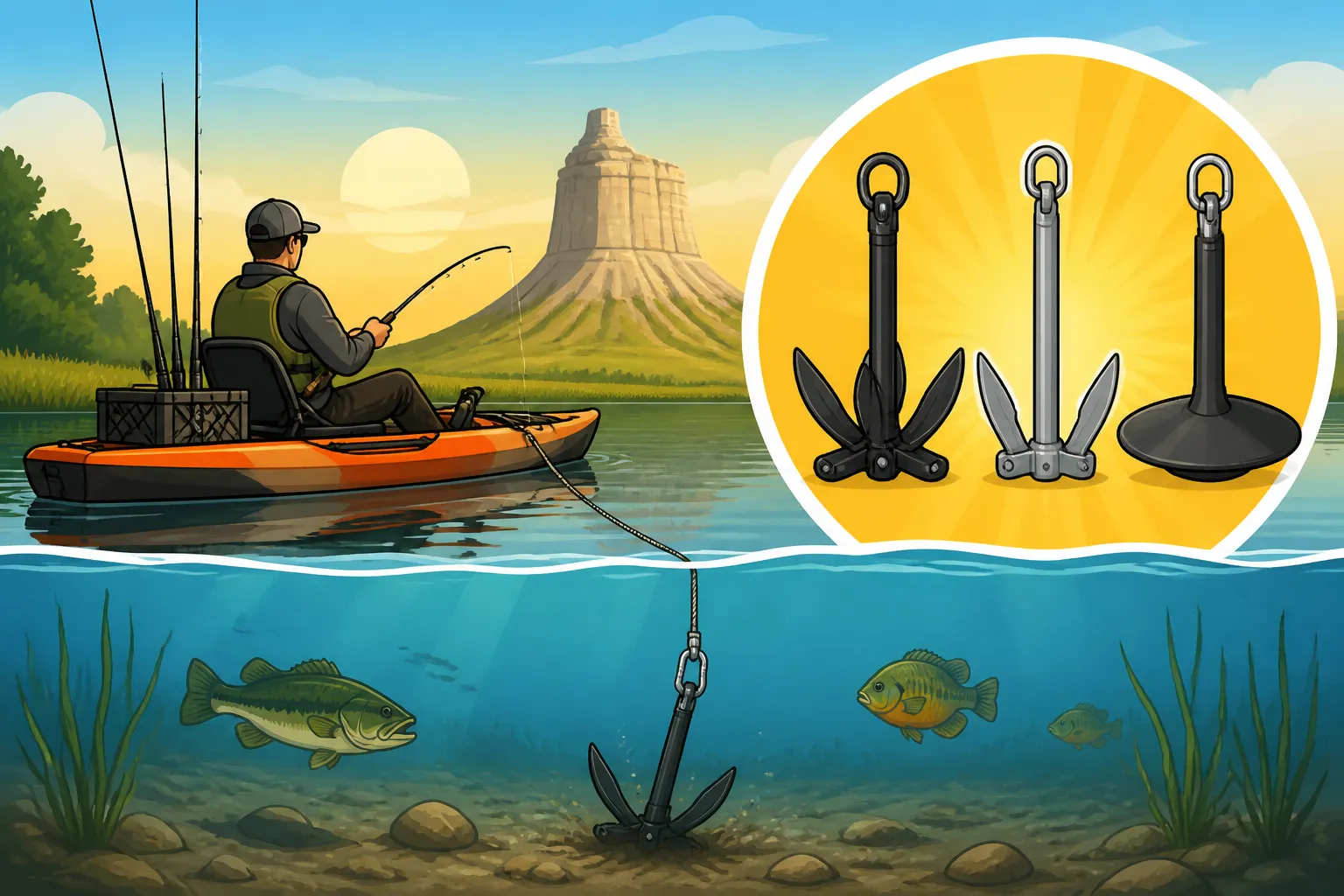
Grapnel anchors are probably the most common type you'll see on kayaks, and for good reason. They feature four or more tines (or flukes) that fold out, resembling a grapple hook. This design allows them to grab onto various types of bottom structures, from rocks and gravel to weeds and submerged timber. When not in use, the tines fold in, making them incredibly compact and easy to store in tight kayak spaces. Many anglers find these anchors to be a fantastic all-around choice for a variety of Nebraska waters.
They typically come in smaller weights, often between 1.5 to 3 pounds, which is generally sufficient for kayaks in moderate conditions. However, their effectiveness heavily relies on their ability to "catch" something on the bottom. In soft mud or very loose sand, they might not dig in as effectively as other types. For anglers who fish a mix of lakes and rivers with varied bottoms, a good grapnel anchor is often the first anchor they purchase. You can often find decent, affordable options at stores like Bass Pro Shops or even a quick search on Amazon.
Stakeout Poles: Silent and Swift
A stakeout pole, sometimes called a push pole or anchor stick, is a long, rigid pole designed to be driven directly into the soft bottom of shallow water. Made from fiberglass, aluminum, or carbon fiber, these poles typically range from 6 to 10 feet in length and have a pointed tip to penetrate the substrate easily. They are a favorite among shallow-water anglers, especially those targeting species in marshes, flats, or calm, shallow river sections, such as those you might find while doing Nebraska Kayak Fishing Techniques in backwaters.
The primary advantage of a stakeout pole is its silent operation and quick deployment. There’s no clanking chain or splashing water to spook fish. You simply push it into the bottom, slide your kayak's scupper hole or a dedicated attachment point over it, and you're locked in. They are fantastic for depths up to their length, offering instant and reliable hold. However, they are completely ineffective in deep water or over hard, rocky bottoms. If your fishing typically involves shallow bays, sandy shorelines, or muddy riverbanks, a stakeout pole is an indispensable tool.
Drift Socks: More Than Just Stopping
While not technically an "anchor" in the traditional sense, a drift sock (or sea anchor) is an incredibly valuable tool for kayak anglers, especially when dealing with wind or current. Instead of stopping your kayak dead, a drift sock acts like an underwater parachute, slowing your drift significantly. This allows you to effectively cover more water in a controlled manner, making multiple passes over productive areas, rather than just zooming by them.
For still fishing, you might use a drift sock to slow your drift to an almost imperceptible crawl, giving you time to fish a productive stretch without being fully anchored. This can be particularly useful when you want to subtly present a bait over a long weed line or across a flat. It also helps maintain your kayak's orientation in the wind, preventing it from spinning wildly. If you're tackling larger Nebraska reservoirs like Lake McConaughy, where wind can be a constant factor, a drift sock can dramatically improve your ability to fish effectively, especially when practicing How to Anchor a Kayak in Current to manage your drift speed.
Folding Anchors: Compact and Mighty
Beyond the standard grapnel, there are other folding anchor designs that often incorporate a heavier head or a different fluke design for better gripping power. These might include various claw-style or pyramid anchors that also collapse for easy storage. The key differentiator here is often the weight and the specific shape of the flukes, which are optimized for certain bottom types.
For instance, a heavier folding anchor (say, 5-7 pounds) with broader flukes might be better suited for areas with a mix of mud and gravel, or for larger, heavier kayaks in slightly stronger currents. The convenience of folding remains, but the added weight and design enhance their holding power. It's important to match the anchor's weight to your kayak's size and the typical conditions you face. A 3-pound grapnel might be perfect for a small, calm pond, but a larger, more robust folding anchor would be better for a bigger lake when the wind picks up.
Box and Mushroom Anchors: For Stationary Power
Box anchors and mushroom anchors are generally less common for kayaks due to their bulk and weight, but they are worth mentioning for very specific, often more stationary applications. A box anchor is designed to dig into soft bottoms and resist pulling, while a mushroom anchor, shaped like a mushroom, uses suction and weight to hold. They are excellent for holding heavy boats in soft bottoms but often overkill and impractical for a kayak.
However, if you're consistently fishing a very specific, soft-bottomed spot with virtually no current, and you're willing to manage the larger size, a very small version of these might offer exceptional holding power. For the vast majority of kayak anglers, the versatility and portability of grapnel or folding anchors, combined with a stakeout pole, will be far more practical for the diverse conditions found across Nebraska.
Factors to Consider When Choosing Your Kayak Anchor
Selecting the right anchor isn't a one-size-fits-all decision. The perfect anchor for a river might be completely useless in a vast, deep lake. Understanding the specific conditions you'll encounter in Nebraska's diverse waterways is key to making an informed choice. You'll want to think about where you typically fish, the kind of kayak you have, and the unpredictable nature of the elements.
Water Depth and Bottom Type in Nebraska Lakes and Rivers
This is arguably the most critical factor. Nebraska offers a mix of deep reservoirs, shallow sandpit lakes, and various river systems, each with unique bottom compositions.
- Deep Reservoirs (e.g., Lake McConaughy, Merritt Reservoir): For deeper waters with varied bottoms (rock, gravel, sometimes mud), a heavier grapnel or folding anchor (3-5 lbs) is often necessary. You'll need enough anchor line to ensure at least a 5:1 scope (5 feet of line for every 1 foot of depth) for good holding power. If you're fishing areas with a lot of rocks and snags, consider a grapnel anchor with a trip line attachment point or a breakaway ziptie system to help retrieve it if it gets stuck.
- Shallow Lakes and Ponds (e.g., Branched Oak Lake coves, local urban ponds): In shallower, often muddier or weedy bottoms, a stakeout pole really shines. It's fast, silent, and effective. If the bottom is too firm for a stakeout pole but still relatively shallow (under 10-15 feet), a lighter grapnel or small mushroom anchor could work. For small, calm waters, a 1.5-3 lb grapnel is usually sufficient.
- Rivers (e.g., Platte River, Elkhorn River): Rivers present unique challenges due to current. For slow-moving rivers with soft bottoms, a stakeout pole might work. For moderate currents, a heavier grapnel anchor or a specific river anchor (often a pyramid or box design) designed to dig in can be effective. However, the anchor line scope needs to be even higher to ensure the anchor sets properly against the current. Many river anglers also rely heavily on drift socks to control their movement, even if not fully anchoring. Consider Best Kayak for Fishing Moving River Water when thinking about how your kayak handles current alongside your anchoring needs.
Kayak Size and Weight
The larger and heavier your kayak, the more anchor weight and holding power you'll generally need. A small, lightweight recreational kayak will hold well with a 1.5-pound grapnel in calm conditions. However, a fully loaded fishing kayak, especially tandem models or those with a lot of gear, electronics, and a cooler, will require a heavier anchor, perhaps 3-5 pounds, to resist wind and current effectively.
Remember that a heavier anchor also means more effort to retrieve, especially if you're pulling it up repeatedly. It's a balance between holding power and ease of use. If you have a larger, heavier kayak and frequently fish in windy or current-prone areas, investing in a robust anchor system is wise. This also ties into considerations for Best Kayak for Fishing Calm Reservoirs versus more dynamic waters.
Current and Wind Conditions
Nebraska is known for its wind, and both wind and current can play havoc with your kayak.
- Wind: Wind acts directly on your kayak's profile above the water. The more surface area exposed to the wind (e.g., a high-sided kayak, presence of a seat, or standing), the more resistance you'll encounter. A drift sock is an excellent complement to an anchor in windy conditions, as it helps stabilize your kayak and reduce penduluming around your anchor point. A heavier anchor or a larger scope on your anchor line is crucial in strong winds.
- Current: Current works on your kayak's submerged hull. Rivers, dam tailwaters, and even currents in large lakes (like around points or channels) can be significant. When dealing with current, you need an anchor that can dig in effectively and an anchor line with enough scope to prevent the anchor from simply dragging. For specific challenges like this, our guide on How to Anchor a Kayak in Current offers more detailed advice. Always overestimate the current rather than underestimate it for safety.
Portability and Storage
Kayaks are all about efficiency of space. You don't have a lot of room for bulky gear. This is where folding grapnel anchors and slim stakeout poles really shine. They can be stored easily in a crate, bungee-strapped to the deck, or even tucked into a hull hatch.
Consider how easy your anchor system is to deploy and retrieve. A system that's a hassle to use will likely lead to frustration and less anchoring. An anchor that snags easily or is difficult to free will eat into your fishing time. The goal is an anchor that disappears when not in use but is readily available and simple to manage when you need it most. Many popular anchor brands are designed with kayak-specific storage in mind, making them compact and ready for action.
Essential Rigging and Deployment Techniques for Kayak Anchors
Having the right anchor is only half the battle; knowing how to rig it safely and deploy it effectively is just as important, especially when you're out on the water solo. Incorrect rigging can lead to frustration, lost anchors, or even dangerous situations. For any serious kayak angler in Nebraska, mastering these techniques is essential for a productive and safe day on the water.
Anchor Trolley Systems: The Kayak Angler's Best Friend
If there's one piece of rigging that's absolutely non-negotiable for kayak anchoring, it's an anchor trolley system. This ingenious setup allows you to move your anchor attachment point from the bow (front) to the stern (back) of your kayak, or anywhere in between, without having to pull up your anchor.
Here's why it's so vital:
- Safety: If you were to anchor directly off the side of your kayak, a strong current or gust of wind could easily flip you over. An anchor trolley ensures you're always pulling from either the bow or the stern, which are the most stable points.
- Positioning: Want to cast towards shore while holding your position in the current? Move the trolley to the stern. Need to fish a drop-off with your bow pointed into the wind? Move it to the bow. It allows you to orient your kayak for the best casting angle, fish fighting position, or to manage chop and waves.
- Snag Retrieval: If your anchor gets stuck (which happens to the best of us!), moving the trolley to the opposite end of the kayak can often change the angle of pull enough to free it. This feature alone makes an anchor trolley worth its weight in gold, potentially saving you from losing an expensive anchor.
An anchor trolley typically consists of a loop of rope or cord running along one side of your kayak, through pulleys at the bow and stern. A ring or carabiner attached to this loop is where your anchor line connects. Learning to install and use one effectively is a game-changer for Nebraska Kayak Fishing Techniques.
Quick Release Systems and Safety
Safety should always be your top priority, especially on the water. A quick-release system for your anchor is not just a convenience; it's a critical safety feature. Imagine being anchored in a strong current when a sudden storm rolls in, or you realize you're drifting too close to a hazard. Fumbling with knots or a stiff cleat can put you in a dangerous situation.
A quick-release system allows you to instantly detach your anchor line from your kayak. This usually involves a simple, high-quality carabiner or a specialized quick-release clip that's easy to unclip even under tension or with cold hands. You should always have your anchor line running through a quick-release point that's easily accessible while you're seated. Many anglers will attach their anchor line directly to the ring of their anchor trolley, and then run the trolley ring through a cleat or clip mounted on the kayak's gunwale, allowing for a fast release.
For ultimate safety, especially in moving water, some anglers will rig their anchor line so that if they do have to cut it in an emergency, they won't lose the entire line. This could involve having a brightly colored float attached to the end of the line, allowing you to retrieve it later when conditions are safer. Always practice your quick-release procedure so it becomes second nature.
Proper Anchor Line Management
An anchor line isn't just a rope; it's an integral part of your anchoring system, and how you manage it impacts effectiveness and safety.
- Length and Scope: For kayaks, a good rule of thumb is to have at least 50 feet of anchor line, and often more (75-100 feet) if you frequently fish deeper water or areas with strong currents. The "scope" refers to the ratio of anchor line deployed to the depth of the water. A 5:1 scope (e.g., 25 feet of line in 5 feet of water) is generally the minimum for good holding power. In strong winds or currents, you might need a 7:1 or even 10:1 scope. This angle helps the anchor dig in and hold, rather than just dragging.
- Chain: For most kayak anchors, adding a short length of chain (3-5 feet) between the anchor and the rope is incredibly beneficial. The chain helps the anchor lie horizontally on the bottom, allowing the flukes to dig in more effectively. It also adds weight at the anchor point, improving the scope and preventing the rope from lifting the anchor too much. This small addition can dramatically increase your anchor's holding power, especially for grapnel anchors.
- Storage: Loose anchor line in a kayak is a recipe for disaster. It can tangle your feet, snag your gear, or even wrap around you if you capsize. Always use a dedicated anchor bag, a small bucket, or a spool to neatly store your line. When deploying, feed the line out hand over hand, ensuring it's not tangled. When retrieving, coil it neatly into your chosen storage container. This practice contributes significantly to a smoother and safer fishing experience.
Safety First: Best Practices for Kayak Anchoring in Nebraska Waters
Anchoring a kayak might seem straightforward, but it comes with a unique set of safety considerations that every Nebraska angler should take seriously. Your small craft is intimately connected to whatever you tie it to, and understanding the nuances of anchoring safely can prevent dangerous situations from escalating. Remember, no fish is worth risking your life.
Understanding Water Conditions and Your Limits
Before you even think about dropping anchor, take a good look around and assess the current water conditions.
- Current Speed: Is the river flowing faster than usual after a rain? Are you near a dam outflow or a constricted channel where current intensifies? Anchoring in strong, sustained currents can be extremely dangerous. The force of the water on your kayak can create immense strain on your anchor line, making it difficult to retrieve, and potentially pulling your kayak under or even flipping it. Our guide on Nebraska Fishing Regulations Explained often touches on areas where currents might be particularly strong, like below dams.
- Wind Speed and Direction: Wind is a kayak angler's nemesis. Even a moderate breeze can put considerable pressure on your kayak. If the wind is strong, or predicted to get strong, consider if anchoring is truly necessary. A drift sock might be a safer option to control your movement without fully committing to a fixed position. If you do anchor, always ensure your anchor trolley allows you to orient your kayak effectively into the waves to prevent swamping.
- Bottom Type: Knowing the bottom type helps you choose the right anchor, but it also informs your safety strategy. A sandy or muddy bottom generally allows for easier anchor retrieval, while a rocky or timber-filled bottom increases the risk of snags. Always be prepared for your anchor to get stuck, especially in unfamiliar waters.
Know your own limits and your kayak's capabilities. If conditions feel too rough, too windy, or the current is too strong, err on the side of caution. There's always another day to fish.
Avoid Over-Anchoring and Entanglement Risks
While you want a secure hold, "over-anchoring" can create its own set of problems.
- Too Much Scope: While sufficient scope is good, excessively long lines can drift into other boat paths, snag on underwater objects further away, or become a tripping hazard in your kayak. Aim for the recommended 5:1 to 7:1 scope for most conditions.
- Multiple Anchors: Unless you are an experienced angler in very specific scenarios (like holding broadside in a river for trotlining, which has its own strict rules), avoid deploying multiple anchors from your kayak. This significantly increases your risk of entanglement, making quick release difficult, and can create conflicting forces on your kayak, potentially making it unstable.
- Entanglement with Other Lines/Boats: Be mindful of other anglers and boaters. Don't deploy your anchor where your line could cross another person's fishing line or boat path. Keep a clear perimeter around your kayak, especially in busy areas like popular spots at Lake McConaughy Fishing Guide.
- Your Own Body: Never, ever tie the anchor line directly to yourself or any fixed part of your kayak that isn't part of a quick-release system. If your anchor snags or you get into a dangerous situation, you need to be able to detach instantly. A simple slipknot on a cleat or a robust carabiner on your anchor trolley ring is often sufficient. The last thing you want is to be tethered to a sinking or flipping kayak.
Emergency Release Procedures
Even with the best planning, emergencies can happen. Practicing and understanding your emergency release procedure is paramount.
- The "Cut Free" Plan: Always carry a sharp knife, easily accessible and secured to your PFD or kayak, that is specifically designated for cutting your anchor line in an emergency. This knife should be capable of cutting through wet, possibly tensioned rope quickly. This is your absolute last resort, but it's a critical one.
- Buoy Markers: For situations where you have to cut your line, having a small, bright buoy or float attached to the end of your anchor line can be a lifesaver. If you have to cut free, you can ditch the anchor and line, and the buoy will mark its location, allowing you to return later when conditions improve to retrieve your gear. This saves your expensive anchor and helps keep discarded fishing gear out of the water.
- Pre-set Release Point: Ensure your quick-release system is always set up and accessible. Whether it's a dedicated anchor cleat, a carabiner on your anchor trolley, or a cam cleat, know exactly how to operate it without looking. This muscle memory is crucial in a high-stress situation.
Think of it like an airplane safety briefing – you hope you never need it, but you'll be glad you know it if you do. Regularly check the condition of your anchor line for fraying or weak spots, as well as the integrity of your quick-release mechanism. A little preventative maintenance goes a long way in ensuring safety.
Maintaining and Storing Your Kayak Anchor Gear
Just like your favorite fishing rod or tackle box, your kayak anchor and its associated rigging need a little TLC to ensure longevity and reliable performance. Neglecting your anchor gear can lead to rust, frayed lines, and ultimately, a piece of equipment that fails when you need it most. A small investment of time in maintenance can save you money and headaches in the long run.
Cleaning and Drying Your Anchor and Line
This might seem basic, but it's incredibly important, especially if you're fishing in different Nebraska waters.
- Rinse After Every Use: After each trip, especially if you've been in murky river water or chemically treated ponds, give your anchor and chain a thorough rinse with fresh water. This removes mud, silt, algae, and any potential aquatic invasive species that might be clinging on. It's a key step in preventing the spread of things like zebra mussels, a constant concern in many Nebraska lakes.
- Wash the Anchor Line: Don't forget the rope! Anchor lines absorb water, dirt, and microscopic organisms. Rinse your entire anchor line, not just the part that was submerged. You might be surprised how much grime comes off. If it's particularly dirty, a mild soap solution and a soft brush can help.
- Thorough Drying: This is critical. Stowage of wet rope or metal gear in an enclosed space encourages mildew on the rope and rust on the anchor and chain. Hang your anchor line to dry completely in a shaded, well-ventilated area before coiling it for storage. Allow the anchor and chain to air dry as well. This prevents unpleasant odors, extends the life of your rope, and keeps metal components from corroding.
Inspecting for Wear and Tear
Regular inspection of your anchor system components can catch potential failures before they happen on the water.
- Anchor Line: Carefully run your hands along the entire length of your anchor line, looking and feeling for any signs of fraying, cuts, nicks, or weak spots. Pay extra attention to the areas closest to the anchor and where it might rub against your kayak's hull or trolley pulleys. If you find significant damage, it's always safer to replace the line than to risk losing your anchor (or worse, your kayak control) during a critical moment.
- Anchor and Chain: Check your anchor itself for any bent flukes (especially on grapnels) or signs of rust. For the chain, look for heavily rusted links or any deformation. A wire brush can remove surface rust, and a coat of rust-inhibiting paint can help extend its life. Ensure all moving parts, like the folding mechanism on a grapnel, operate smoothly.
- Trolley System: Inspect the rope or cord of your anchor trolley for fraying. Check the pulleys for smooth operation and ensure they're not cracked or binding. Examine the carabiners or clips for rust, wear, or any signs of weakness. If any part of your trolley system looks compromised, replace it. The smooth operation of your trolley is vital for both positioning and safety.
- Knots and Splices: Check all knots for tightness and integrity. If a knot looks like it's coming loose or wearing thin, re-tie it. For spliced ropes, ensure the splices are still secure.
Proper Storage Techniques
How you store your gear matters.
- Organized Storage: Keep your anchor, line, and any associated clips or floats organized. An anchor bag is ideal, as it keeps everything contained and prevents tangles. Many anglers use a small plastic bucket or a dedicated storage bin in their kayak for anchor gear. This also prevents rusty anchors from staining your kayak or other gear.
- Away from Sunlight: Store your anchor line out of direct sunlight when not in use. UV rays degrade rope fibers over time, weakening the line and reducing its lifespan.
- Temperature Control: Extreme temperature fluctuations aren't ideal, but for most anchor gear, a garage or shed that stays relatively dry and out of the elements is perfectly fine. The main goal is to keep it dry and clean.
By adopting these simple maintenance and storage habits, your kayak anchor system will remain a reliable companion on countless Nebraska fishing adventures. It ensures your gear is always ready for action, allowing you to focus on the thrill of the catch rather than worrying about equipment failure.
Kayak Anchor Comparison Table
To help you quickly compare the most common kayak anchor types for Nebraska waters, here's a table summarizing their key features, pros, and cons:
| Anchor Type | Typical Weight (Lbs) | Best for Bottom Types | Pros | Cons | Nebraska Application |
|---|---|---|---|---|---|
| Grapnel Anchor | 1.5 – 3 | Rock, Gravel, Weeds, Mud | Compact, versatile, good holding in varied bottoms | Can snag easily in heavy cover, less effective in very soft mud | Most common for lakes & rivers with varied bottoms (e.g., Lake Maloney) |
| Stakeout Pole | N/A (length-based) | Soft Mud, Sand, Clay (shallow) | Silent, fast deployment, excellent hold in shallow, no line needed | Useless in deep water or hard/rocky bottoms, bulky to store | Shallow coves, river backwaters, urban ponds (e.g., Holmes Lake) |
| Drift Sock | N/A (size-based) | All | Slows drift, controls kayak orientation, good for covering water | Does not "anchor" you in place, still allows slow movement | Windy reservoirs (e.g., Harlan County Reservoir), slow river drifts |
| Folding Anchor | 3 – 7 | Rock, Gravel, Mud | Better holding power than light grapnel, still foldable, more robust | Heavier, can still snag, more expensive than basic grapnels | Larger kayaks, windier lakes, moderate current rivers |
| Mushroom Anchor | 5 – 10 | Soft Mud, Silt, Sand | Excellent holding in very soft bottoms via suction and weight | Bulky, heavy, poor holding on hard bottoms, impractical for many kayaks | Very calm, shallow, muddy ponds or specific, soft-bottomed lake areas |
Final Thoughts on Anchoring Your Kayak in Nebraska
Mastering the art of kayak anchoring is a skill that will profoundly impact your fishing success and enjoyment on Nebraska's diverse waterways. It transforms your nimble paddlecraft from a drifting vessel into a stable, precise fishing platform, allowing you to thoroughly work those productive spots. Whether you're chasing walleye on a windy reservoir, targeting catfish in a river eddy, or picking apart a brush pile for crappie in a quiet cove, the right anchor and proper technique are your secret weapons.
Always prioritize safety, invest in a reliable anchor trolley, and take the time to maintain your gear. With a little practice and attention to the conditions, you'll be confidently holding your spot and reeling in more fish, making every kayak fishing trip across the Cornhusker State a truly rewarding experience.
Disclaimer
This article is for general informational purposes only and does not constitute professional advice. Laws, prices and regulations vary by location and change over time. Consult a qualified professional for guidance on your specific situation.