How to Anchor a Kayak in Current
There's nothing quite like the serenity of a kayak gliding across a peaceful Nebraska lake, but add some current, and suddenly that serene glide can turn into a struggle to hold your position. Whether you're trying to work a specific seam for walleye on the Platte River or just want to stay put over a crappie brush pile in a flowing reservoir, figuring out how to anchor a kayak safely and effectively in moving water can feel like a real puzzle. This guide is here to untangle that challenge, walking you through the essential gear, techniques, and safety tips to keep you firmly in place when the water around you just won't sit still.
Understanding the Challenges of Anchoring a Kayak in Current
Before we dive into the "how-to," it’s crucial to understand why anchoring in current is different and often more challenging than still water. The dynamic nature of moving water, combined with the lightweight, low-profile design of a kayak, presents unique obstacles that anglers often underestimate.
The Nature of River and Stream Currents
Currents aren't just one big, uniform push of water. Rivers, streams, and even reservoirs with significant inflows or outflows have incredibly varied current patterns that can change almost by the foot. You might encounter swift, laminar flows in the main channel, where the water moves smoothly and powerfully in one direction. Then, just a few feet away, you could have turbulent eddies where the water swirls in circles, or even reverse currents that pull against the main flow.
Consider a spot on the Missouri River, for instance. You might see a strong current pushing past a wing dam, but just behind that structure, there’s a quiet slack water pocket. Understanding these nuances is key. A small, lightweight kayak acts like a leaf on this water – it’s easily pushed and pulled. If you drop an anchor in the main current, the force exerted on your kayak and anchor line can be immense, potentially pulling your anchor free or, worse, capsizing your boat if you're not positioned correctly. The depth of the water and the composition of the riverbed also play huge roles. A shallow, rocky bottom might offer good anchor-holding power, but a deep, silty bottom in a strong current can be like trying to anchor in butter.
Kayak Design and Current Stability
Not all kayaks are created equal, especially when it comes to battling current. Recreational kayaks, often shorter and wider, are designed for stability and easy maneuvering in calm waters. They tend to have flatter hulls, which means more surface area for the current to push against, making them less efficient at cutting through moving water and more susceptible to being swept downstream.
Fishing kayaks, on the other hand, often feature more sophisticated hull designs, like cathedral hulls or trimaran hulls, that offer a better balance of stability and tracking. Some are longer and narrower, designed to slice through water with less resistance, while others prioritize stand-up stability. Even within fishing kayaks, there's a big difference between a dedicated river kayak, which might be shorter and more rockered for maneuverability in rapids, and a long, stable lake fishing kayak. When you add a strong current to the mix, a kayak with a higher profile or a wider, flatter hull will feel the push much more intensely. This isn't to say you can't anchor a wider kayak in current, but it means you need to be extra mindful of your positioning and the strength of the anchor you choose. The drag created by your body and gear above the waterline also adds to the force the current exerts on your anchored vessel.
Essential Gear for Anchoring in Moving Water
Having the right equipment is non-negotiable when you're thinking about anchoring your kayak in current. This isn't just about convenience; it's about safety. Trying to make do with an inadequate anchor or an improper setup can lead to frustrating situations, lost gear, or even dangerous capsizes.
Types of Anchors Suitable for Current
When it comes to anchors for kayak fishing in Nebraska's rivers and flowing waters, you have several choices, each with its strengths and weaknesses. The best anchor for you will depend on the type of bottom you're fishing, the strength of the current, and your personal preferences.
| Anchor Type | Description | Best For | Pros | Cons |
|---|---|---|---|---|
| Grapple/Claw | Four or more collapsible prongs that can grab onto structure. | Rocky bottoms, brush piles, submerged logs, moderate current. | Excellent holding power on irregular bottoms. Collapsible for storage. | Can get permanently snagged. Not ideal for soft bottoms. |
| Box/River | Rectangular or square, often with mesh sides for added drag. | Moderate to strong current, sandy/muddy bottoms. | Good holding power in current. Less likely to snag on rocks than grapple. | Bulky to store. Less effective on very rocky bottoms. |
| Mushroom | Heavy, mushroom-shaped head. | Soft mud, sand, light current. | Decent for very soft bottoms. Less prone to snagging. | Poor holding power in strong current or on hard/rocky bottoms. |
| Drift Anchor/Drogue | Cone-shaped fabric chute that deploys in the water to create drag. | Slowing drift in current, controlling speed. Not for static anchoring. | Excellent for controlled drift fishing. Minimal snag risk. | Does not provide static anchor. Only slows the kayak's movement. |
For most scenarios in a Nebraska river with noticeable current, a grapple anchor is a fantastic choice, especially if you're fishing rocky areas or spots with submerged timber, which you'll find plenty of on the Platte or Niobrara Rivers. Their ability to "grab" onto irregularities gives them superior holding power. Just remember the downside: they can get really stuck. Some grapple anchors have a release mechanism that allows the tines to fold back if pulled from a different angle, which is a lifesaver.
A box anchor, while bulkier, can be a great option for stronger currents, particularly over softer bottoms like sand or mud that you might encounter in wider sections of the Missouri River. Its flat bottom and design create more resistance against the current, digging in effectively without the same snagging risk as a grapple. They can be found at places like Bass Pro Shops or online at Amazon.
Mushroom anchors are generally not recommended for anything but the lightest currents or still water due to their limited holding power. And a drift anchor, while incredibly useful for controlling your speed during a drift, is not an anchor in the traditional sense; it won't hold you in one fixed spot. It's a tool for slowing down, not stopping.
Anchor Line, Ropes, and Retrieval Systems
Your anchor is only as good as the line connecting it to your kayak. For anchoring in current, you want a strong, durable, and appropriately sized line. Nylon is a popular choice for anchor lines because it has some stretch, which helps absorb shock from waves and current surges, reducing the strain on your anchor and kayak. Polypropylene line floats, which can be useful to keep it away from your propeller or out of snags, but it's generally not as strong or as abrasion-resistant as nylon. Aim for a line with a breaking strength well beyond the maximum force you expect the current to exert.
The length of your anchor line is critical for proper holding power. A general rule of thumb, especially in current, is to have an anchor line that is at least 3 to 5 times the depth of the water you're in, plus the height of your kayak's bow from the water. This creates a proper "scope," allowing the anchor to dig in horizontally. If you're in 10 feet of water, you might need 40-50 feet of line deployed for optimal hold. Don't skimp on line length; it's a common mistake that leads to anchors dragging.
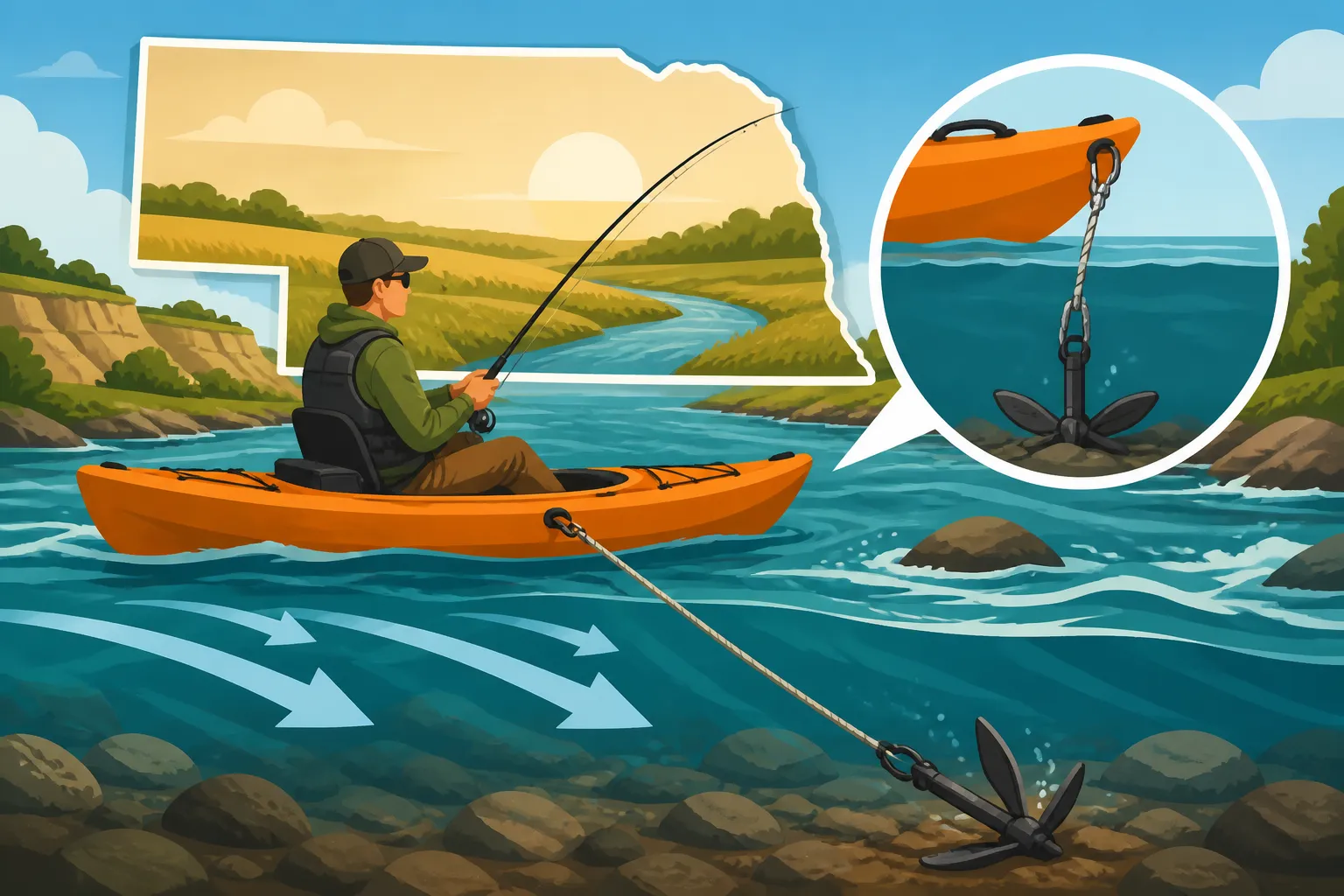
Now, for the absolute game-changer in current: the anchor trolley. An anchor trolley is a system of pulleys and a continuous loop of rope or cable that runs along one side of your kayak, from bow to stern. Your anchor line clips into this loop. This allows you to deploy your anchor from the front, middle, or rear of your kayak and, most importantly, adjust its position once anchored. Why is this crucial in current? Because it allows you to orient your kayak optimally. If you anchor from the bow in a strong current, your kayak will naturally turn into the current like a weather vane, providing the most stable position. If you anchored from the stern, the current would hit your broadside, pushing you sideways, potentially swamping your kayak. With a trolley, you can adjust your position to face upstream, downstream, or even slightly angled, giving you control over your fishing presentation and safety.
A quick-release system on your anchor line is paramount for safety. This can be as simple as a cleat that allows for rapid un-cleating, or a dedicated quick-release cam cleat. In an emergency – perhaps a log suddenly floats downriver towards you, or the current unexpectedly surges – you need to be able to instantly free yourself from your anchor. Never tie your anchor line directly to your kayak without a quick-release mechanism. You can find comprehensive Best Kayak Anchors for Still Fishing articles that detail various anchor lines and retrieval systems, many of which are adaptable to current.
Other Safety and Auxiliary Gear
Beyond the anchor and line, a few other items are essential for safe kayak fishing in moving water:
- Personal Flotation Device (PFD): This is non-negotiable. Always wear your PFD when on the water, especially in current. Even the calmest-looking river can have unexpected hazards. Check out Required Safety Equipment on a Nebraska Boat for more details on PFD regulations.
- Waders or Wet Shoes: If you anticipate getting in and out of your kayak or wading in shallow areas, appropriate footwear is important. Waders keep you dry in cold water, while wet shoes provide grip and protection for your feet on rocky riverbeds.
- Gloves: Handling anchor lines, especially in strong current, can lead to rope burns. Gloves protect your hands and provide a better grip.
- Sharp Knife: A small, sharp knife, easily accessible and designed for marine use, is a critical safety tool. If your anchor line becomes hopelessly snagged and cannot be released by other means, you may need to cut it to prevent being pulled under or capsized. Mount it within easy reach on your PFD or kayak.
- Whistle: A simple safety whistle, like those you can find at any outdoor store or a sporting goods section of Amazon, is crucial for signaling other boaters or emergency personnel. Do You Need a Whistle or Horn on a Nebraska Kayak? will tell you more about specific requirements.
- Dry Bag: Keep your phone, keys, and any other essentials in a waterproof dry bag. Unexpected capsizes can happen, and you don't want to lose your valuables.
Having all these items readily available will make your anchoring experience not only more effective but significantly safer.
Step-by-Step Guide to Anchoring Your Kayak in Current
Now that you're geared up, let's talk about the practical side of actually getting that anchor to hold you in place in moving water. It's a bit of an art form, but with practice, you'll get the hang of it.
Scouting Your Spot and Planning Your Approach
Before you even think about dropping anchor, take a moment to "read" the water. This is crucial for both effectiveness and safety. Look for visual cues:
- Seams: These are lines where two different currents meet, or where current meets slack water. Fish often sit in the calmer water of a seam, waiting for food to be swept by.
- Eddies: Swirling pockets of water where the current slows or even reverses. These are prime spots for fish, and often offer a more stable anchoring point than the main current.
- Slack Water: Areas of very little current, often behind large rocks, fallen trees (log jams), or points of land.
- Bottom Structure: Can you see submerged rocks, gravel beds, or drop-offs? These areas often hold fish and can provide good anchor-holding ground.
Identify where you want to fish and, more importantly, where you want your kayak to be when anchored. Then, consider your approach. Always approach your intended anchor spot from upstream. This allows the current to naturally guide you and gives you more control as you prepare to deploy your anchor. It also ensures that when you drop the anchor, the kayak will drift back and set the anchor with the appropriate scope. Assess the depth of the water and try to get a feel for the bottom composition – is it rocky, muddy, sandy? This will help you decide if your chosen anchor is suitable and if it's likely to hold. You also need to be aware of other boaters, kayakers, or even swimmers. Ensure your anchoring location won't impede navigation or create a hazard for others.
Safe Anchor Deployment Techniques
Deploying your anchor in current is a measured, deliberate process. Rushing it can lead to snags, a dragged anchor, or putting yourself in a risky situation.
- Approach Upstream: Paddle past your desired fishing spot, maybe 20-50 feet upstream, depending on the current strength and water depth. You want enough room for your anchor line to deploy with good scope.
- Prepare Your Anchor and Trolley: Have your anchor ready to drop and your anchor line clipped into your anchor trolley. Move the trolley's ring to the bow of your kayak.
- Gradual Deployment: Gently lower your anchor into the water from the bow. Don't just throw it in. Letting it down slowly helps prevent tangles and ensures it settles correctly on the bottom. As the current pushes your kayak downstream, pay out line, letting the anchor drag along the bottom.
- Set the Anchor: Once your kayak has drifted back to your desired fishing position, slowly pay out a bit more line until you feel the anchor "catch" and dig in. Give it a gentle tug or let the current pull on the kayak a bit to confirm it's set. If it drags, pay out more line or try a slightly different spot. Remember that 3-5:1 scope ratio for your anchor line.
- Adjust with the Anchor Trolley: Once the anchor is securely set at the bow, use your anchor trolley to slowly slide the anchor line attachment point along the side of your kayak. You'll likely want to move it towards the bow, or even slightly past the bow, to fully orient your kayak facing directly upstream. This "bow-on" position is the most stable and presents the least surface area to the current, making you more stable and less prone to swamping. This is a crucial step that makes kayak anchoring in current much safer than simply tying off to one point.
Always remember your quick-release system. Keep it accessible. If anything feels unsafe, be ready to release your anchor line instantly.
Managing Your Kayak While Anchored
Even when anchored correctly, the current is a constant force. Managing your kayak means being aware and making small adjustments.
The anchor trolley isn't just for deployment; it's also for fine-tuning your position. If the current changes direction slightly, or you want to cast to a different angle, you can adjust the trolley forward or backward a few feet. This subtle shift can change your casting lane without having to retrieve and re-deploy your anchor. For example, if you're fishing a seam where fast water meets slow, you can use the trolley to keep your kayak precisely on the edge of the seam, allowing you to cast into either zone effectively.
One of the biggest frustrations for anglers is a snagged anchor. If your anchor gets stuck on a rock or log, resist the urge to yank on it violently. Instead, try moving your kayak around the snag point using paddle power or the anchor trolley. Often, pulling from a different angle will free the anchor. If you've been careful in selecting a grapple anchor with a trip or release mechanism, now's the time it truly shines. Pulling hard from the opposite direction (if possible) can sometimes free the tines. If it’s absolutely stuck and you can't free it, and it becomes a safety hazard, this is when your readily accessible knife becomes essential to cut the line. It's better to lose an anchor than risk injury or losing your kayak.
Always be aware of the changing conditions. Is the current picking up? Are there approaching storm clouds? Is debris floating downstream? Stay vigilant. The river environment is dynamic.
Retrieving Your Anchor Safely
Just like deployment, anchor retrieval requires a systematic approach.
- Release Tension Gradually: If your anchor line is cleated, slowly release some tension, allowing the current to push your kayak slightly downstream. This can help loosen the anchor from the bottom.
- Paddle Towards the Anchor: Start paddling directly towards your anchor. This reduces the angle and tension on the line, making it easier to pull the anchor free.
- Pull Smoothly, Not Violently: When you're directly over the anchor, pull the line smoothly and steadily upwards. Avoid sharp, jerking motions that could flip your kayak or cause the anchor to suddenly release and swing into you.
- Clean and Store: Once retrieved, quickly clean off any mud or debris from your anchor and line before stowing it. If you have a collapsible grapple anchor, fold it up neatly. Coil your line to prevent tangles on your next outing.
Remember, practice makes perfect. Your first few times anchoring in current might be a bit awkward, but with each trip, you'll gain confidence and efficiency. For more general advice on fishing and safety, you might want to look into Nebraska Fishing Regulations Explained.
Advanced Tips and Safety Considerations for River Kayaking
Becoming proficient at anchoring in current goes beyond just dropping a piece of metal. It involves a deeper understanding of river dynamics and a strong commitment to safety.
Understanding Current Dynamics and Kayak Positioning
Expert river kayakers develop an almost instinctual ability to "read" the water. This isn't just about spotting obvious eddies; it's about understanding subtle changes in surface texture, foam lines, and debris movement that indicate current speed and direction. For instance, knowing how to fish a seam or current break can be incredibly productive. These areas are natural ambush points for fish, as they can sit in the calmer water and dart out into the faster current to grab passing food. Your anchor trolley is invaluable here, allowing you to precisely position your kayak right on that seam, presenting your bait or lure perfectly.
Sometimes, rather than anchoring, you might want to utilize the current to your advantage. Drift fishing, where you let the current carry your kayak along while you cast, can be very effective, especially for covering a lot of water. If you want to control your drift speed, a drift anchor (also known as a drogue or sea anchor) is your best friend. It won't stop you, but it will slow your progress significantly, allowing you to present your lure more effectively. Conversely, using a How to Fish Fast Current on the Platte River technique might mean anchoring in an eddy just outside the main flow, and then casting into the faster water.
Always be aware of potential obstacles. Strainers (fallen trees or brush that allow water to pass through but not solid objects) and log jams are incredibly dangerous in current. If your kayak gets pinned against a strainer, the force of the water can quickly flood and fold your kayak, trapping you. Never anchor directly upstream of such an obstacle where you could be pushed into it if your anchor slips. Plan your escape routes!
Emergency Protocols and Risk Mitigation
Safety is paramount, especially in moving water. There will be times when things don't go as planned, and knowing what to do can make all the difference.
If your anchor gets hopelessly stuck and you can't retrieve it, and you've tried everything including pulling from different angles, then cutting the line is your last resort. It's a tough decision because anchors aren't cheap (though you can find good, affordable options for kayak anchors at Amazon or Bass Pro Shops), but your safety comes first. Keep your knife sharp and accessible. If you decide to cut, make a clean cut and be prepared for the sudden release of tension. The current will immediately grab your kayak, so be ready to paddle and navigate.
Unexpected increases in current, perhaps due to heavy rains upstream or a dam release, can quickly turn a calm day into a dangerous one. If the current suddenly becomes too strong, or conditions deteriorate (e.g., strong winds kicking up), don't hesitate to pull your anchor and seek safety. Head for a calm bank or a protected cove. Always check weather forecasts and river conditions before you head out, and continue to monitor them while you're on the water.
Finally, while solo kayaking can be incredibly peaceful, there's always an added layer of safety when you fish with a buddy, especially in moving water. A buddy system means someone knows where you are, can assist in an emergency, or simply share in the joy (and challenges) of the day. Share your float plan with someone on shore before you leave.
Maintenance and Storage of Anchoring Gear
Proper maintenance of your anchoring gear might seem like a small detail, but it contributes to its reliability and longevity. After each outing, especially in muddy or silty rivers, rinse your anchor and anchor line thoroughly with fresh water. This removes grit and sediment that can abrade your line or corrode metal parts. Hang your anchor line to dry completely before coiling it for storage. Storing a wet, muddy line can lead to mildew and degradation over time.
Regularly inspect your anchor line for any signs of wear, fraying, or cuts. Pay close attention to the sections closest to the anchor and where the line might rub against your kayak or cleats. If you notice significant wear, replace the section or the entire line. Also, check the hardware on your anchor trolley and quick-release system for rust or damage. A quick-release cleat that seizes up when you need it most is a serious hazard. Proper storage, keeping your line neatly coiled and your anchor in a designated spot, prevents tangles and ensures everything is ready for your next adventure on the water.
By understanding the challenges, equipping yourself properly, practicing safe deployment and retrieval, and staying vigilant, you'll master anchoring your kayak in current, opening up a whole new world of fishing opportunities on Nebraska's incredible waterways. You might also find it helpful to look into Best Kayak Fishing Setup for Beginners to ensure all your gear works together seamlessly.
Disclaimer
This article is for general informational purposes only and does not constitute professional advice. Laws, prices and regulations vary by location and change over time. Consult a qualified professional for guidance on your specific situation.