Best Jon Boat Size for the Platte River
If you've ever dreamt of gliding across the expansive, yet often surprisingly shallow, waters of the Platte River for a day of fishing, you've probably quickly run into the classic angler's dilemma: what kind of boat is truly going to serve you best out there? It's not like fishing a deep reservoir; the Platte has its own unique personality, full of character, and plenty of hidden challenges that can turn a great day into a frustrating one if you're not properly equipped. This guide is all about helping you navigate the choices, specifically focusing on Jon boats, to ensure your next Platte River adventure is smooth sailing, or at least, smooth floating.
Understanding the Platte River's Unique Challenges
The Platte River isn't just "a river" in Nebraska; it's a dynamic, sometimes temperamental, waterway that demands respect and the right gear. Its unique characteristics mean that a boat perfectly suited for Lake McConaughy might be completely impractical here. Before we even talk about specific boat sizes, we need to understand what you're up against.
Shallow Water and Obstacles
One of the most defining features of the Platte is its often incredibly shallow nature. We're not talking about just a few feet; in many sections, especially during drier periods or outside of major rainfall, you'll encounter stretches that are mere inches deep. This isn't just a nuisance; it's a constant concern for boaters. You might be cruising along one moment, and the next, you're high and dry on a sandbar or scraping bottom, which can be incredibly frustrating and even damaging to your prop or hull.
Beyond the shallows, the Platte is also a living river, constantly shifting its bed and carrying debris. You'll encounter submerged logs, fallen trees along the banks (which make for great fish habitat, but terrible boat navigation!), and shifting sandbars that can appear seemingly overnight. These obstacles require a boat that can either glide over them with minimal draft or be easily maneuvered around them. A heavy, deep-V hull designed for big water simply won't cut it here; it'll leave you stranded more often than not. The constant threat of grounding means you need a vessel that can take a bump or two without crumbling, and one that you can potentially push or pull off a snag if you do misjudge the depth.
Current and Flow Variability
While the Platte can be shallow, it still carries a current, and this current can vary significantly depending on recent rainfall, upstream releases, and the time of year. A strong current can be exhilarating for drift fishing, but it also means you need a boat that handles predictably. Picture this: you've found the perfect eddy, but the main current is ripping just a few yards away. You need a boat that lets you stay put or move precisely without fighting a losing battle against the water.
Furthermore, the Platte's flow is anything but static. Water levels can change dramatically over a season, or even within a few days. What was a navigable channel last week might be a muddy bank today, or vice-versa. This variability directly impacts boat choice; a boat that's "just right" for high water might be a nightmare during low flow. This fluctuation means your ideal Jon boat needs to be versatile enough to handle a range of conditions, or you'll find yourself limited to fishing only certain times of the year or specific sections of the river. It's a balance of being robust enough for higher flows and nimble enough for those skinny water adventures. For anglers looking to really understand the river's moods, staying informed on current conditions is key, and having a boat that can adapt to How High Water Affects River Fishing in Nebraska is a huge advantage.
Access Points and Portability Needs
Unlike large reservoirs with numerous concrete boat ramps, many prime fishing spots on the Platte River are accessed via less developed means. Think gravel roads leading to a grassy bank, or even just pulling over on a county road and finding a path down to the water. This means your boat needs to be easily launched and retrieved, often without the aid of a large, dedicated ramp.
This is where portability truly shines for a Jon boat. If you have a massive, heavy boat, you'll be restricted to only the few formal ramps, which are often crowded or located in less productive areas. A lighter, more manageable Jon boat, especially when paired with a simple trailer or even transported in the bed of a truck, opens up a world of possibilities. You can explore those less-frequented stretches, get away from the crowds, and truly experience the wild side of the Platte. The ease of getting your boat to and from the water also impacts your overall enjoyment; nobody wants to spend more time struggling with their boat than actually fishing. For those looking to explore more remote areas, understanding Platte River Wading Access Points might also inform your choice, as a small Jon boat can often get you to similar spots.
Key Considerations for Jon Boat Sizing on the Platte
Now that we've chewed on the Platte's personality, let's talk about how those traits translate into choosing the right Jon boat size. It's all about finding that sweet spot between capability and practicality.
Length and Width for Stability and Maneuverability
When it comes to Jon boats on the Platte, length and width are two sides of the same coin, and they both feed into stability and maneuverability.
- Length: Shorter Jon boats (think 12-14 feet) are generally easier to maneuver in tight spots, navigate around snags, and turn quickly in current. They also tend to have a shallower draft, which is a huge plus for the Platte's skinny water. However, a shorter boat typically means less internal space for gear and passengers, and they can feel a bit less stable when multiple people are moving around. On the flip side, longer Jon boats (16-18 feet) offer more deck space, better stability, and can handle a bit more chop if you encounter it on wider sections of the river. But they can be a bear to maneuver in tight channels, harder to launch from undeveloped banks, and might sit a little deeper in the water, increasing your chances of grounding. For serious river anglers, you might find a robust 14-foot model at a place like Bass Pro Shops to be a versatile choice.
- Width (Beam): A wider Jon boat (often referred to as a "wide-bottom" or "modified V") provides significantly more stability. This is crucial when you're standing up to cast, netting a fish, or if you have a fishing buddy moving around. A wider beam also offers more floor space, making it feel less cramped. The trade-off is that wider boats sometimes have a slightly deeper draft, and can be a bit harder to push through dense vegetation or very narrow channels. However, for most Platte River applications, the added stability and space of a wider boat are usually preferred over a very narrow model, especially for safety and comfort. You want to feel confident standing up, casting, and moving around without constantly worrying about tipping.
Ultimately, you're looking for a balance. A boat that's too long might be a headache to control, while one that's too narrow will feel tippy and cramped. For the Platte, many anglers find a length in the 14 to 16-foot range, with a decent beam (at least 48 inches at the bottom), hits that sweet spot. It's long enough for two people and gear, stable enough to move around, and still nimble enough for the river's quirks.
Transom Height and Motor Compatibility
The transom height of your Jon boat is absolutely critical, particularly when considering what kind of motor you'll be hanging off the back. Most modern outboard motors come in either short shaft (15 inches) or long shaft (20 inches) configurations. Matching your motor's shaft length to your boat's transom height is non-negotiable for optimal performance and safety.
- Short Transom (15 inches): These are common on smaller, older Jon boats. They pair perfectly with short shaft outboards. If you try to put a long shaft motor on a short transom, the prop will be too deep, causing drag, making steering awkward, and potentially hitting bottom more easily.
- Long Transom (20 inches): More prevalent on larger, newer Jon boats and other fishing boats. These are designed for long shaft outboards, which position the prop deeper for better bite and cooling in deeper water. However, on the Platte's shallow stretches, a long shaft motor, even on a long transom, can still pose a challenge with prop clearance.
This is where the conversation around jet drives comes into play for the Platte River. Many Platte River regulars swear by jet drive outboards because they eliminate the lower unit that hangs below the prop, allowing the boat to run in incredibly shallow water. If you're serious about navigating the skinny water and sandbars, a jet drive might be worth the investment. Jon boats are typically well-suited for these motors, but you'll still need to ensure your transom can handle the weight and horsepower of a jet-specific motor. A properly sized boat for Platte River Fishing Access Near North Platte with a jet drive can open up many more fishing opportunities.
Weight, Capacity, and Portability
Don't underestimate the importance of weight and capacity for a Platte River Jon boat. These factors directly impact how you transport, launch, and use your boat.
- Weight: Lighter Jon boats are easier to load and unload from a truck bed (for smaller models) or to trailer with a smaller vehicle. If you frequently fish alone or rely on less-developed launch sites, a lighter boat (e.g., under 200-300 lbs for a 12-14 footer) is a huge advantage. It means less struggle and more time fishing. Aluminum is the material of choice for Jon boats specifically because of its lightweight yet durable properties.
- Capacity: This refers to the maximum number of people and total weight (people + gear) your boat can safely carry. Always check the manufacturer's capacity plate! If you primarily fish solo, a smaller, lighter boat might be perfect. But if you often bring a fishing buddy, a dog, a cooler full of drinks and lunch, and a bunch of tackle, you'll quickly exceed the capacity of a tiny Jon boat. Overloading a boat, especially in a current, is incredibly dangerous and can lead to instability. Plan for your typical crew and gear, then give yourself a little buffer.
- Portability: This ties everything together. Can you realistically get your chosen boat to and from your desired fishing spots? If you plan on doing a lot of "exploratory" fishing, where you're seeking out new, informal access points, a boat that's easily managed by one or two people is paramount. This might mean a smaller, lighter hull, or investing in a specialized boat trailer designed for rougher terrain. The ability to launch from almost anywhere is one of the biggest appeals of a Jon boat for river fishing, so don't sacrifice it by choosing a boat that's too cumbersome. Consider accessories like a small boat dolly or a rugged trailer from a reputable retailer like Bass Pro Shops for maximum versatility.
Recommended Jon Boat Sizes for Different Platte River Scenarios
The "best" Jon boat size isn't a one-size-fits-all answer for the Platte. It really boils down to your typical fishing party, the amount of gear you carry, and the specific sections of the river you plan to explore.
Solo Angler or Light Trips
For the lone wolf or those quick, minimalist fishing trips, a smaller Jon boat offers unparalleled freedom and ease.
- Ideal Size Range: 12 to 14 feet in length, with a bottom width of 36 to 42 inches.
- Why it works: These boats are incredibly lightweight, often under 200 pounds, making them easy to car-top or load into a truck bed by yourself. Their shallow draft means you can glide over many of the Platte's notorious sandbars without getting stuck. Maneuverability is excellent, allowing you to quickly navigate tight turns, pivot around obstacles, and get into small backwater eddies where bigger boats simply can't go. You can easily row, use a small electric trolling motor, or a modest 5-10 horsepower outboard (short shaft, of course, or a small jet drive).
- Considerations: While great for one person, space is limited. If you plan to bring a lot of gear, a large cooler, or a big tackle box, it can feel cramped quickly. Stability is decent for one person sitting or carefully standing, but less forgiving if you're constantly shifting weight or encountering boat wakes (though less common on the Platte). For minimalist anglers, these boats are fantastic for a peaceful day of Nebraska Drift Fishing Techniques for Rivers, allowing you to truly immerse yourself in the experience.
Two Anglers and Gear
This is probably the most common scenario for many fishing buddies heading to the Platte. You need enough space and stability for two people to comfortably fish, plus their necessary gear.
- Ideal Size Range: 14 to 16 feet in length, with a bottom width of 42 to 48 inches (or even wider).
- Why it works: A 14-foot wide-bottom Jon boat is a fantastic all-around choice for two people. It provides considerably more stability than a smaller boat, allowing both anglers to stand and cast without feeling like they're going to tip over. There's enough floor space for two tackle boxes, a cooler, and maybe a small anchor system. A 15-foot or 16-foot boat further enhances this, offering even more elbow room, storage, and the ability to comfortably handle a slightly larger outboard motor (say, 15-25 horsepower, often with a jet drive). These boats are still light enough to be manageable off a simple trailer and can be launched from many semi-developed spots. They strike an excellent balance between capacity, stability, and shallow-water capability.
- Considerations: While more stable than smaller models, careful weight distribution is still important. You'll definitely want to consider a proper trailer for boats in this size range, as loading them into a truck bed might require two strong individuals or a specialized ramp/lift. The increased size means a slightly deeper draft compared to a 12-footer, so you'll need to be a bit more mindful of extremely shallow sections, but a jet drive setup can largely mitigate this concern. Many excellent options for this size can be found at outdoor retailers or online platforms like Amazon for accessories.
Multi-Purpose or Occasional Larger Groups
If you occasionally want to bring three people, or if you plan to use your Jon boat for more than just fishing (e.g., duck hunting, hauling gear for camping), you might lean towards a slightly larger vessel.
- Ideal Size Range: 16 to 18 feet in length, with a bottom width of 48 inches or more.
- Why it works: These larger Jon boats offer maximum stability and generous deck space. You can comfortably fit three anglers (though it might still be a little cozy for active casting), or two anglers with a significant amount of gear. They can also handle a larger outboard motor (25-40+ horsepower, often a jet drive), which provides more power for longer runs or battling stronger currents. The added length can also help smooth out the ride in choppier sections of wider rivers or reservoirs (if you occasionally take it to other waters).
- Considerations: The trade-off here is portability and draft. An 18-foot Jon boat is heavy and requires a substantial trailer, making informal launches much more difficult. Its larger size means it will not navigate the tightest, shallowest backwaters as easily as a 12 or 14-footer. While still a shallow-draft vessel compared to a V-hull, it will sit deeper in the water than its smaller counterparts. This size is best suited for anglers who primarily fish the wider, deeper sections of the Platte or its tributaries, or those who truly need the extra capacity for other outdoor pursuits. Before committing to such a size, it's wise to review Nebraska Boat Registration and Fishing Rules to ensure you meet all requirements for larger vessels.
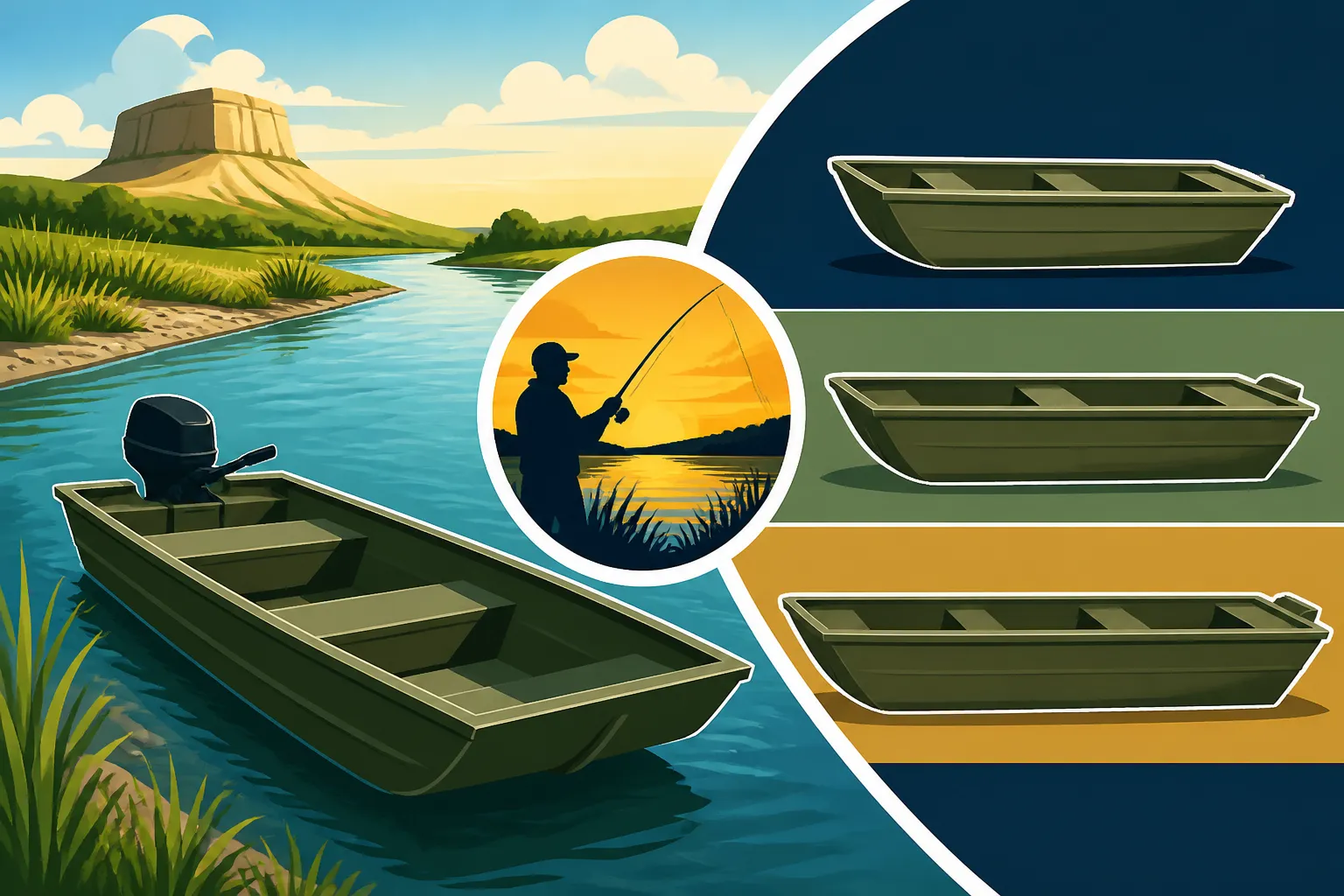
Here's a quick comparison to help visualize the choices:
| Jon Boat Size (Length) | Bottom Width (Typical) | Passenger/Gear | Platte River Suitability | Key Advantages | Key Disadvantages |
|---|---|---|---|---|---|
| 10-12 feet | 32-36 inches | 1 angler + light gear | Best for extreme shallows, very tight spots | Max portability, very shallow draft | Limited space, less stable, minimal capacity |
| 14 feet | 36-48 inches | 1-2 anglers + moderate gear | Excellent all-rounder for most Platte fishing | Good balance of stability, portability, draft | Can feel snug with 2 active anglers |
| 16 feet | 42-52 inches | 2-3 anglers + ample gear | Great for stability, longer trips, wider sections | More space, very stable, handles larger motors | Less maneuverable in very tight areas, heavier |
| 18 feet | 48-60 inches | 3+ anglers + heavy gear | Best for wider, deeper Platte sections, multi-purpose | Maximum space & stability, handles substantial loads | Heavier, harder to launch informally, deeper draft |
Essential Features and Rigging for Platte River Jon Boats
Once you've zeroed in on the right size, thinking about the construction and how you'll rig your Jon boat is the next step to ensuring it's truly Platte-ready.
Hull Material and Construction
Almost all Jon boats are made from aluminum, but there are differences in how they're built and the thickness of the material, which absolutely matters on a river like the Platte.
- Aluminum Thickness: Look for a boat made with decent gauge aluminum. Thicker aluminum (e.g., .080 to .100 gauge or more) will be more resistant to dents and punctures from scraping over sandbars or bumping submerged logs. While ultra-light gauge aluminum might make a boat slightly easier to haul, the added durability of a heavier gauge is often worth the extra weight for river fishing where impacts are more likely.
- Riveted vs. Welded Hulls:
- Riveted Hulls: These boats are constructed by fastening aluminum sheets with rivets. They tend to be slightly more flexible, which can be an advantage in absorbing impacts without cracking. If a rivet does loosen over time, it can usually be replaced. They are often a more affordable option.
- Welded Hulls: Welded Jon boats offer superior strength and rigidity. The seams are fused, which theoretically means fewer potential leak points over time compared to rivets. However, a hard impact on a welded hull can sometimes cause a crack that's more difficult and expensive to repair than a simple popped rivet. For serious shallow-water punishment, many seasoned river anglers lean towards the robust feel of a welded hull. Both types can be excellent, but if you anticipate frequent encounters with rocky bottoms or submerged timber, the structural integrity of a well-built welded hull or a heavily riveted one might give you more peace of mind.
Regardless of construction, ensuring your boat meets Nebraska Boat Safety Equipment Requirements is vital before any trip.
Interior Layout and Customization
A basic Jon boat can be a blank canvas, which is both a blessing and a curse. You can customize it exactly to your needs, but you also need to think about what those needs are.
- Open vs. Bench Seats: Many Jon boats come with simple bench seats. While functional, they can limit movement. Some anglers prefer an open layout (perhaps with removable seats) to maximize floor space for gear or to allow for custom seating arrangements like pedestal seats. For river fishing, keeping the interior uncluttered is often wise to prevent snagging lines or tripping.
- Storage: Jon boats typically lack built-in storage. Think about adding a dry box or tackle storage solutions. A simple plastic tote secured to the floor can work wonders. If you're carrying safety gear, a first-aid kit, and extra clothes, keeping them dry and accessible is crucial.
- Decking and Flooring: Some anglers opt to add a marine-grade plywood or aluminum deck to create a flat, stable fishing platform, particularly in the bow. This raises you slightly, improving casting angles and visibility, which can be a huge advantage when spotting structure or shallow spots. Be mindful of added weight, but a small casting deck can dramatically improve the fishing experience. You can find materials and advice for these customizations at stores like Bass Pro Shops.
Powering Your Platte River Jon Boat
Choosing the right motor for your Jon boat on the Platte is almost as important as the boat itself.
- Outboard Motor (Propeller Driven): For most Jon boat sizes, a traditional propeller-driven outboard will work. However, as discussed, the shallow nature of the Platte means you need to be constantly vigilant about prop strike. A short shaft motor is usually preferred, and many anglers will run a motor with a "power trim and tilt" feature, allowing them to quickly raise the motor in shallow water. Carrying a spare prop (or two!) is not a luxury, it's a necessity.
- Jet Drive Outboard: As mentioned, jet drives are often the preferred choice for dedicated Platte River anglers. These motors suck water in and then expel it, pushing the boat forward without a lower unit extending below the hull. This allows you to run in incredibly shallow water – think inches, not feet. They do require more horsepower than a prop motor to achieve the same thrust and are generally less fuel-efficient, but for navigating the Platte, their advantages are immense. If you're serious about river fishing, budgeting for a jet drive is a smart move. When looking for parts or even a new engine, online retailers like Amazon can sometimes offer competitive options for smaller accessories and components.
- Electric Trolling Motors: For quiet maneuvering, especially when How to Drift Fish the Platte River Safely or holding position against a gentle current, a bow-mounted electric trolling motor is invaluable. They allow for precise boat control, letting you slip into prime fishing holes without spooking fish. A foot-controlled model frees up your hands for fishing. Even with a gas outboard, an electric motor is a fantastic secondary power source. Ensure you have a good deep-cycle battery to power it for a full day.
Remember that any boat you take on the Platte needs to be properly registered. You can find detailed information on Nebraska Boat Registration Cost by Boat Length and How to Register a Boat in Nebraska to ensure you're legal and ready to hit the water.
In the end, choosing the best Jon boat size for the Platte River is a personal decision, but by carefully considering the river's unique characteristics and your own fishing style, you can make an informed choice that will lead to countless successful and enjoyable days on the water.
Disclaimer
This article is for general informational purposes only and does not constitute professional advice. Laws, prices and regulations vary by location and change over time. Consult a qualified professional for guidance on your specific situation.