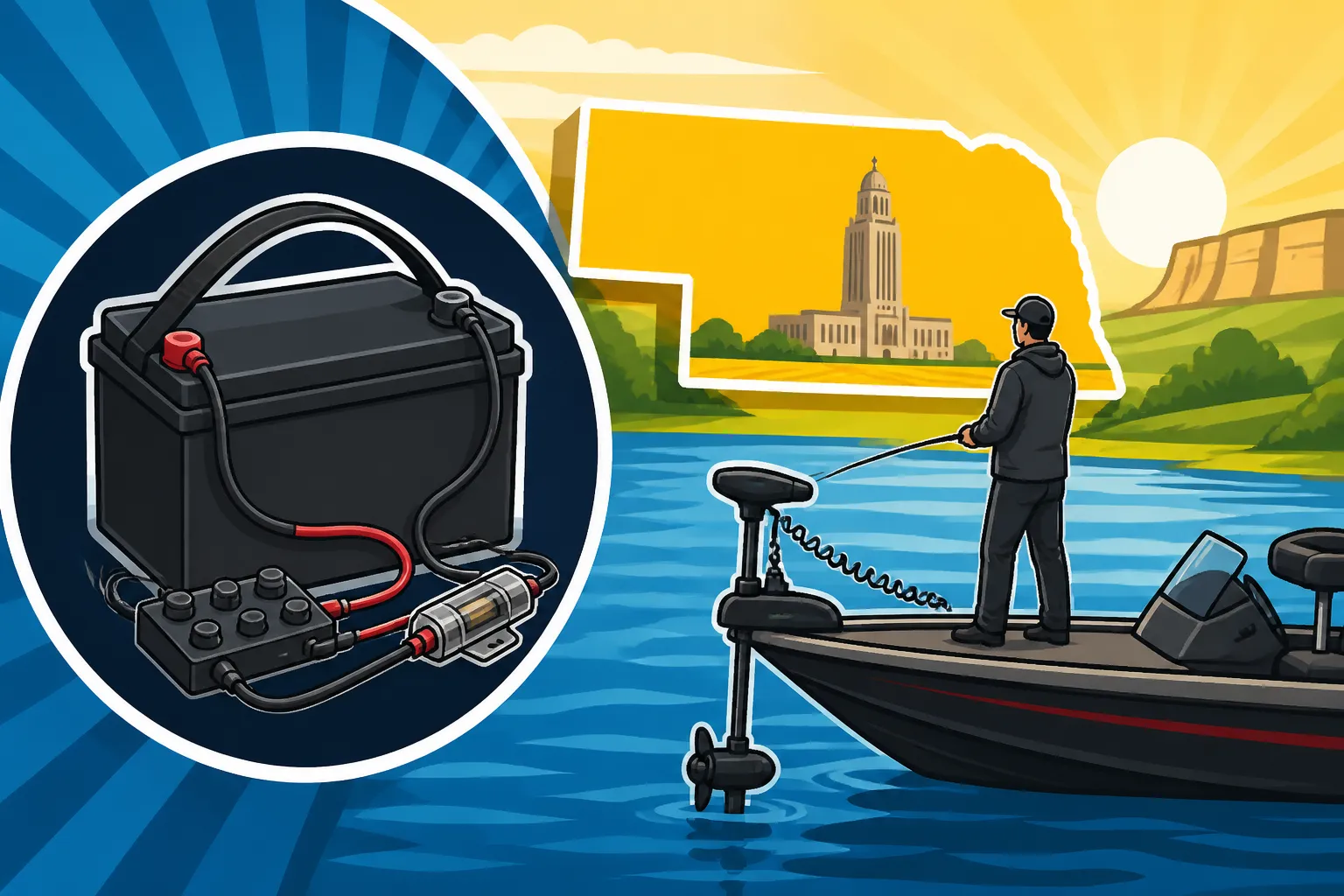
Best Trolling Motor Battery Setup for a Full Day of Fishing
One of the most common frustrations for any angler hitting the beautiful waters of Nebraska's lakes and rivers is a trolling motor that dies halfway through a prime fishing day. There's nothing worse than finding that perfect submerged structure or getting on a hot bite only to have your silent propulsion system give up the ghost. This comprehensive guide will walk you through everything you need to know to build the best trolling motor battery setup, ensuring you have enough juice to fish from sunup to sundown, even when the wind kicks up on Lake McConaughy.
Understanding Your Trolling Motor's Power Needs
Before you even think about buying batteries, you need to understand how much power your trolling motor actually consumes. Many anglers just grab whatever battery is on sale, only to find themselves paddling back to the ramp prematurely. A "full day of fishing" means different things to different people and different trolling motors. Are you just occasionally nudging your boat into position, or are you fighting strong winds and current for hours on end?
Calculating Amp-Hour Requirements
Your trolling motor's power draw is typically measured in amps (A) at full thrust. Batteries are rated in amp-hours (Ah), which essentially tells you how many amps a battery can deliver for a certain number of hours. To figure out what you need, you first need to know your motor's maximum amp draw, which is usually listed in its specifications.
For example, a typical 12V trolling motor might draw 40-50 amps at maximum thrust. If you plan to run it at full power for an hour, you'll use 40-50 Ah. But let's be realistic – most of us don't run at full throttle all day. We use it intermittently, adjusting speed as needed. A good rule of thumb for average use might be to estimate your motor draws about 50% of its maximum amp draw for the hours you expect to be actively using it. So, if your motor maxes out at 50 amps, and you expect to be "on" the trolling motor for 6 hours throughout an 8-hour fishing trip, you might calculate (50 amps / 2) * 6 hours = 150 Ah.
However, lead-acid batteries (which we'll discuss soon) shouldn't be discharged below 50% of their capacity if you want them to last. This means if you need 150 Ah, you'd actually need a battery or battery bank with a total usable capacity of 300 Ah. This is a critical point many anglers miss! Always size up your battery bank to avoid deep cycling your batteries and shortening their lifespan. Consider the demands of fishing larger, windier lakes like Harlan County Reservoir or Lewis and Clark Lake, where you might need to lean on your motor more than on a calm farm pond.
Factors Affecting Power Consumption
Several factors will chew through your battery life faster than you might expect. Wind is a huge one; trying to hold position against a stiff breeze means your motor is working harder. If you're fishing on Best Boat for Fishing Lake McConaughy in Wind, you know this struggle well. Current in rivers like the Platte River or Missouri River also demands more power. The size and weight of your boat play a role, too; a heavier boat requires more thrust to move.
Additionally, factors like water temperature (cold batteries perform slightly less efficiently) and the condition of your propeller (a bent or fouled prop reduces efficiency) can subtly impact consumption. Even the type of fishing you're doing matters – slow trolling for walleye across a large flat will draw power continuously, whereas sporadic use for bass fishing around cover will have different demands.
Types of Batteries for Trolling Motors
Now that you have a better handle on your power needs, let's talk about the different kinds of batteries available. Each has its pros, cons, and a price point that will influence your decision.
Lead-Acid Batteries Deep Cycle, AGM, and Gel
Traditional lead-acid batteries have been the workhorse of trolling motor setups for decades. Within this category, you'll primarily find "deep cycle" batteries, which are designed to be discharged and recharged many times, unlike starting batteries that provide a short burst of high current.
-
Flooded Deep Cycle Batteries: These are your most affordable option. They contain liquid electrolyte that requires maintenance, specifically checking water levels and topping them off with distilled water periodically. They are robust but heavier, can vent corrosive gases, and need to be kept upright. While budget-friendly, their lifespan can be shorter if not properly maintained, and their usable capacity is typically only 50% of their rated capacity to ensure longevity. You can often find these at local automotive or marine stores, and sometimes through large retailers like Walmart.
-
Absorbed Glass Mat (AGM) Batteries: A step up from flooded batteries, AGMs use a fiberglass mat to absorb the electrolyte, making them maintenance-free and spill-proof. They can be mounted in various positions, charge faster, and tolerate deeper discharges better than flooded batteries (though still aiming for 50% discharge is best for lifespan). They are more expensive than flooded batteries but offer better performance and durability. Many anglers consider AGMs a great balance between cost and performance for a reliable day on the water.
-
Gel Cell Batteries: Similar to AGMs in being sealed and maintenance-free, gel cells use a silica gel to suspend the electrolyte. They are very resistant to vibration and extreme temperatures. However, they typically have lower peak current capabilities, charge slower, and are more sensitive to overcharging than AGMs, making them generally less common for trolling motor applications where high draw can be a factor.
Lithium-Ion (LiFePO4) Batteries
This is where battery technology has really leaped forward for anglers. Lithium Iron Phosphate (LiFePO4) batteries are the premium choice for trolling motors, and for good reason. They offer a host of advantages that can completely change your fishing experience, although they come with a higher upfront cost.
The biggest benefit of LiFePO4 batteries is their usable capacity. You can safely discharge them down to 80-100% of their rated capacity without significant impact on their lifespan. This means a 100Ah LiFePO4 battery can provide nearly twice the usable energy of a 100Ah lead-acid battery. They are also incredibly lightweight – often half to a third the weight of a comparable lead-acid battery, which can make a huge difference in boat performance and fuel efficiency, especially for smaller boats. Imagine less weight in the back of your jon boat on the Elkhorn River!
LiFePO4 batteries also boast a much longer lifespan, often 5-10 times that of lead-acid batteries, meaning they pay for themselves over time. They deliver consistent power output throughout their discharge cycle, unlike lead-acid batteries which tend to fade as voltage drops. Their charging is faster, and they require no maintenance. Brands like Battle Born, Dakota Lithium, and Relion are popular choices, often available through marine specialty shops or online retailers like Amazon and Bass Pro Shops. If you're looking for Best Gear Upgrades for a Serious Nebraska Angler, a lithium battery setup is often at the top of the list.
Choosing the Right Battery Setup
Deciding on the best battery setup involves more than just picking a battery type; you need to consider your trolling motor's voltage, how you'll wire multiple batteries, and the practicalities of space and budget.
Matching Battery Voltage to Trolling Motor Voltage
Trolling motors come in 12V, 24V, and 36V configurations. It's absolutely crucial that your battery setup matches your motor's voltage. Trying to run a 24V motor on a 12V battery will provide insufficient power, and connecting a 12V motor to a 24V supply can damage it.
- 12V Systems: Common on smaller boats and motors with lower thrust (e.g., 30-55 lbs thrust). Usually requires one 12V battery.
- 24V Systems: Found on mid-sized boats and motors (e.g., 70-80 lbs thrust). Requires two 12V batteries wired in series.
- 36V Systems: Typically used on larger boats, bass boats, and high-thrust motors (e.g., 100+ lbs thrust) that demand maximum power for long periods. This setup requires three 12V batteries wired in series. If you're running a powerful motor on a larger rig, like those popular for Walleye Fishing in Nebraska on Lake McConaughy, a 36V system is often essential.
Series vs. Parallel Wiring
When you have multiple batteries, how you connect them dictates the output voltage and capacity.
-
Series Wiring (for increased voltage): To increase voltage, you connect the positive terminal of one battery to the negative terminal of the next. For example, two 12V batteries in series create a 24V system. The total amp-hours remain the same as a single battery.
- Example for 24V: Connect the positive (+) of Battery 1 to the negative (-) of Battery 2. Your trolling motor then connects to the remaining negative (-) of Battery 1 and the remaining positive (+) of Battery 2.
- Example for 36V: Connect (+) of Battery 1 to (-) of Battery 2, and (+) of Battery 2 to (-) of Battery 3. Your motor connects to the remaining (-) of Battery 1 and (+) of Battery 3.
-
Parallel Wiring (for increased capacity/amp-hours): To increase amp-hours while keeping the voltage the same, you connect positive to positive and negative to negative. This is useful if you have a 12V motor but need significantly more run time.
- Example for more 12V capacity: Connect the positive (+) of Battery 1 to the positive (+) of Battery 2. Connect the negative (-) of Battery 1 to the negative (-) of Battery 2. Your trolling motor connects to either battery's positive and negative terminals. This effectively doubles your amp-hour capacity at 12V.
It's absolutely vital to use proper gauge wiring for all connections and ensure all terminals are clean and tight to prevent power loss or potential hazards. Always use marine-grade battery terminals and covers for safety.
System Configuration Comparison
Here's a quick look at common battery configurations:
| Configuration | Motor Voltage | Batteries Required | Wiring Type | Benefits | Considerations |
|---|---|---|---|---|---|
| Single 12V | 12V | 1x 12V | N/A | Simplest, lightest, cheapest initial cost | Limited run time for higher thrust motors |
| Dual 12V | 24V | 2x 12V | Series | Good balance of power and run time | Added weight, more wiring than single 12V |
| Triple 12V | 36V | 3x 12V | Series | Maximum power and longest run time | Significant weight, highest cost, most space needed |
| Dual 12V Parallel | 12V | 2x 12V | Parallel | Doubles 12V capacity, extended run time | More space than single 12V, still 12V output |
| Single Lithium | 12V, 24V, or 36V | 1x (matching voltage) | N/A | Lightweight, long life, deep discharge | Highest upfront cost, specific charging needs |
Weight, Cost, and Space Considerations
The choice ultimately comes down to a balance of these three factors.
- Weight: This is where lithium batteries truly shine. Reducing hundreds of pounds from your boat can improve top speed, fuel economy, and how your boat handles, especially on plane. For serious anglers or those with smaller boats, the weight savings can be a game-changer.
- Cost: Lead-acid batteries are much cheaper upfront. A comparable LiFePO4 battery might cost several times more. However, when you factor in the longer lifespan (5-10 years for lithium vs. 2-4 for lead-acid) and the ability to use more of its rated capacity, lithium can be more cost-effective over its lifetime. Think about how many times you'd replace lead-acid batteries over a decade.
- Space: Three large lead-acid batteries take up a considerable amount of room and add significant weight. If your boat has limited battery compartments, this can be a real issue. Lithium batteries, being smaller and lighter, often make it easier to fit a high-capacity system into tight spaces. Always ensure your battery compartment offers proper ventilation, especially for flooded lead-acid batteries, and that all Nebraska Boat Safety Equipment Requirements are met, including securing batteries to prevent shifting.
Before making a purchase, measure your available battery compartment space. Consider what type of boat you have – whether it's a dedicated bass boat or a multi-species fishing boat, and factor in how much Best Trolling Motor Thrust for a Bass Boat you require for your typical fishing conditions.
Maintenance and Charging for Longevity
Investing in a quality battery setup is only half the battle. Proper maintenance and charging habits are crucial for maximizing your battery's lifespan, regardless of whether you choose lead-acid or lithium.
Charging Best Practices
Using the correct charger is paramount. For lead-acid batteries, a "smart charger" designed for deep cycle batteries is highly recommended. These chargers often have multiple stages (bulk, absorption, float) to charge efficiently without overcharging. If you're using flooded batteries, check the water levels before charging to prevent plates from being exposed. Never use a car battery charger for a deep cycle marine battery, as they have different charging profiles and can damage your deep cycle battery.
For lithium (LiFePO4) batteries, you must use a charger specifically designed for LiFePO4. These batteries have different voltage requirements and charging algorithms. While some modern smart chargers might have a "lithium mode," always verify it's compatible. Using an incompatible charger can reduce efficiency, shorten battery life, or even be dangerous. Chargers from reputable brands like Minn Kota or Pro Charging Systems are excellent choices. Many marine retailers like Bass Pro Shops carry a wide selection of suitable chargers for both battery types.
It's also a good practice to charge your batteries fully after each use, especially with lead-acid batteries, rather than letting them sit in a discharged state. A partially discharged battery can begin to sulfate, which permanently reduces its capacity.
Winter Storage and Off-Season Care
When the Nebraska fishing season winds down and you start thinking about How to Ice Fish in Nebraska or How to Store Fishing Gear Over the Winter, your trolling motor batteries need special attention.
For lead-acid batteries, ensure they are fully charged before storage. If storing for extended periods (e.g., over winter), it's best to remove them from the boat, clean the terminals, and store them in a cool, dry place where they won't freeze. Periodically (every 4-6 weeks) check their voltage and top them off with a maintenance charge using a trickle charger, especially if they are flooded cell batteries. Freezing a discharged lead-acid battery can cause permanent damage, as the electrolyte becomes more like water when discharged.
Lithium batteries are much simpler for winter storage. They actually prefer to be stored at a partial charge (typically around 50-70%) rather than a full charge for maximum longevity. Most LiFePO4 batteries have an internal Battery Management System (BMS) that protects them from over-discharge, over-charge, and temperature extremes, making them very low-maintenance for storage. Just disconnect them from any loads and they'll be fine until spring. You won't need to babysit them with regular top-off charges like lead-acid.
Wiring and Connections
Finally, regularly inspect all your battery wiring and connections. Corrosion is the enemy of any marine electrical system. Check battery terminals, fuses, and connections at the trolling motor plug. Clean any corrosion with a wire brush and apply a dielectric grease or battery terminal protector to prevent future buildup. Loose or corroded connections can lead to power loss, reduced performance, and even create heat that could be a fire hazard. Ensure your wiring is properly secured and protected from chafing, especially when trailering your boat or bouncing around on choppy waters. For more general boating information, check out Nebraska Boat Registration and Equipment Requirements.
By taking the time to understand your power needs, choosing the right battery technology for your budget and fishing style, and diligently maintaining your setup, you'll ensure your trolling motor is always ready to take you to those hidden spots and hold you right over the fish, all day long.
Disclaimer
This article is for general informational purposes only and does not constitute professional advice. Laws, prices and regulations vary by location and change over time. Consult a qualified professional for guidance on your specific situation.