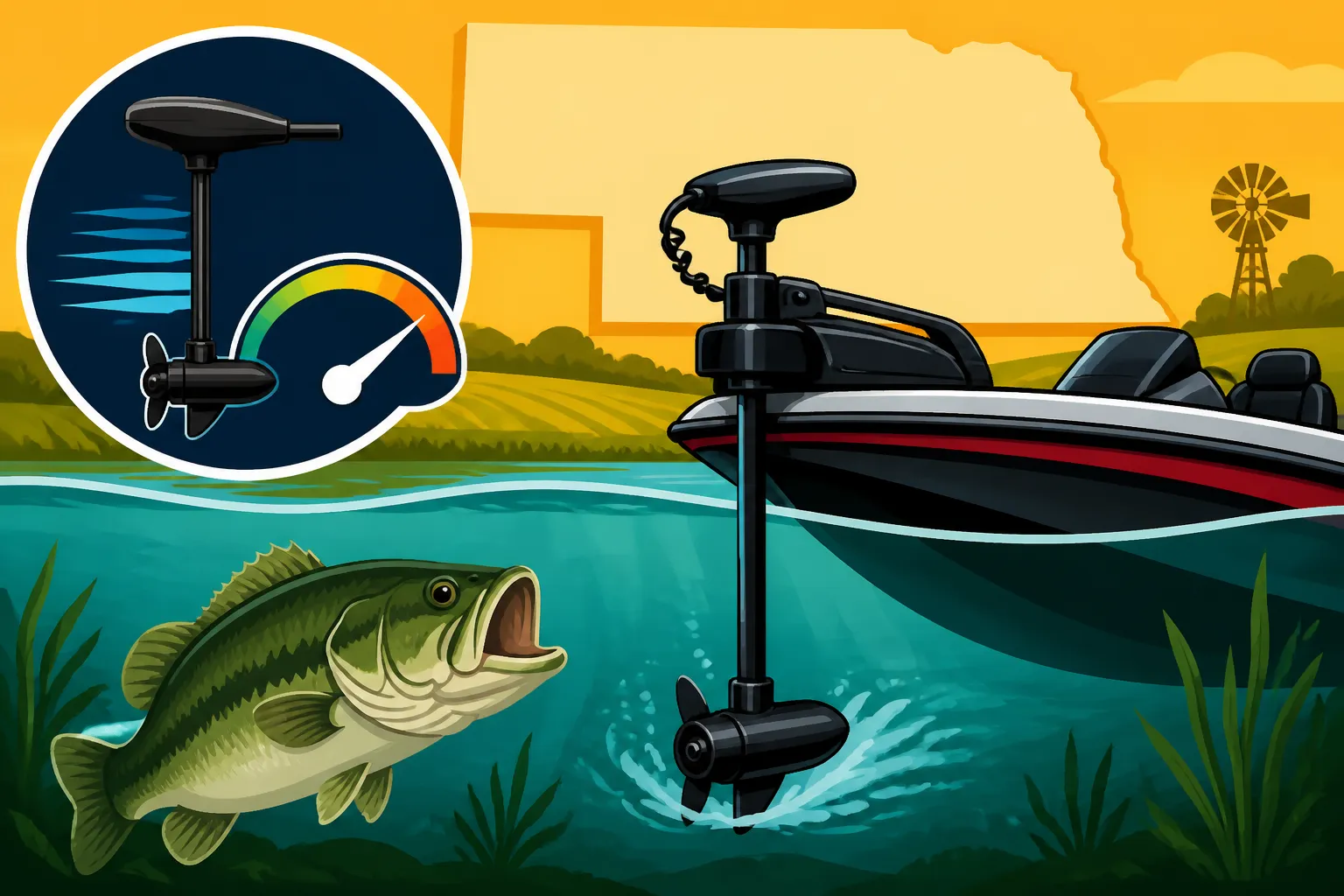
Best Trolling Motor Thrust for a Bass Boat
Navigating the world of trolling motors for your bass boat can feel like a daunting task, especially when you're trying to figure out how much "oomph" you actually need. Many anglers just grab whatever's on sale or what their buddy uses, only to find themselves fighting against strong winds on Lake McConaughy or struggling to hold position on a river current. This guide is here to cut through the confusion and help you determine the best trolling motor thrust for your bass boat, ensuring you have the power and control you need for a successful day out on Nebraska's waters.
Understanding Trolling Motor Thrust
Before we dive into recommendations, it's crucial to understand what trolling motor thrust actually means and why it's the most critical specification when choosing a motor for your bass boat. It's not just a number; it's the force that moves your boat, keeping you on that perfect casting line or battling a strong gust.
What is "Thrust" in a Trolling Motor?
At its simplest, thrust is the amount of pushing or pulling power a trolling motor can generate. It's measured in pounds (lbs). Think of it like this: if you have a 50 lb thrust motor, it means the motor can generate 50 pounds of force to move your boat through the water. This force is what directly counteracts drag from the water, wind resistance, and currents. The higher the thrust rating, the more power the motor has. It's powered by an electric motor, drawing energy from your boat's battery system. The voltage (12V, 24V, 36V) is closely tied to the thrust, with higher thrust motors typically requiring higher voltage systems to deliver that sustained power.
Why Thrust Matters for Bass Boats
For bass anglers, a trolling motor isn't just an accessory; it's a primary tool. It allows for silent, precise boat positioning, which is absolutely critical for presenting baits effectively without spooking fish. Insufficient thrust means you'll be constantly fighting the elements, struggling to stay on a brush pile at Branched Oak Lake or drift along a promising channel on the Platte River. Your boat will be pushed off course by wind or current, forcing you to overwork the motor, drain your batteries faster, and ultimately reduce your fishing efficiency and enjoyment.
On the other hand, while it might seem like more thrust is always better, excessive thrust can also have drawbacks, mainly relating to cost, weight, and battery consumption. A motor with far more thrust than you need might be heavier, take up more bow space, and require a more complex, heavier battery setup than necessary. It's about finding that sweet spot where you have ample power without unnecessary excess, optimizing for performance, battery life, and overall boat setup.
Factors Influencing Your Thrust Needs in Nebraska
Nebraska's diverse fishing environments, from vast reservoirs to winding rivers and countless farm ponds, mean that a one-size-fits-all approach to trolling motor thrust simply won't work. Several key factors play a significant role in determining how much thrust your bass boat truly needs.
Boat Weight and Length
This is arguably the most fundamental factor. A heavier boat requires more force to move and hold its position. When considering "boat weight," you're not just thinking about the boat itself. You need to account for the total weight when fully loaded: the boat, motor, fuel, all your fishing gear (tackle boxes, rods, coolers), batteries, and, of course, yourself and any fishing partners.
- Lighter Bass Boats (Under 17 feet, ~1,500 lbs loaded): For smaller aluminum bass boats or lightweight fiberglass models, you'll generally need less thrust. These boats don't have as much mass to overcome, so they respond well to moderate power.
- Standard Bass Boats (17-20 feet, ~2,000-3,000 lbs loaded): This is where most popular bass boats fall. These require a substantial amount of thrust to maintain control, especially when fully rigged with all the latest electronics, multiple batteries, and a livewell full of water.
- Larger Tournament-Style Bass Boats (20+ feet, 3,500+ lbs loaded): These beasts, often packed with gear and multiple anglers, demand the highest thrust ratings to ensure they can be maneuvered effectively and held precisely in demanding conditions.
A good starting point for calculating thrust is often cited as 2 pounds of thrust for every 100 pounds of fully loaded boat weight. However, this is just a baseline and needs adjustment for other factors.
Fishing Conditions: Wind and Current
Nebraska is known for its wind, and anyone who's fished Lake McConaughy or Harlan County Reservoir on a blustery day knows how quickly conditions can turn. Wind is the nemesis of trolling motor performance. A strong headwind or crosswind can render an underpowered motor almost useless, making it impossible to stay on a spot.
Similarly, fishing rivers like the Platte or Missouri River, even in calmer sections, introduces current as a constant force to contend with. If your motor doesn't have enough power to overcome the current, you'll be constantly swept downstream, unable to work a promising eddy or structure effectively. Always err on the side of caution and consider the worst-case wind and current scenarios you might encounter. A motor that performs adequately on a calm day might be utterly frustrating when the wind kicks up or you're fishing a strong current. This is why many experienced Nebraska anglers will opt for slightly more thrust than the minimum recommended.
Waterbody Types: Reservoirs, Rivers, and Ponds
The type of water you fish most frequently in Nebraska significantly impacts your thrust requirements.
- Large Reservoirs (e.g., Lake McConaughy, Merritt Reservoir, Lewis and Clark Lake): These expansive bodies of water are highly susceptible to wind and chop. They often feature deep structure and long runs where you'll need to cover ground or hold against strong gusts. High thrust is almost a necessity here to maintain control and keep your boat positioned precisely. You'll want to review Best Nebraska Lakes for Walleye or Lewis and Clark Lake Walleye Fishing to see how critical boat control is in these environments.
- Medium to Small Reservoirs and Lakes (e.g., Branched Oak Lake, Sherman Reservoir, Johnson Lake): While still prone to wind, these waters might not have the same open expanse as the largest reservoirs. However, holding on points, brush piles, or along shorelines against a breeze still demands good thrust. For these waters, a solid mid-to-high thrust motor is usually ideal. For specific advice, check out Branched Oak Lake Catfish Fishing or Sherman Reservoir Wiper Fishing.
- Rivers (e.g., Platte River, Missouri River, Niobrara River): Rivers present a constant current challenge. Even if the wind is calm, the current will test your motor's ability to hold your boat in place or move upstream. If you're planning on doing a lot of Platte River Catfish Fishing or targeting smallmouth on the Niobrara River Fishing, you'll definitely want to lean towards higher thrust options to maintain boat control and position.
- Farm Ponds and Smaller Urban Lakes (e.g., Holmes Lake, Standing Bear Lake): These typically smaller, more protected waters have minimal current and often less exposure to strong winds. For these scenarios, you can often get away with less thrust, especially if your boat is also on the smaller side. A moderate thrust motor is usually more than sufficient. You might be interested in Best Nebraska Urban Fishing Program Ponds for these kinds of spots.
Your Fishing Style and Usage
Your personal fishing style also plays a role in determining your ideal thrust.
- Casual Angler: If you're a casual angler who mostly fishes on calm days, typically in smaller, protected waters, you might not need the absolute top-tier thrust. You prioritize relaxation and don't necessarily need to battle every gust or current with aggressive maneuvers.
- Tournament Angler / Serious Enthusiast: If you're hitting the water every chance you get, regardless of weather, or if you participate in bass tournaments, then maximizing boat control is paramount. You'll need higher thrust to stay on fish, make quick adjustments, and navigate challenging conditions. Losing a fish or precious minutes in a tournament because your boat drifts off target is not an option. You'll often be using features like spot-lock or anchor mode extensively, which benefit greatly from higher thrust capabilities, especially with heavier boats.
- Multi-Species Angler: If your bass boat doubles as a platform for chasing walleye, catfish, or crappie, your needs might shift. For instance, How to Fish for Walleye in Nebraska often involves trolling or holding against wind on large reservoirs, which demands similar high thrust as bass fishing. Catfish anglers on rivers will also appreciate the power to hold against current.
Calculating Your Ideal Trolling Motor Thrust
Now that we've looked at the variables, let's get down to the brass tacks of figuring out a good thrust number for your bass boat. While there's no single magic formula, a combination of guidelines and common sense will lead you to the right choice.
The General Rule of Thumb
A widely accepted starting point is to allow 2 pounds of thrust for every 100 pounds of fully loaded boat weight.
Here’s how to calculate your loaded boat weight:
- Boat Weight (dry): Check your boat's specifications.
- Outboard Motor Weight: Add this in.
- Fuel Weight: A gallon of gasoline is about 6 lbs. Calculate for your tank size.
- Battery Weight: Trolling motor batteries are heavy! A typical deep cycle marine battery can weigh 40-70 lbs. If you have two or three for a 24V or 36V system, that adds up quickly.
- Gear Weight: Estimate the weight of your tackle, rods, anchor, coolers (especially if they're full of ice and drinks), and safety equipment.
- Angler Weight: Add the weight of yourself and any usual fishing partners.
Example Calculation:
- Bass boat (dry): 1,200 lbs
- Outboard motor: 450 lbs
- Fuel (30 gallons): 180 lbs (30 * 6 lbs)
- Batteries (3 x 60 lbs): 180 lbs
- Gear: 150 lbs
- 2 anglers: 350 lbs (approx.)
- Total Loaded Weight: 2,510 lbs
Using the rule of thumb: 2,510 lbs / 100 lbs = 25.1. Then 25.1 * 2 lbs/100 lbs = 50.2 lbs of thrust.
This 50 lbs is your absolute minimum starting point.
Adjusting for Adverse Conditions
The "rule of thumb" gives you the thrust needed to move your boat in ideal, calm conditions. However, Nebraska is rarely "ideal and calm." This is where you need to add a significant buffer.
- Wind: If you frequently fish in windy conditions (which is common across Nebraska's plains and large reservoirs), you should add at least 20-30% more thrust to your calculated minimum. For a 50 lb minimum, this means jumping to 60-65 lbs.
- Current: If you spend a lot of time on rivers like the Missouri or Platte, battling current is a given. Again, adding 20-30% extra thrust will be invaluable.
- Boat Type: If you have a deep-V aluminum boat, it might catch more wind than a sleek fiberglass bass boat, even if the weight is similar. Consider the boat's profile.
- Frequent Use/Tournaments: If you're a serious angler who needs pinpoint control in all conditions, always opt for the higher end of your calculated range.
So, for our example above, if the minimum was 50 lbs, and you factor in typical Nebraska winds, you'd be looking at a minimum effective thrust requirement of 60-70 lbs. This leads us to the next section where we see popular thrust options.
Considering Battery Life and Efficiency
It's a common misconception that a higher thrust motor will always drain your batteries faster. While running a high-thrust motor at its maximum setting will indeed consume more power, you rarely need to run it at 100%. A higher thrust motor, when run at a lower percentage of its maximum power (say, 50% for an 80 lb thrust motor), can often be more efficient than a lower thrust motor (like a 50 lb thrust motor) being constantly run at 80-90% power to achieve the same boat speed or hold position.
The key is that a higher thrust motor provides a greater reserve of power. This means it doesn't have to work as hard to perform routine tasks, potentially leading to longer battery life on a typical fishing day. Just make sure your battery system (12V, 24V, 36V) is appropriately matched to the motor and that you're using good quality deep-cycle marine batteries. When looking at options, you can often find great deals on batteries and chargers at places like Bass Pro Shops or even online at Amazon. Knowing how to match your motor to your battery system is crucial for a full day on the water, especially when pursuing Nebraska Annual Fishing Permit goals.
Popular Trolling Motor Thrust Ranges for Bass Boats
Let's break down the common thrust ranges and who they're typically best for, keeping Nebraska's fishing conditions in mind. Remember, the goal is not just to move, but to control your boat effectively.
Low to Mid-Range Thrust (50-70 lbs)
This range is generally suitable for smaller, lighter bass boats or those who primarily fish calm, sheltered waters.
- Ideal for:
- Smaller aluminum jon boats or bass boats (14-16 feet)
- Boats that weigh less than 2,000 lbs fully loaded
- Anglers who mostly fish farm ponds, smaller urban lakes (like Holmes Lake Fishing in Lincoln), or very calm river sections.
- Those who avoid fishing in strong winds or currents.
- Pros:
- More affordable initial cost.
- Often lighter motors, easier to deploy and store.
- Typically runs on a single 12V battery system, simplifying wiring and reducing battery weight/cost.
- Cons:
- Struggles significantly in wind, strong currents, or choppy water.
- May not hold position well with GPS Spot-Lock features on larger boats in adverse conditions.
- Battery might drain quicker if constantly running at high speeds to compensate for lack of power.
- Real-world scenario: You have a 16-foot aluminum Tracker boat that you primarily use on a small private pond near Grand Island or for casual fishing at Fremont Lakes State Recreation Area on calm mornings. A 55-pound thrust motor (which typically runs on 12V) might be perfectly adequate for these conditions, allowing you to quietly maneuver around docks and weed beds without issue.
Mid to High-Range Thrust (80-100 lbs)
This is the sweet spot for many standard bass boats and is often the most recommended range for anglers who fish a variety of waters, including medium to large Nebraska reservoirs.
- Ideal for:
- Most fiberglass bass boats (17-20 feet)
- Heavier aluminum bass boats (17-19 feet)
- Boats weighing between 2,000 lbs and 3,000 lbs fully loaded.
- Anglers who frequently fish larger lakes like Branched Oak, Sherman, or Johnson Lake, and occasionally venture onto bigger waters like Harlan County Reservoir or Lewis and Clark.
- Those who expect to encounter moderate winds and currents.
- Anglers who rely on GPS features like Spot-Lock for precise boat positioning.
- Pros:
- Excellent balance of power, control, and battery efficiency for most conditions.
- Provides sufficient power to battle moderate winds and currents, allowing for better boat control.
- Often available in 24V systems, offering good battery life for a full day of fishing.
- A good choice if you're targeting Walleye Fishing in Nebraska on larger bodies of water where boat control is paramount.
- Cons:
- Requires a 24V (or sometimes 36V) battery system, meaning more batteries, more weight, and more complex wiring than 12V.
- Higher initial cost than lower thrust options.
- Real-world scenario: You own a 19-foot Bass Cat or Ranger bass boat and regularly fish tournaments on Lake McConaughy or Merritt Reservoir. You know Nebraska winds can pick up fast, and you need to hold your boat precisely over submerged humps or along rocky shorelines. An 80-pound or 100-pound thrust motor (typically 24V or 36V) will give you the confidence to do this effectively, even when the weather isn't cooperating. This kind of setup will serve you well when you're trying How to Fish Deep Structure for Summer Walleye.
High-End Thrust (112+ lbs)
This category is for the largest bass boats, competitive anglers, or those who fish massive, open waters prone to extreme conditions.
- Ideal for:
- Largest fiberglass bass boats (20-22+ feet)
- Boats weighing 3,000 lbs or more fully loaded.
- Anglers who fish consistently on vast, open waters like the Missouri River or the largest sections of Lewis and Clark Lake, where strong winds and currents are always a factor.
- Tournament professionals who demand absolute maximum control and performance in all scenarios.
- Pros:
- Unmatched power and control, even in the harshest conditions.
- Excellent for maintaining precise GPS positioning (Spot-Lock) on very large boats in heavy wind/chop.
- Offers significant power reserves, meaning the motor doesn't have to work as hard, potentially extending battery life if you have the right battery bank.
- Cons:
- Highest initial cost for the motor itself and the required 36V battery system.
- Heavier motor, adding weight to the bow of your boat.
- Requires a 36V battery system (three deep-cycle batteries), which means substantial weight and a larger upfront investment in batteries and a compatible charger.
- Real-world scenario: You're a serious tournament angler running a 21-foot Skeeter or Phoenix bass boat. You're out on the water year-round, regardless of a stiff 20 mph breeze or strong current. Your boat is loaded with gear, multiple livewell pumps, and advanced electronics. A 112-pound thrust, 36V trolling motor is essential to ensure you can stay on those precise fishing spots and maneuver your large vessel with authority, allowing you to dominate in varied conditions.
Here's a quick reference table to help visualize the recommendations:
| Boat Length (feet) | Estimated Loaded Weight (lbs) | Primary Water Type | Recommended Minimum Thrust (lbs) | Recommended Voltage | Considerations |
|---|---|---|---|---|---|
| Up to 16 | < 2,000 | Small lakes, ponds | 50-60 | 12V | Good for calm days, lighter boats. |
| 17-18 | 2,000-2,500 | Medium lakes, some rivers | 70-80 | 24V | Solid all-around for varied conditions. |
| 19-20 | 2,500-3,500 | Large reservoirs, rivers | 80-100 | 24V or 36V | Excellent control in most Nebraska conditions, popular choice. |
| 21+ | 3,500+ | Very large reservoirs, strong rivers | 112+ | 36V | Maximum power for heavy boats, extreme conditions, tournament anglers. |
Ultimately, choosing the best trolling motor thrust for your bass boat is an investment in your fishing success and enjoyment. By carefully considering your boat's characteristics, the typical conditions on your favorite Nebraska fishing spots, and your personal fishing style, you can select a motor that will serve you well for years to come. Don't be afraid to overcompensate slightly for wind and current; it's always better to have a little more power than you need than not enough. Happy fishing!
Disclaimer
This article is for general informational purposes only and does not constitute professional advice. Laws, prices and regulations vary by location and change over time. Consult a qualified professional for guidance on your specific situation.