How to Set the Hook on a Catfish Bite
Oh, the sheer frustration of feeling that strong, unmistakable tug on your line, setting the hook with all your might, only to reel in… nothing. Just a bare hook, perhaps a bit of slime, and the crushing realization that a fat Nebraska catfish just got away. It’s a common scenario for many anglers, myself included, and it leaves you wondering: what exactly am I doing wrong? This guide is here to unravel the mysteries of the catfish bite, helping you understand their unique behaviors and master the perfect hook set to land more of those whiskered beauties.
Understanding the Catfish Bite: The Signals You're Receiving
Before you even think about setting the hook, you need to understand what a catfish bite actually feels like. Unlike the sharp, aggressive strike of a bass or the subtle peck of a panfish, a catfish bite can be incredibly varied, sometimes gentle and sometimes like a freight train. Learning to read these signals is the first crucial step to connecting.
The Nuances of a Catfish's Take
Catfish aren't always looking for a fight right away. They're often scavengers, preferring to mouth or "test" their food before committing. This means you might feel a series of light taps or bumps on your line, almost like weeds or a small fish nibbling. This is especially true for channel catfish, which are abundant across Nebraska's lakes and rivers. If you pull back too early on these initial bumps, you'll likely pull the bait right out of their mouth. On the other hand, a large flathead might just slowly pick up the bait and start swimming away, creating a steady, heavy drag on your line. You might not feel a "thump" at all, just a continuous bend in your rod.
Consider a scenario on the Platte River, where the current can mask subtle bites. You might be drifting a piece of cut bait near a log jam. Suddenly, your line feels heavy, not a snag, but a persistent pull. That's often a flathead carefully moving off with your offering. If you're fishing a still reservoir like Branched Oak Lake with stink bait for channel cats, you might see your rod tip bouncing erratically for a few seconds before it slowly doubles over. Each species and even individual fish can have its own personality when it comes to taking a bait, so being observant is key. Understanding these differences is vital when you're looking at How to Catch Catfish in Nebraska and trying to increase your success rate.
Factors Influencing Bite Behavior
Several things can change how a catfish bites. Water temperature, for instance, plays a huge role. In colder water, catfish tend to be more sluggish, and their bites will often be softer and more tentative. During the warmer months, especially in the evening or night, they can be much more aggressive. The type of bait you're using also matters. A strong, smelly bait like chicken liver or prepared "stink bait" might encourage a more confident take, as the fish can locate it easily and is less wary. Fresh cut bait, on the other hand, might prompt a more cautious approach as the fish assesses its "liveliness."
Current is another major factor, particularly in rivers like the Missouri or Elkhorn. In strong currents, catfish will often position themselves downstream of structure, waiting for food to drift to them. Their bites might be harder to detect against the drag of the current on your line. Conversely, in calm waters, every little bump and twitch will be more pronounced. Your line setup can also affect how you feel the bite; a slack line will absorb a lot of the initial sensation, while a taut line will transmit even the slightest disturbance. This highlights the importance of matching your setup to the conditions, a detail often discussed in guides like Best Bait for Nebraska Catfish.
The Right Tools for the Job: Rods, Reels, and Hooks
Your gear isn't just about hauling in a big fish; it's intricately linked to how you detect bites and, more importantly, how effectively you set the hook. Having the right rod, reel, and hook combination can make all the difference between a missed opportunity and a successful catch.
Rod Action and Sensitivity
For catfish, you generally want a rod with a medium-heavy to heavy power rating and a moderate to fast action. The "power" refers to how much force it takes to bend the rod, which you need for fighting large fish. The "action" describes where along the blank the rod bends. A moderate action rod will bend more through the middle, offering a bit more flexibility. This can be great for absorbing the initial tugs of a catfish, preventing you from pulling the bait away too quickly, and providing enough backbone for a solid hook set. A fast action rod bends mostly near the tip, offering excellent sensitivity for detecting those subtle bites, but can be less forgiving if you set the hook too aggressively on a tentative fish.
Imagine you're fishing for trophy channel cats in Harlan County Reservoir. A medium-heavy, moderate-fast action rod would allow you to feel those gentle bumps while still having the power to drive a large hook into a tough catfish mouth. If you're targeting massive flatheads in the deeper holes of the Niobrara River, a heavy-power, fast-action rod might be more appropriate to handle powerful runs and ensure a strong hook set. Many excellent options are available online, and checking out what's offered on Amazon can give you a good idea of the range of specialized catfish rods out there. To deep dive into this, you might want to read Best Rod Setup for Nebraska Catfish.
Reel Choice and Line Management
Your reel's primary job is to hold your line and retrieve your catch, but it also plays a role in the hook set. For catfish, a strong baitcasting reel is often preferred for its power and ability to handle heavy lines and big fish. Spinning reels can also work well, especially for lighter setups or for casting smaller baits. The key is to have a smooth, reliable drag system, which will allow the fish to take line without breaking off, especially during those powerful initial runs.
Line choice is equally critical. Monofilament line has some stretch, which can be forgiving but might dampen bite detection. Braided line, with its near-zero stretch, offers incredible sensitivity, transmitting even the lightest tap directly to your hands. This is why many experienced catfish anglers swear by braided line, especially when targeting larger species or fishing in deeper water. However, braided line requires a slightly different hook set, as its lack of stretch means less "give" and a more direct transfer of power. If you're looking to upgrade your line, Best Braided Line for Catfish Fishing offers a great breakdown of options. Keeping your line free of twists and kinks, and checking it regularly for abrasion, also contributes significantly to your ability to feel bites and make solid connections.
Hook Selection: Size, Style, and Sharpness
This is where many anglers miss the mark. The right hook is paramount for a good hook set. For catfish, especially channel cats, circle hooks are incredibly popular, and for good reason. A circle hook is designed to set itself in the corner of the fish's mouth as the fish swims away, reducing gut-hooking and making for easier, safer releases. With a circle hook, the traditional "snap-back" hook set isn't usually necessary; instead, you simply let the fish take the bait, and when the rod loads up, you begin reeling steadily. The hook does the work.
For flatheads or when using very large baits, a J-hook might be preferred by some. If you opt for J-hooks, make sure they are incredibly sharp and appropriately sized for your bait. A dull hook will not penetrate the tough, cartilaginous mouth of a catfish, no matter how hard you set it. Regularly check your hooks for sharpness and replace them often. Many anglers find it useful to keep a hook file handy. When browsing for hooks, especially for unique or larger sizes, check out the extensive selection on Amazon to find exactly what you need. Dive deeper into specific types with Best Circle Hooks for Catfish Fishing.
| Hook Type | Ideal Bite Detection | Hook Set Technique | Advantages | Disadvantages |
|---|---|---|---|---|
| Circle Hook | Sustained pull/bend | Reel steadily into fish | Minimizes gut-hooking, often sets itself, good for releasing fish | Can be missed if angler strikes too early |
| J-Hook (Offset) | Hard pull/run | Sharp, deliberate snap | Good penetration with strong strike, versatile for various baits | Higher risk of gut-hooking if fish swallows bait deeply |
| Treble Hook | Any clear bite | Firm, upward sweep | Multiple points for hooking, good for aggressive biters | Can damage fish more, harder to remove, less common for catfishing |
Mastering the Hook Set: Techniques for Every Situation
Now that you understand the bite and have the right gear, let's talk about the actual mechanics of setting the hook. It's not a one-size-fits-all approach; different scenarios call for different tactics.
The "Reel and Lean" for Circle Hooks
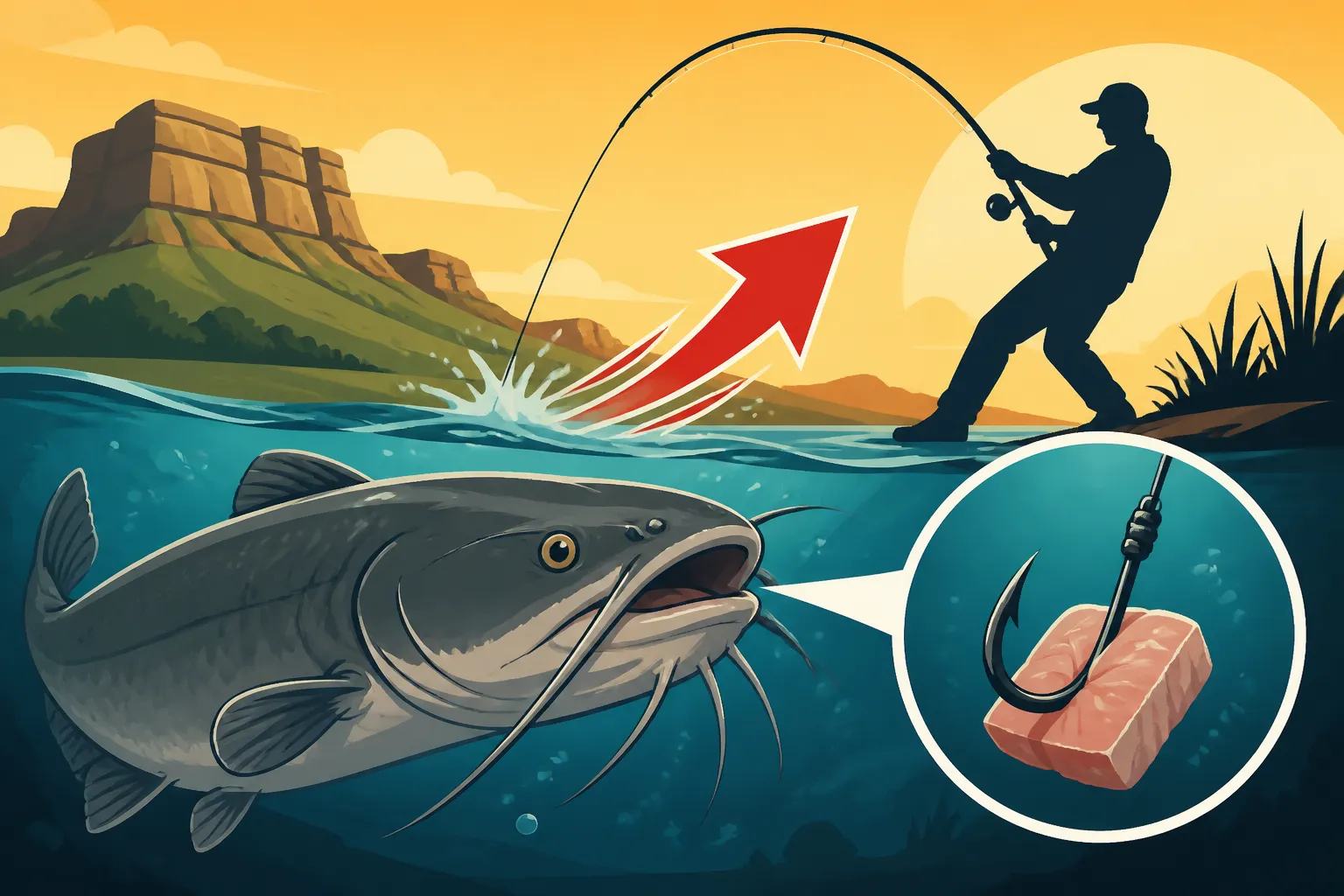
If you're using circle hooks, which I highly recommend for most catfishing, your hook set is going to be less about a violent snap and more about a steady application of pressure. When you feel a definitive pull or your rod starts to bend steadily, resist the urge to rear back on the rod. Instead, simply start reeling slowly and steadily, taking up any slack in the line. As the line tightens, gently lift your rod tip and lean into the fish. The circle hook will naturally rotate and embed itself in the corner of the catfish's mouth.
This technique is incredibly effective for channel catfish and often for smaller flatheads as well, especially when you're fishing with baits like shrimp, worms, or even prepared dough baits. The self-setting nature of the circle hook means less chance of pulling the bait away prematurely and a much higher chance of a clean, lip-hooked fish. This is particularly useful when you're rigged for something like How to Rig Cut Bait for Channel Catfish. Patience is truly a virtue with circle hooks; let the fish commit, and the hook will do its job.
The "Sweep and Drive" for J-Hooks
If you're using traditional J-hooks (offset hooks are a common choice for bigger baits and flatheads), your hook set needs to be more assertive. When you feel that solid, unmistakable pull, or if your rod doubles over, quickly take up any slack in your line by reeling down until you feel direct contact with the fish. Then, with a strong, sweeping motion, pull your rod tip up and away from the fish, driving the hook home. It's not just a flick of the wrist; it's a powerful, deliberate movement that uses the flex of your rod to sink the hook.
This method is often preferred by anglers targeting large flathead catfish, especially when fishing with large live baits at night. Since flatheads often engulf their prey, a strong, immediate hook set with a J-hook is necessary to penetrate their tough mouths before they swallow the hook too deeply. When learning How to Catch Flathead Catfish at Night, you'll find that a quick reaction time is key. Remember to keep your rod tip high and maintain pressure once the hook is set. This prevents the fish from shaking the hook loose during the fight.
Adapting to Different Fishing Styles
Your hook set technique might also need to change based on your fishing method. If you're bank fishing, for example, and your rod is in a rod holder, you might be waiting for the rod to really double over before you grab it and begin your hook set. In this case, a circle hook excels, allowing the fish to run a bit before the hook engages. For more active fishing, like drift fishing from a boat, you might have the rod in hand, allowing for a quicker response to even subtle bites.
When you're engaged in something like How to Fish Overnight for Catfish, especially with multiple rods out, you often rely on visual cues from your rod tips or audible cues from bite alarms. In these situations, the "reel and lean" with circle hooks is often the most forgiving, as you don't need to be right on the rod at the exact moment of the bite. Conversely, if you're actively casting and retrieving, trying to entice a bite, you'll be more attuned to direct tactile feedback and can employ a more aggressive J-hook strike if that's your preferred setup.
Common Mistakes and How to Avoid Them
Even seasoned anglers sometimes fall into bad habits or make common mistakes when trying to set the hook on catfish. Recognizing these pitfalls can significantly improve your hook-up ratio and prevent that familiar feeling of disappointment.
Premature Hook Sets
This is probably the most common mistake in catfishing. You feel a bump, your heart leaps, and you immediately try to set the hook. Unfortunately, often the catfish is just mouthing the bait, nudging it, or even just bumping your line without the hook fully in its mouth. A premature hook set usually results in you pulling the bait away from the fish before it has a chance to take it completely.
To avoid this, especially with channel catfish, develop a bit of patience. When you feel those initial taps or bumps, resist the urge to strike. Instead, wait for a more consistent pull, a steady bend in the rod, or for your line to start moving deliberately away. This is particularly important when you're using smaller hooks or fishing with baits that might be easily "stolen." Give the fish a moment to really commit to the bait. This principle is fundamental to successful Channel Catfish Fishing in Nebraska.
Insufficient Hook Set Power or Technique
On the flip side, some anglers might not put enough power into their hook set, especially when using J-hooks. A catfish's mouth can be tough and cartilaginous, requiring a firm, authoritative strike to ensure the hook penetrates properly. A weak or half-hearted hook set might only prick the fish, leading to it throwing the hook during the fight.
Make sure you're positioned well, with your feet planted, and use your entire body to drive the hook home, not just your arms. It's a quick, powerful sweep. Also, ensure there's no slack in your line before you strike. Reeling down until you feel tension is crucial. If you're using braided line, remember its lack of stretch means every bit of force is transmitted directly, so you might not need quite as much physical effort as with mono, but the decisive motion is still essential. This is also important for landing those elusive big ones when Flathead Catfish Fishing in Nebraska.
Incorrect Gear for the Situation
Trying to set a hook on a big flathead with a flimsy panfish rod or an undersized hook is a recipe for disaster. The rod won't have the backbone to drive the hook, and the hook itself might bend or break. Conversely, using a heavy-duty surf rod for small channel cats might mean you're so overpowered that you can't feel the subtle bites.
Always match your gear to the target species and the size of the bait you're using. If you're using a large piece of cut bait on a heavy setup, you'll need a stout hook and a powerful rod. For lighter presentations, a more sensitive rod and appropriately sized hooks will serve you better. Don't be afraid to experiment with different setups. When considering your overall setup, guides like Best Fishing Gear for Nebraska Anglers can offer comprehensive advice. Remember, good gear is an investment in your fishing success, and many anglers start by searching for their ideal setup on platforms like Amazon.
Not Re-checking Your Bait
Sometimes, you might feel a bite, strike, and come up empty. What happened? Often, a catfish has managed to pull your bait off the hook without actually getting hooked itself. This is particularly common with softer baits like worms, shrimp, or chicken livers. After a missed bite, always reel in and check your bait. Is it still there? Has it been nibbled down?
Re-baiting ensures you're always presenting an attractive and effective offering. If you're consistently losing bait without hook-ups, it might be a sign to switch to a more durable bait, adjust your hook size, or try a different rigging method, like hiding the hook point more effectively within the bait. This quick check can save you a lot of wasted time and improve your chances of catching fish throughout your trip, especially during prime times like those discussed in Best Time of Year to Catch Catfish in Nebraska.
By understanding the bite, preparing your gear correctly, and refining your hook set technique, you'll be well on your way to turning those frustrating misses into satisfying catches. It takes practice, but the reward of landing a big Nebraska catfish is absolutely worth it!
Disclaimer
This article is for general informational purposes only and does not constitute professional advice. Laws, prices and regulations vary by location and change over time. Consult a qualified professional for guidance on your specific situation.