How to Fish a Drop-Off From the Bank
It's a common frustration for bank anglers: you arrive at your favorite spot, cast out, and feel like you're just scratching the surface of the water, while those with boats are out there hitting all the sweet, deep spots. Getting your bait to that critical drop-off where fish congregate can feel impossible without a vessel, leaving many to wonder how they can truly access the best fishing without buying a boat. This guide is here to tell you it's absolutely possible to effectively fish drop-offs from the bank in Nebraska, and we'll show you exactly how to do it with the right strategies and gear.
Understanding Drop-Offs and Why They're Fish Magnets
Before we dive into the "how-to," let's really understand what a drop-off is and why these submerged topographical features are so crucial to successful fishing, especially here in Nebraska. It’s not just about depth; it’s about the entire ecosystem a drop-off creates.
What Exactly is a Drop-Off?
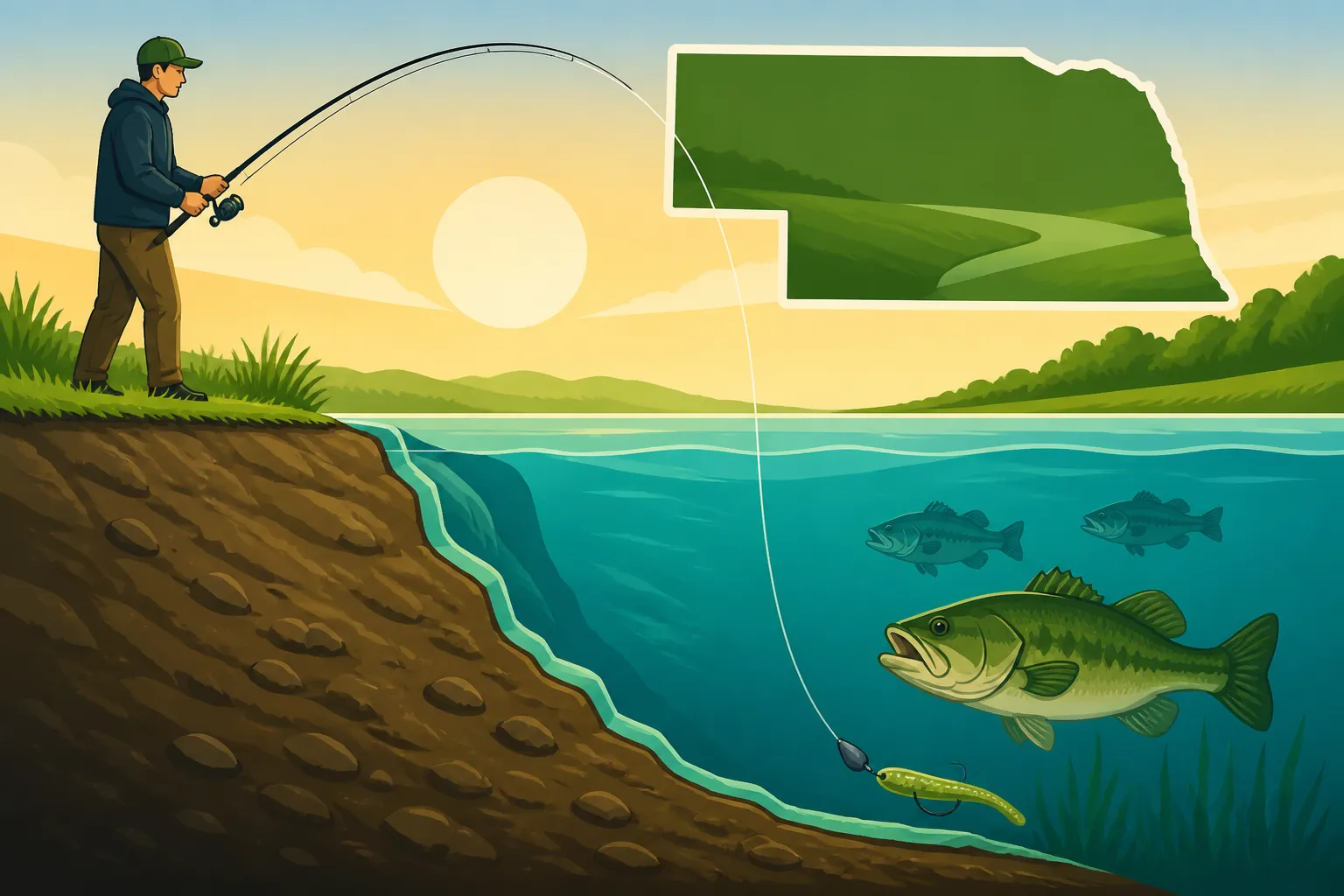
Simply put, a drop-off is any area where the bottom contour of a lake, reservoir, or river transitions from shallower water to significantly deeper water. Think of it like an underwater cliff or a steep hill. These can be dramatic, like a sudden ledge near an old river channel, or more subtle, a gradual slope that eventually plunges into the abyss. In Nebraska, you'll find these everywhere, from the vast expanses of Lake McConaughy with its ancient riverbeds, to the smaller sandpits and reservoirs where old creek channels create perfect fish habitat.
Why do fish love these spots so much? It's all about survival and opportunity. Drop-offs offer fish a convenient highway to move between different depths where they can find comfortable temperatures, optimal oxygen levels, and, most importantly, food. They provide excellent ambush points for predators like walleye and bass, allowing them to hide in the deeper water and dart up into the shallows to attack unsuspecting baitfish. For baitfish, these slopes offer quick escape routes to deeper, safer water when a predator looms. Moreover, drop-offs often concentrate forage, as current or wind can push baitfish, insects, and other food sources along these underwater edges. It's truly a prime piece of real estate for almost any species you're targeting in Nebraska.
Reading the Water to Spot Potential Drop-Offs from Shore
Okay, so we've established that drop-offs are key. But how in the world do you find them from the bank when you don't have fancy sonar? It's a valid question, and it requires a bit more observation and perhaps some homework, but it's entirely doable. First, start with visual cues. Look for changes in water color – a darker band often indicates deeper water. Pay attention to how current patterns interact with the shoreline; eddies or calmer water near a point might hint at a deeper scour. Submerged vegetation often grows to a certain depth, and where it abruptly stops could mark the beginning of a drop-off. Any points of land that extend out into the water are usually good indicators of a corresponding underwater point that will have steep drop-offs on its sides.
Beyond visual cues, a bit of research goes a long way. Many Nebraska Game and Parks Commission maps, especially for larger reservoirs, will have contour lines indicating depth changes. Studying these beforehand can give you a major advantage. Talk to local bait shop owners or other experienced anglers; they often have invaluable insights into specific bank-fishing spots. Finally, and this is crucial, learn to feel the bottom with your retrieve. Cast out, let your weight hit the bottom, and then slowly retrieve. When your lure or weight suddenly drops off or snags more easily, you’ve likely hit a depth change. It takes practice, but your rod tip can be an extension of your eyes underwater. It’s definitely challenging without a fish finder, and it can feel like guesswork at times, but with practice, you'll develop an intuition for these hidden structures.
Essential Gear for Bank Fishing Drop-Offs
Successfully fishing drop-offs from the bank requires some specific gear choices that prioritize casting distance, sensitivity, and the ability to work your bait effectively in deeper water. You can't just use any old kids' fishing rod and expect to reach those distant ledges.
Rod, Reel, and Line for Distance and Control
When you're trying to hit a drop-off that's a good distance from shore, your rod choice is paramount. Forget short, stubby rods; you'll want something with a bit of length, typically 7 to 9 feet, maybe even longer if you can handle it. This extra length translates directly into more casting distance because it allows for a longer lever arm to propel your lure. Look for a medium-heavy power rod with a fast action tip. The medium-heavy power will give you the backbone to cast heavier weights and fight bigger fish, while the fast action tip will maintain the sensitivity needed to feel subtle bites and detect bottom changes hundreds of feet away.
For your reel, a good quality spinning reel is usually the preferred choice for bank fishing due to its ease of casting and minimal backlashing issues, especially for beginners. Opt for a reel that holds a good amount of line and has a smooth, reliable drag system, as you might be battling larger fish that make strong runs. Many excellent spinning reels can be found on platforms like Amazon, offering a range of features and price points.
Now, let's talk line. This is where many bank anglers make a mistake. Monofilament is fine for general fishing, but for targeting distant drop-offs, braided line is your best friend. Braided line has almost no stretch, which means superior sensitivity – you'll feel every bump, every rock, and every subtle bite, even at extreme distances. It also has a much thinner diameter for its breaking strength compared to mono, allowing for longer casts and cutting through the water more efficiently. Spool your reel with 15-30 pound braided line, depending on the size of fish you expect and the cover you're fishing. Since braided line is highly visible underwater and can be easily abraded by rocks or zebra mussels, always tie on a fluorocarbon leader (6-15 pound test, about 2-3 feet long) using a strong knot like an Albright or FG knot. This leader provides stealth and abrasion resistance where it matters most, near your bait.
Terminal Tackle for Reaching the Depths
Your choice of terminal tackle is equally important, as it dictates how your bait gets to, and stays on, the drop-off. The goal is to get your offering down quickly and keep it there, even in current or wind.
You'll need a variety of weights. Egg sinkers or flat weights are excellent for Carolina rigs or slip sinker rigs, allowing your line to slide freely, making it harder for fish to feel resistance. Pyramid or no-roll sinkers are great if you're fishing in current and want your bait to stay put. The actual weight size will depend on the depth, wind, and current – start with something like 1/2 to 1 ounce and adjust as needed. You can easily stock up on these versatile weights through retailers like Amazon. Don't forget an assortment of jig heads, ranging from 1/8 ounce for lighter presentations to 3/4 ounce or more for deep vertical jigging or working plastics along the bottom.
For hooks, offset worm hooks are excellent for Texas-rigging soft plastics, keeping them weedless when dragging through cover. Circle hooks, especially in larger sizes, are fantastic for live or cut bait when targeting catfish on the bottom, as they promote lip hooks and reduce gut hooking. You'll also want some Aberdeen or short-shank bait holder hooks for smaller live baits or dough baits.
Finally, consider your bait. For live bait, nightcrawlers are universal, minnows are killer for walleye and crappie, and cut bait (like shad or pieces of carp) or chicken liver are unbeatable for catfish. When it comes to artificial lures, soft plastics rigged on jig heads or Carolina rigs are incredibly versatile for mimicking baitfish or crawfish. Swimbaits, grub tails, and stick worms can all be very effective. Small crankbaits that dive to appropriate depths can also be productive when retrieved parallel to the drop-off edge. For more in-depth advice on what tackle works for specific species, you might want to check out our guide on the Best Tackle for Nebraska Walleye Fishing or for a broader overview, Best Rods and Reels for Nebraska Fishing.
Proven Techniques for Fishing Bank Drop-Offs
Now that you've got the right gear, let's get into the nitty-gritty of how to actually put your bait where the fish are hiding along those elusive drop-offs. It's all about precision casting and patient retrieval.
The Cast and Retrieve: Reaching and Working the Edge
The first challenge is simply getting your bait out there. Use an overhead cast for maximum distance, ensuring you have enough room behind you and checking for overhead obstructions. Aim slightly past where you think the drop-off is, allowing your bait to sink and then retrieve it back, dragging it up and over the edge. Fan casting – making several casts in a semi-circle pattern – is crucial. This helps you explore the contour of the bottom and locate the exact depth changes. Start by casting straight out, then gradually shift your casts to the left and right, covering a wide swath of water.
Once your bait is in the water, the key is maintaining bottom contact and feeling that transition. Let your weight or lure sink all the way to the bottom. If you're using a Carolina rig, you'll feel the sinker hit first, then a slight pause as your bait settles. With a jig, you'll feel a distinctive "thump." Then, begin a slow, controlled retrieve. You want to move your bait just enough to keep it from snagging, but slowly enough to let it stay in the strike zone near the drop-off. You're trying to literally "feel" the bottom contour changing through your rod tip and braided line. When you feel that sudden drop, you know you've found the edge! This is where you slow your retrieve even further, or even pause, letting your bait linger at the most promising spot. To help improve your casting distance, you can also check out our article on How to Cast Farther From Shore.
Let's break down two popular rigs for working drop-offs from the bank:
- Carolina Rig: This rig is fantastic for covering ground and presenting a bait naturally. Thread an egg sinker onto your main line, followed by a bead (to protect your knot). Tie a swivel to your main line, then add a 2-4 foot fluorocarbon leader to the other end of the swivel, finally tying on your hook. The sliding weight allows your bait to float or drift more freely, often right at the base of that drop-off, enticing fish that might be wary of direct weight contact. This is particularly effective for bass and walleye that are hugging the bottom near structure.
- Slip Sinker Rig (Bottom Rig): This is a classic for a reason, especially for catfish and stationary presentations. Thread a slip sinker (egg, pyramid, or no-roll) onto your main line, then tie a swivel. To the swivel, add an 8-18 inch leader of fluorocarbon or monofilament, and then your hook. The slip sinker keeps your bait anchored, but the line can still slide through the weight, giving less resistance to a biting fish. This is ideal when you've located a precise spot on the drop-off where you believe fish are holding, and you want to leave your bait there for an extended period. For more details on these setups, definitely read our guide on Best Bank Fishing Rigs for Nebraska Reservoirs.
Static vs. Active Presentations
Once you've located the drop-off, how you present your bait can make all the difference. You generally have two main approaches:
- Static Presentations: This involves letting your bait sit relatively still on or near the drop-off. A slip sinker rig with live bait (like a nightcrawler or cut bait) is perfect for this. Cast it out, let it settle at the base of the drop-off, and then keep your rod in a holder or simply hold it, waiting for a bite. This is incredibly effective for species like channel catfish in places like Branched Oak Lake, or even lazy walleye that aren't actively chasing. The lack of movement can be less intimidating for wary fish. If you're fishing in a river, like parts of the Platte River, you can let the current subtly move your static bait along the contours of the drop-off, mimicking natural drift.
- Active Presentations: This involves working your bait with movement, mimicking a swimming or fleeing creature. Jigging soft plastics along the break is a prime example. Cast out, let your jig sink to the bottom, then lift your rod tip a foot or two, letting the jig fall back down on a semi-slack line. This "lift and fall" motion can trigger aggressive strikes from bass and active walleye. You can also slowly retrieve small crankbaits that dive to the depth of the drop-off, bouncing them off the bottom as they swim. This is about covering more water along the edge and actively searching for fish that are willing to chase.
Choosing between static and active often depends on the species you're targeting and their mood, as well as the time of year. Sometimes, fish want an easy meal, and sometimes they need to be provoked. Experiment to see what works best on any given day.
Adapting to Different Species and Conditions
Different fish species behave differently around drop-offs, and your approach should reflect that.
- Walleye: These elusive fish are often found right on the edge or at the base of drop-offs, especially in large reservoirs like Lake McConaughy. They prefer cooler, deeper water during the day and will move up shallower to feed during low light. For walleye, slow retrieves with live bait (like a shiner or large nightcrawler on a crawler harness) or subtle jigging with soft plastics are often best. Try to keep your bait literally crawling on the bottom near that depth transition. Our comprehensive guide on How to Fish for Walleye in Nebraska delves deeper into their habits and preferred techniques.
- Catfish: Channel catfish, flathead catfish, and even blue catfish will use drop-offs as feeding stations. They're often less picky about presentation. Bottom rigs with stink bait, cut bait, or chicken liver left statically at the base of a drop-off are incredibly effective. Look for drop-offs near deeper holes or bends in rivers. For detailed advice on this, check out How to Catch Channel Catfish From the Bank.
- Bass (Largemouth and Smallmouth): Bass, especially largemouth, will often relate to any cover on or near the drop-off, such as submerged brush piles, rocks, or old stumps. Work soft plastics, crankbaits, or jigs over these structures, letting them fall down the face of the drop-off. Smallmouth bass in rocky rivers or clear lakes will also use drop-offs as ambush points.
- Crappie and Panfish: While often found in shallower cover, crappie will also suspend along deeper drop-offs, especially during colder months or in large schools. If the drop-off is relatively close to the bank, a slip bobber rig with a minnow or small jig can be deadly, allowing you to present your bait at a precise depth.
Understanding the specific species' habits and preferences will help you fine-tune your approach and increase your success when targeting drop-offs from the bank.
Strategic Considerations and Local Insights
Beyond the mechanics of casting and retrieving, thinking strategically about timing and location can significantly boost your success when fishing drop-offs from the bank in Nebraska.
Timing Your Approach: Best Conditions and Times
The "when" can be just as important as the "how" in fishing. Fish behavior is heavily influenced by factors like light, weather, and seasonal changes.
- Early Morning and Late Evening: These low-light periods are often prime time for predator species like walleye and bass, which will move shallower to feed under the cover of darkness or dim light. This means they might be more accessible on drop-offs closer to the bank during these hours. As the sun gets high, they typically retreat to deeper, cooler water along those same drop-offs. Knowing the Best Time of Day to Catch Walleye in Nebraska can be particularly beneficial for targeting these popular game fish.
- Wind: Don't shy away from windy days, especially if the wind is blowing into the bank you're fishing. Wind can create current, which in turn pushes baitfish, insects, and other food sources towards that shoreline. This "wind-blown bank" effect can concentrate game fish along nearby drop-offs, turning a potentially difficult day into a highly productive one. The chop on the surface also helps break up your outline, making you less visible to wary fish.
- Barometric Pressure: Fish tend to be more active and feed more readily during periods of stable or slowly falling barometric pressure. A sudden, sharp drop often signals an impending storm and can turn fish off. Conversely, a rapidly rising barometer after a storm can also make them sluggish. Paying attention to these subtle atmospheric changes can give you an edge. We've got more information on this in our article How Barometric Pressure Affects Fishing in Nebraska.
By combining these timing insights with your understanding of drop-offs, you can pick the best windows of opportunity for your bank fishing adventures.
Finding Nebraska's Bank-Accessible Drop-Offs
Nebraska offers a wealth of fishing opportunities, and many of its best spots feature excellent bank access to productive drop-offs. The key is knowing where to look!
- Public Access Points: Many State Recreation Areas (SRAs) and city parks around Nebraska have designated bank fishing areas with surprisingly good access to deeper water. For example, some of the older sandpits along the Platte River often have steep drops near their edges where channel catfish and bass love to hide. Reservoirs like Branched Oak Lake or Pawnee Lake often have points or causeways that extend out, providing bank anglers a significant advantage in reaching deeper structure.
- Specific Locations: In Lincoln, Holmes Lake and Wagon Train Lake offer good bank access, with certain sections featuring readily accessible drop-offs. Around Omaha, Standing Bear Lake and Zorinsky Lake also have points and deeper areas within casting distance from shore. Even larger bodies of water like Lake McConaughy have specific public access points and beaches where a long cast can put you right on the edge of a deep channel or submerged structure. For a general overview of accessible spots, take a look at our guide to the Best Nebraska Lakes for Shore Fishing Without a Boat.
- Utilizing Online Resources and Local Knowledge: The Nebraska Game and Parks Commission website is an invaluable resource, often providing maps and fishing reports for public lakes and reservoirs. These can often highlight features like old creek channels or steep banks. Don't underestimate the power of a friendly chat at a local bait shop. The folks working there often know the specific quirks of local waters, including the best bank-fishing spots. They can point you to the local "honey holes" or at least tell you which areas have favorable contours. Before heading out, always consult the Where to Find the Nebraska Fishing Regulations Booklet for the most current rules and limits for your target species and location.
By combining careful planning, the right gear, and an understanding of fish behavior, you'll be well on your way to successfully fishing drop-offs from the bank, proving that you don't always need a boat to catch big fish in Nebraska.
Here's a quick comparison of popular bank fishing rigs for drop-offs:
| Rig Type | Best Use Case | Key Advantage | Target Species | Complexity |
|---|---|---|---|---|
| Carolina Rig | Casting long distances, subtle presentations | Weight slides, bait moves naturally, weedless | Bass, Walleye, Catfish | Medium |
| Slip Sinker Rig | Static bait presentation, bottom fishing | Fish doesn't feel weight, easy to detect bites | Catfish, Walleye, Panfish | Easy |
| Jig Head (with soft plastic) | Active retrieve, feeling bottom contour, versatile | Direct contact with lure, mimics baitfish/crawfish | Bass, Walleye, Crappie | Easy |
Disclaimer
This article is for general informational purposes only and does not constitute professional advice. Laws, prices and regulations vary by location and change over time. Consult a qualified professional for guidance on your specific situation.