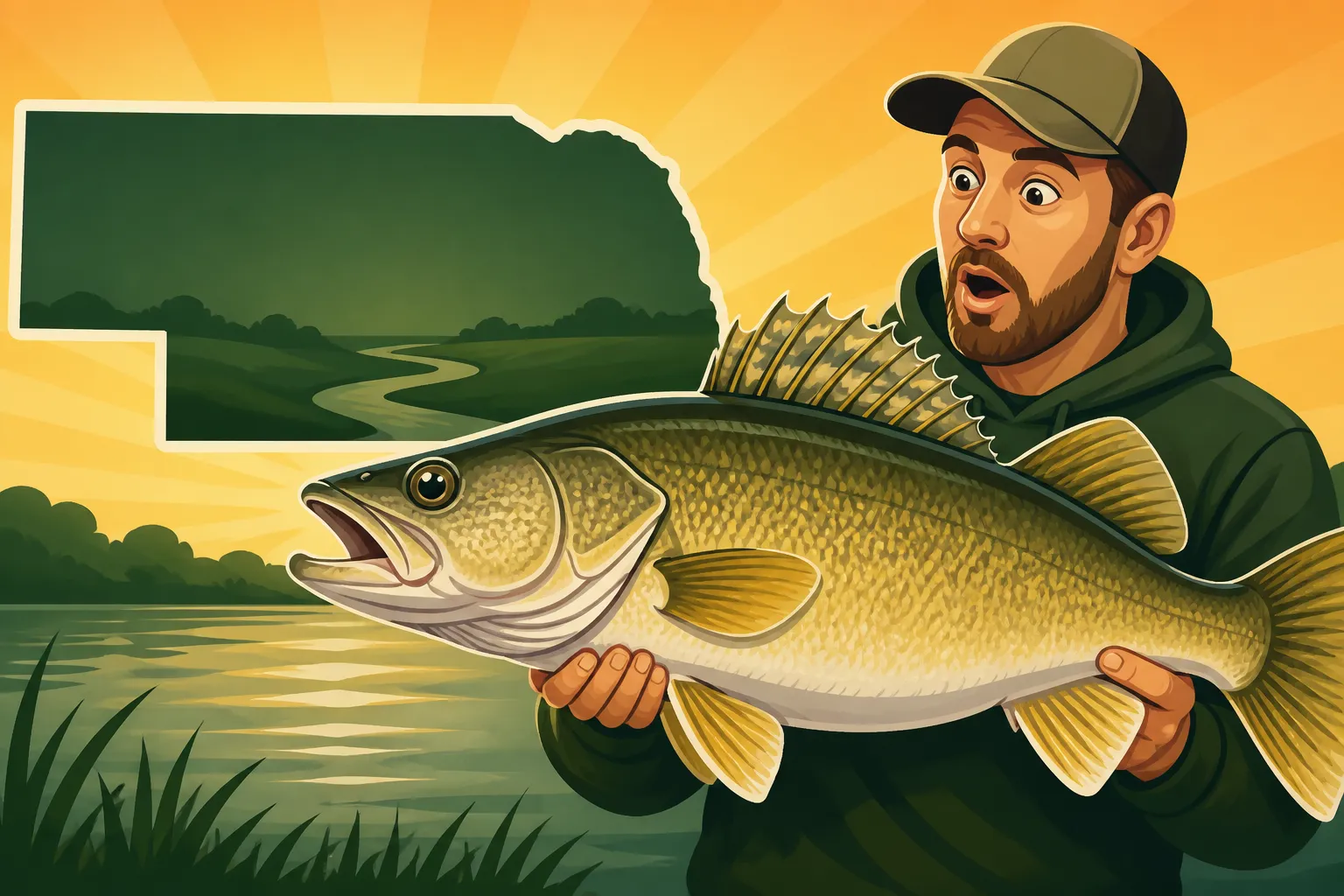
Is a 16-Pound Walleye a Trophy Fish in Nebraska?
Oh, the thrill of reeling in a truly massive walleye! There's nothing quite like it. You fight it, you land it, and then that immediate rush of adrenaline starts to fade, replaced by a burning question: "Is this big one truly a trophy?" If you've just hauled in a 16-pound walleye from a Nebraska lake or river, you're undoubtedly wondering if you've hit the big time. This guide is here to shed light on what constitutes a trophy walleye in the Cornhusker State, comparing your impressive 16-pounder against official records, common catches, and the general awe of fellow anglers.
What Defines a Trophy Fish in Nebraska?
The term "trophy fish" can feel a bit subjective, can't it? What one angler considers a trophy might just be a nice meal for another. However, in Nebraska, there are some pretty clear benchmarks and cultural understandings that help define what truly earns that coveted "trophy" status. It's not just about bragging rights, though those are certainly a part of it!
Official Recognition Programs (Master Angler)
Nebraska has a fantastic program designed to recognize anglers who catch exceptionally large fish: the Master Angler program. This isn't just a casual nod; it's an official recognition by the state's Game and Parks Commission. For a fish to qualify as a Master Angler catch, it needs to meet specific minimum weight or length requirements, which vary by species. These aren't necessarily world-record sizes, but they are significantly larger than your average catch.
For walleye, the Master Angler program sets a high bar. When you consider that many anglers are thrilled to catch a 5-pound walleye, let alone a 10-pounder, the Master Angler minimum really puts things into perspective. It means your fish isn't just big; it's truly remarkable among its kind in Nebraska waters. Achieving Master Angler status is a badge of honor, a testament to skill, perseverance, and a little bit of luck. It validates your catch as something truly special, something that stands out in the vast waters of Nebraska. You can look up the specific requirements on the Nebraska Game and Parks website or in the annual fishing guide, but rest assured, a 16-pound walleye would have many people reaching for that application form!
State Record vs. Personal Best
The state record is the absolute pinnacle, the biggest fish of its species ever officially documented in Nebraska. This is the Mount Everest of fishing achievements. To beat a state record, you're talking about a once-in-a-lifetime fish, often caught under unique circumstances, and almost always involving a fair amount of official paperwork and verification. A state record fish is the stuff of legends, cementing an angler's name in the history books.
Then there's your "personal best." This is intensely personal, of course. It's the biggest fish you've ever caught of that particular species. For many, a personal best could be a 2-pound crappie or a 5-pound bass, and it's celebrated just as heartily. A personal best of, say, an 8-pound walleye is a fantastic accomplishment for most anglers. Comparing a 16-pound walleye to your personal best, you might find it's a monumental leap. The feeling of besting your own record is incredibly satisfying, a measure of your growth as an angler. While a 16-pound walleye might not be a state record, it would undoubtedly be a "personal best" for almost anyone who catches it. It represents a new level of angling achievement for you, and that's a trophy in itself.
Community Standards Among Anglers
Beyond the official programs and personal achievements, there's the unspoken "community standard" among anglers. This is what fishermen and women on the docks, at the bait shops, or around the campfire consider "trophy size." It's often influenced by local waters, what's typically caught, and the stories passed down. In Nebraska, where walleye fishing is incredibly popular, a 5- to 8-pound walleye is often considered a "nice fish" and definitely worth a picture. A walleye pushing double digits—10 pounds or more—starts to turn heads. People will stop what they're doing to get a look.
A 16-pound walleye, in the eyes of virtually any Nebraska angler, would be met with gasps of astonishment and genuine awe. It’s the kind of fish that makes people say, "No way! You really caught that here?" It would instantly earn you immense respect and probably a few requests for details about where and how you caught it. It's far beyond "nice" and well into the "legendary" category for many. It's the kind of fish that local bait shops might ask to take a picture of to hang on their wall. This community standard, while informal, is often the most validating because it comes from your peers who truly understand the effort and rarity involved.
The Reality of a 16-Pound Walleye in Nebraska Waters
So, let's get down to the brass tacks: what does a 16-pound walleye really mean in the grand scheme of Nebraska fishing? Is it just a big fish, or is it truly in a league of its own? The answer, unequivocally, is that it's an absolute behemoth.
Average Walleye Size in Nebraska
Most anglers in Nebraska consider a successful walleye outing to include fish in the 15 to 22-inch range, which typically translates to about 1.5 to 4 pounds. Landing a 5 or 6-pound walleye is often celebrated as a genuinely good fish, and a 7 to 9-pounder is what many seasoned anglers spend a lifetime chasing for a true "wall hanger." These are the fish that provide excellent table fare and a respectable fight. They're common enough to be a realistic goal, but challenging enough to be rewarding.
A 16-pound walleye is almost unheard of for the vast majority of Nebraska anglers. It's multiple times larger than the average keeper and significantly larger than what most people would consider a "big" walleye. It would immediately stand out in any livewell or on any stringer you might see at a boat ramp. Think about it: if the average fish is 3 pounds, a 16-pounder is more than five times that size! That's like comparing a regular-sized person to a giant.
State Record Walleye in Nebraska: A Benchmark
To truly grasp the magnitude of a 16-pound walleye, we need to look at the top. The Nebraska state record for walleye is a monumental fish, an incredible specimen that has stood for years as the ultimate goal for many. Currently, the state record for walleye in Nebraska sits at an astonishing 16 pounds, 2 ounces. This fish was caught in Lake McConaughy back in 1971, a testament to the incredible potential of Nebraska's waters, especially those deep, productive reservoirs.
Knowing this, if you've caught a 16-pound walleye, you are literally within ounces of the all-time state record. Let that sink in for a moment. You're not just close; you're knocking on the door of Nebraska angling history. This is not merely a "trophy fish"; it's a legendary catch that rivals the best ever taken from the state. For most species, the state record is a distant, almost mythical figure. To be that close means you've truly landed a fish of a lifetime. You can learn more about the biggest catches by checking out Nebraska Walleye Size and Weight Records.
Comparing 16 Pounds to the State Record
So, your 16-pound walleye is almost identical to the state record of 16 pounds, 2 ounces. This isn't just a "big fish"; it's an unbelievably rare fish. It's the kind of catch that people dream about for their entire angling careers and never achieve. You're talking about a fish that represents the genetic and environmental peak of its species in Nebraska.
The difference of a mere 2 ounces between your fish and the state record is negligible in terms of its "trophy" status. It doesn't detract from the fact that you caught a fish that could technically be the state record, or at least challenge it if scales were calibrated slightly differently or if the fish had eaten one more minnow. This comparison makes it abundantly clear: a 16-pound walleye is not just a trophy; it is one of the most significant freshwater fish an angler could hope to catch in Nebraska, bordering on mythical status. It certainly falls within the highest tier of recognition, easily surpassing the Master Angler minimums by a wide margin. This is definitely a fish to celebrate and share the story of!
Why Nebraska Can Produce Giants: Factors for Large Walleye
It's easy to assume that such a huge walleye is a fluke, a one-off stroke of luck. While luck certainly plays a role in any trophy catch, Nebraska's waters possess specific characteristics that allow walleye to grow to such incredible sizes. It's a combination of habitat, food, and management.
Prime Habitats and Forage Bases (e.g., Lake McConaughy)
Nebraska is home to some truly outstanding walleye fisheries, and none stands out quite like Lake McConaughy. Known affectionately as "Big Mac," this massive reservoir in western Nebraska is famous for its clear, deep waters and, more importantly, its incredible forage base. It's often hailed as one of the Best Nebraska Lakes for Walleye, and for good reason. Lake McConaughy is teeming with gizzard shad and other baitfish, which are like rocket fuel for growing walleye. A plentiful and consistent food supply means walleye don't have to expend excessive energy hunting; they can focus on growing.
Beyond McConaughy, other large reservoirs like Merritt Reservoir, Harlan County Reservoir, and Sherman Reservoir also offer excellent conditions. These lakes often have extensive underwater structure—like old creek channels, humps, and submerged timber—that provide ideal ambush points and cover for large walleye. When you combine abundant food with diverse, protective habitat, you create the perfect environment for walleye to live long, grow big, and become true giants. A 16-pound walleye isn't just a product of one good year; it's the result of decades of ideal conditions and consistent feeding. For more specific tips on fishing this legendary lake, check out Lake McConaughy Walleye Fishing.
Age and Growth Rates
A 16-pound walleye isn't a young fish. Walleye grow relatively slowly compared to some other game fish. To reach such an immense size, a walleye would need to have lived for a significant number of years, likely over a decade, possibly even 15 years or more. These old, wise fish have survived countless challenges—predators, harsh winters, and thousands of anglers' baits. Their longevity is a testament to their hardiness and often, their intelligence.
The growth rate of walleye is influenced by water temperature, food availability, and genetics. In richer, warmer waters with ample food, walleye tend to grow faster. However, even in optimal conditions, hitting 16 pounds requires an exceptional individual fish with superior genetics that has managed to avoid being caught or succumbing to natural mortality for a very long time. It's truly a survivor. Understanding How Old a Trophy Walleye Is in Nebraska helps to appreciate the lifespan and sustained health required to achieve such a size.
Fishing Pressure and Management Practices
While Nebraska's waters are productive, they are also popular. Fishing pressure is a reality. This makes a trophy catch even more impressive. However, the Nebraska Game and Parks Commission plays a crucial role in managing these fisheries to ensure that trophy potential remains. This involves things like stocking programs, implementing size and bag limits, and habitat improvement projects.
For instance, certain length limits on walleye in specific lakes, like the protected slot limits or minimum length requirements, allow younger fish to grow past their initial vulnerability before they can be harvested. This helps ensure a healthy population structure, where some fish live long enough to reach trophy size. The Commission also monitors the health of baitfish populations and water quality, all of which indirectly contribute to the ability of walleye to thrive and grow large. These thoughtful management practices, alongside natural bounty, create the environment where a 16-pound walleye is not impossible, just exceedingly rare. You can read up on the specifics in Nebraska Fishing Regulations Explained.
Strategies for Pursuing Nebraska's Trophy Walleye
Now that you know a 16-pound walleye is a true giant, you might be thinking, "How can I catch one?" While there's no magic bullet, there are certainly strategies that increase your odds of encountering one of these Nebraska monsters. It's about combining knowledge, skill, and patience.
Targeting Specific Locations
If you're serious about a trophy walleye, you need to be fishing in waters known to produce them. As mentioned, Lake McConaughy is the undisputed king of Nebraska walleye. Its vastness and deep, clear water make it an ideal hunting ground for giant walleye. However, other reservoirs can also yield unexpected giants. Merritt Reservoir, Sherman Reservoir, and Harlan County Reservoir all have reputations for producing excellent walleye fishing and the occasional true lunker. It's often these large, deep, and relatively infertile (compared to shallower, nutrient-rich lakes) reservoirs that produce the biggest, oldest fish because they have the space and a consistent, albeit sometimes challenging, food source.
Don't just fish in these lakes; fish the right parts of them. Look for deep main-lake points, submerged humps, offshore rock piles, and old creek channels. These are the highways and dinner tables for big walleye. They prefer structure and depth, especially during the brighter parts of the day or in warmer months. Identifying these key features often requires good electronics and a lot of time on the water.
Optimal Techniques and Gear
Catching a 16-pound walleye usually doesn't happen on ultralight panfish gear. You need robust tackle capable of handling a powerful, heavy fish, especially in strong currents or around abrasive structure. When it comes to how to fish for these giants, deep trolling with large crankbaits or blade baits is a common strategy in open water. On structure, jigging with heavy jigs and large plastics or live bait rigs, like a How to Use a Crawler Harness for Walleye, can be incredibly effective.
Live bait, especially large shiners or gizzard shad, can often be the ticket for enticing a truly enormous walleye that might be wary of artificials. For your gear, consider a medium-heavy to heavy power spinning or baitcasting rod, paired with a reel that has a smooth, strong drag. Spool up with a strong braided line, perhaps 20-30 pound test, with a fluorocarbon leader for abrasion resistance and stealth. Don't skimp on your hooks either; sharp, strong hooks are crucial for penetrating the hard mouths of big walleye. You can find a lot of excellent, heavy-duty gear for trophy walleye fishing on Amazon, from specialized rods to high-quality braided lines. For a deeper dive into tackle, check out Best Rod Setup for Nebraska Walleye.
Timing Your Trophy Hunt
Timing is everything in trophy fishing. The best time of year to catch a truly massive walleye often coincides with their pre-spawn or post-spawn feeding frenzies, when they are at their heaviest and most aggressive. This typically means late winter/early spring before the spawn, or late spring/early summer after they've recovered. Fall can also be an excellent time as fish feed heavily in preparation for winter.
Beyond the seasons, consider the time of day. Big walleye are often more active during low-light conditions—dawn, dusk, and especially at night. Night fishing allows these large, wary fish to move into shallower water to feed with less apprehension. Overcast days can also extend their feeding window. Pay attention to weather patterns, barometric pressure, and even moon phases; while not definitive, they can influence fish activity. For detailed seasonal strategies, look into Best Time of Year to Catch a Trophy Walleye in Nebraska.
Documenting and Honoring Your Trophy Catch
So you've done it. You've landed a Nebraska walleye that weighs in at 16 pounds. This is a monumental achievement, and how you choose to celebrate and honor it is just as important as the catch itself.
Catch and Release for Future Generations
Given the rarity and age of a 16-pound walleye, many trophy anglers opt for catch and release. These old, large fish are incredibly valuable to the fishery. They are often the best spawners, contributing significantly to the genetic pool. Releasing them allows them to continue their life cycle, potentially producing more trophy-sized offspring. Plus, allowing another angler the chance to catch such a magnificent creature is a generous act of sportsmanship.
If you plan to release a trophy walleye, be prepared. Have your camera ready, your measuring board handy, and a large, knotless rubberized net. Minimize the time the fish is out of the water. Handle it gently, supporting its body, especially its belly, and avoid touching its gills. Revive the fish thoroughly before letting it go, ensuring it swims away strongly. This ensures the future of the fishery and maintains the population of these magnificent giants. For more information, refer to Catch and Release Best Practices in Nebraska.
Photography and Replica Mounts
Even if you release the fish, you'll want a tangible memory of your incredible catch. High-quality photos are essential. Get several shots from different angles, showcasing the fish's size and beauty. Have a friend take a picture of you holding the fish, and make sure to get a clear shot of the fish next to a measuring board to accurately record its length. These photos will be invaluable for a replica mount.
A replica mount is an amazing way to immortalize your trophy without keeping the actual fish. Modern replica mounts are incredibly realistic, often indistinguishable from traditional skin mounts, and they last forever without degradation. Many talented artists specialize in creating these, using your photos and measurements to craft a stunning, lifelike representation of your catch. You can even find resources for quality replica artists by searching online platforms like Amazon for fishing art or taxidermy supplies. This way, you get to keep your trophy on the wall, and the fish gets to swim another day.
Sharing Your Accomplishment
Finally, don't be shy about sharing your story! A 16-pound walleye from Nebraska is an event worth recounting. Share your photos and the tale of the catch with fellow anglers, family, and friends. Submit it to the Nebraska Game and Parks Commission for Master Angler recognition, and consider sending it to local fishing publications or online forums. Your story can inspire others, help promote conservation, and solidify your place among the ranks of Nebraska's truly elite walleye anglers. It's a memory that will last a lifetime, not just for you, but for all those who hear the incredible tale of your near-state-record catch.
Trophy Walleye Benchmarks in Nebraska
To provide a clear perspective on just how significant a 16-pound walleye is in Nebraska, here's a quick comparison of various benchmarks:
| Category | Typical Size/Weight Range | Significance |
|---|---|---|
| Average Keeper Walleye | 15-22 inches (1.5 – 4 lbs) | Common, good eating fish, typical successful outing. |
| "Nice" Walleye | 5-8 lbs | Excellent catch, often warrants a photo, respectable fight. |
| Master Angler Minimum | Typically 10-12 lbs (varies slightly) | Official state recognition for exceptional size, far beyond average. |
| 16-Pound Walleye | 16 lbs | Extremely rare, near state record, legendary status, once-in-a-lifetime fish for almost any angler. |
| Nebraska State Record | 16 lbs, 2 oz | The largest walleye ever officially recorded in Nebraska, the pinnacle of angling achievement. |
This table clearly illustrates that a 16-pound walleye is not just a trophy; it's a fish that stands shoulder-to-shoulder with the absolute biggest walleye ever caught in the state of Nebraska. It's truly a magnificent accomplishment.
Disclaimer
This article is for general informational purposes only and does not constitute professional advice. Laws, prices and regulations vary by location and change over time. Consult a qualified professional for guidance on your specific situation.