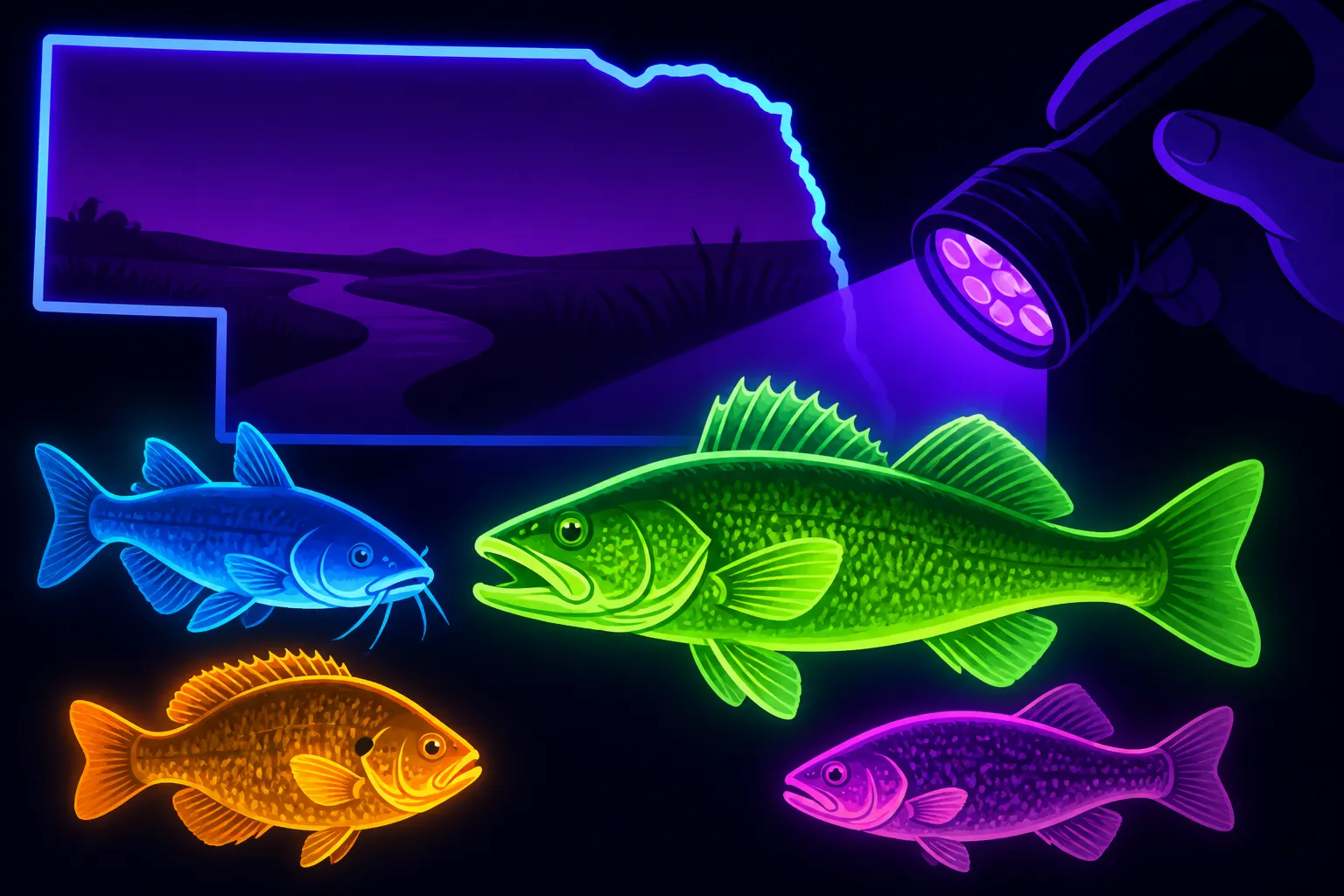
Nebraska Fish That Glow Under Blacklight
There's nothing quite like the mystery and excitement of night fishing under the vast Nebraska sky. You're out there, the stars are brilliant, and suddenly, you feel that tell-tale tug on your line. As you reel in your catch, a thought might cross your mind: is there something special about this fish, something that makes it stand out even in the dark? Well, you're not imagining things, because some fish in Nebraska actually exhibit a fascinating phenomenon: they appear to glow under a blacklight. This guide will dive deep into which of our finned friends possess this unique trait, the science behind it, and how understanding it can even give you an edge on your next nocturnal angling adventure.
The Phenomenon of Fish Fluorescence: What Does "Glow Under Blacklight" Even Mean?
Let's start by demystifying what we mean when we say a fish "glows" under a blacklight. It's not magic, but rather a cool scientific trick involving light that's invisible to the human eye. Understanding this basic principle is key to appreciating why certain fish appear to light up.
Understanding UV Light and Visible Light
When you think of "light," you usually think of the visible spectrum – the colors of the rainbow, from red to violet, that our eyes can perceive. But there's a whole lot more light out there that we can't see, and ultraviolet (UV) light is one of those. Blacklights specifically emit a type of UV light called UV-A, which is longer wavelength UV and mostly harmless, unlike the harsher UV-B and UV-C rays that cause sunburn.
What happens is that certain substances have the ability to absorb this invisible UV-A light and then re-emit it almost immediately as visible light. This conversion process is what creates the "glow" effect we see. It’s the same principle that makes your white clothes appear brighter in a nightclub under a blacklight, or how some minerals light up in a geology exhibit. For fish, it’s not just a cool party trick; it's often tied to their biology and how they interact with their environment, even if they aren't actively "glowing" for their own purposes in nature.
Fluorescence vs. Phosphorescence in Aquatic Life
While both fluorescence and phosphorescence involve absorbing energy and re-emitting light, there's a crucial difference, especially when we talk about fish. Fluorescence is pretty much instantaneous: as soon as the UV light source is removed, the glow stops. Think of a fluorescent highlighter pen – it only glows under the blacklight.
Phosphorescence, on the other hand, is like a lingering glow. It absorbs energy and then releases it slowly over time, meaning the object continues to glow even after the light source is removed. Think of glow-in-the-dark stars you stick on your ceiling; they "charge up" and then glow for a while in the dark. In the context of fish, what we usually observe under a blacklight is fluorescence. The fish's eyes or certain pigments will light up while the blacklight is shining on them, but as soon as you turn the blacklight off, the glow disappears. This immediate reaction is what makes a blacklight a useful tool for anglers looking to spot specific features in low light.
Which Nebraska Fish Species Are Known to Exhibit Fluorescence?
While not every fish in Nebraska is going to light up like a neon sign under a blacklight, there are definitely a few species, or at least specific parts of them, that will give you a noticeable glow. It's truly fascinating once you see it for yourself.
The Elusive Walleye and Its Glowing Eyes
Without a doubt, the most famous and striking example of a fish glowing under blacklight in Nebraska, and indeed across North America, is the walleye. If you've ever spent any time Walleye Fishing in Nebraska after sunset, you might have heard whispers of their "glowing eyes." This isn't just folklore; it's a very real and distinct feature that makes them stand out.
The walleye's eye has a special reflective layer called the tapetum lucidum behind its retina. This layer acts like a mirror, reflecting light back through the retina, which gives the photoreceptor cells a second chance to detect light. This is an incredible adaptation that helps walleye see exceptionally well in low-light conditions, giving them a distinct advantage as nocturnal predators. When you shine a blacklight on a walleye, particularly a healthy, fresh one, those eyes will light up with an eerie, almost otherworldly glow, often appearing bright yellow or green. It's incredibly useful for identifying a walleye definitively in the dark, and it’s a cool bonus for any angler who catches one after dusk.
Crappie and Other Panfish – Subtle Shimmers
While walleye eyes are the star of the show, other species, particularly crappie and some other panfish, can also exhibit subtle fluorescence. It's typically not as dramatic or easily visible as a walleye's eyes, but if you look closely, you might notice something.
Crappie, whether you're catching them for a fish fry or just enjoying the sport of Crappie Fishing in Nebraska, can sometimes show faint fluorescent qualities on their scales or fins. This isn't due to a reflective eye layer like the walleye, but more likely to specific pigments in their skin or mucus coating that naturally react to UV light. It's often a soft, iridescent shimmer rather than a bright glow. You might notice it more on certain individuals, or under specific blacklight conditions. Similarly, other panfish like bluegill or yellow perch might display a very mild, inconsistent fluorescence. It’s far from a guarantee and often quite subtle, making it more of an interesting observation than a reliable identification tool.
The Potential for Other Species: Bass and Catfish
Now, when it comes to species like largemouth bass, smallmouth bass, or our beloved catfish, the "glow" effect under blacklight is generally not a prominent feature, if present at all. Anglers pursuing Largemouth Bass Fishing in Nebraska or Channel Catfish Fishing in Nebraska typically aren't using blacklights to spot their catches.
However, it's worth noting that the natural world is full of surprises. While these species don't have the tapetum lucidum of a walleye or widely recognized fluorescent pigments, variations in water clarity, diet, and even individual fish genetics could potentially lead to some minor, localized fluorescence. For example, some fish mucus coatings might react faintly, or certain parasitic organisms on a fish could fluoresce. These instances would be highly sporadic and not reliable for identification. Generally speaking, if you're looking for a fish that truly "glows" under blacklight in Nebraska, the walleye is your best bet, with panfish offering a more subtle, less consistent shimmer.
The Biological Reasons Behind the Glow
So, why do some fish light up under UV light while others don't? It all comes down to some incredible biological adaptations and the chemistry of their bodies. It's not just a random quirk; these are often features with a real purpose, even if that purpose isn't specifically to glow under a human's blacklight.
Tapetum Lucidum: Nature's Night Vision Goggles
Let's circle back to the walleye, because their glowing eyes are a perfect example of biology at play. The tapetum lucidum (Latin for "bright tapestry") is a retroreflector tissue layer located behind the retina in the eyes of many nocturnal or crepuscular (active at dawn and dusk) animals, including walleye, cats, and even alligators.
Its primary function is to enhance vision in low-light conditions. When light enters the eye and passes through the retina, any light that isn't absorbed by the photoreceptor cells (rods and cones) hits the tapetum lucidum. This layer then reflects the light back through the retina, giving the photoreceptors a second chance to absorb those precious photons. This significantly improves light-gathering ability, effectively giving the fish "night vision." The reason it glows under blacklight is that this reflective layer contains highly reflective crystals (often guanine or zinc cysteine) that can also be fluorescent, absorbing the UV and re-emitting visible light. It's a testament to evolutionary adaptation, allowing walleye to effectively hunt their prey in the dimmest of light, be it dawn, dusk, or deep under cloudy water.
Fluorescent Proteins and Pigments in Fish Skin
Beyond the specialized tapetum lucidum, some fish possess fluorescent proteins and pigments within their skin, scales, and fins. This phenomenon is much more widely studied in marine environments, where vibrant fluorescent corals and fish are more common, but it exists to a lesser extent in freshwater species too.
These fluorescent compounds are essentially molecules that absorb light at one wavelength (like UV-A from a blacklight) and then emit it at a longer, visible wavelength (like green, red, or orange). The exact biological purpose of these pigments in freshwater fish isn't always clear. In some cases, it might be for species recognition, camouflage, or even protection from UV radiation. For crappie and other panfish, any observed fluorescence is likely due to these types of pigments. It's not as concentrated or specialized as the walleye's eye, which is why the glow is usually much fainter and more diffuse, often appearing as a subtle shimmer across their body rather than a distinct, bright light.
Environmental Factors and Diet Influences
It's a complex world under the water, and environmental factors can definitely play a role in how or if a fish might glow. For instance, the clarity of the water, its depth, and even the fish's diet could all have an impact on the presence and intensity of fluorescent compounds.
Consider water clarity: in highly turbid or stained waters, the amount of natural UV light penetrating the water column might be significantly reduced. This could potentially influence the development or expression of fluorescent pigments in fish that reside there. Similarly, a fish's diet might contain certain compounds that, when metabolized, contribute to fluorescent properties in their tissues. Imagine a scenario where a particular type of plankton or insect, rich in a specific carotenoid, becomes a primary food source. Over time, these compounds could accumulate in the fish's body, potentially enhancing any natural fluorescence. While this is more speculative for Nebraska's freshwater fish, it's a known principle in other aquatic ecosystems, demonstrating the intricate connection between an organism and its environment.
Practical Applications for Anglers: Using Blacklights on the Water
Beyond the cool factor, knowing that certain Nebraska fish glow under blacklight actually has some legitimate practical applications for anglers, especially those who enjoy the tranquility and challenge of night fishing. A blacklight can become a surprisingly useful tool in your tackle box.
Identifying Species and Locating Fish at Night
One of the most immediate benefits of a blacklight for Nebraska anglers is species identification, particularly for walleye. Ever pulled in a fish in the dead of night, heart pounding, and wondered if it's the trophy walleye you've been dreaming of, or just a drum or white bass? A quick pass with a handheld blacklight can confirm your suspicions if those unmistakable glowing eyes light up. This can be especially helpful if you're trying to adhere to specific bag limits for certain species, like the Nebraska Walleye Daily Bag Limit, where quick and accurate identification is crucial.
Beyond identification, some anglers believe a blacklight can also help in locating fish. While it won't magically make fish appear, the reflective quality of walleye eyes, even if faint, might sometimes be picked up with a very powerful blacklight from a distance, revealing their presence. It's not a fish finder, but it's another trick in the bag for Nebraska Night Fishing Techniques.
Enhanced Lures and Baits: The UV Advantage
Modern fishing tackle has embraced the science of UV light. Many lures and baits today are specifically designed to be UV-reactive, meaning they contain pigments that fluoresce under UV light. This is where a blacklight can really shine (pun intended!) for anglers.
When you're fishing in low light, at dawn, dusk, at night, or in stained or deep water, these UV-reactive lures can be significantly more visible to fish. The UV light that penetrates the water, even if minimal, can make these lures "pop" in a way that non-UV lures can't. This increased visibility can sometimes be the difference between a fish noticing your bait and swimming right past it. Many anglers swear by UV-enhanced lures for species like walleye and crappie. You can often find a wide selection of these specialized lures by browsing online retailers like Amazon, making it easy to stock up on options that might give you that crucial edge. Best Tackle for Nebraska Walleye Fishing often includes jigs and crankbaits with UV properties.
Important Considerations for Night Fishing with Blacklights
While a blacklight can be a fantastic tool, it's important to use it wisely and responsibly. Overuse or improper use can not only be ineffective but might also disrupt the natural environment or even spook the fish you're trying to catch.
When selecting a blacklight, consider a dedicated fishing blacklight designed for boat use or a powerful handheld unit. You'll find a variety of options on platforms like Amazon, from small portable units to larger fixtures that illuminate your entire fishing area. Always be mindful of local Nebraska Fishing Regulations Explained regarding the use of lights to attract fish. While using a blacklight to illuminate your line or identify a fish is generally fine, regulations might differ if the light is perceived as attracting fish to your specific location for harvest. Additionally, when night fishing, always prioritize safety. Ensure you have proper navigation lights on your boat if you're on the water, as outlined in Nebraska Boat Registration and Fishing Rules, and be aware of your surroundings. A blacklight is an aid, not a replacement for good fishing practices and safety protocols.
| Feature / Species | Walleye Eyes | Crappie Scales/Fins | UV-Reactive Lures |
|---|---|---|---|
| Primary "Glow" | Bright, distinct yellow/green | Faint, iridescent shimmer | Various colors (blue, green, pink) |
| Biological Reason / Mechanism | Tapetum Lucidum (reflective eye layer) | Fluorescent pigments in skin/scales | Synthetic UV-reactive pigments |
| Visibility under Blacklight | Very high, unmistakable | Low to medium, variable | High, designed to stand out |
| Angler Application | Species identification at night | Minor aid in identification | Increased lure visibility to fish |
| When to Use Blacklight | Confirming walleye catch, line illumination | Observing subtle features, line illumination | Enhancing lure visibility in low light/stained water |
Separating Fact from Fiction: Common Misconceptions
When we talk about something as cool as fish glowing under a blacklight, it's easy for myths and misunderstandings to take root. As a veteran lifestyle blogger, I've heard my share of fishing tales, and it's important to ground our excitement in reality. Let's clear up some common misconceptions so you can approach this phenomenon with a realistic perspective.
Not All Fish Glow Equally (or at All)
This is perhaps the most crucial point to understand. The idea that "fish glow under blacklight" is a fun concept, but it's far from a universal truth. As we've discussed, the walleye is the shining example in Nebraska waters, thanks to its specialized tapetum lucidum. Even then, the intensity of their eye-glow can vary from fish to fish. Some might light up like miniature headlights, while others might offer a softer, more subtle gleam. Factors like the fish's age, health, and even how recently it's been exposed to light can affect the visibility of the glow.
For other species, like crappie, the fluorescence is often so faint or inconsistent that it's barely noticeable to the casual observer. And for many popular game fish such as most bass, catfish, or pike, you're simply not going to see any significant glow at all. So, if you shine your blacklight into a bucket of mixed panfish and only a few eyes light up, don't be surprised; it's simply a reflection of this biological variability. It’s definitely helpful to carry a Nebraska Fish Species Identification Guide to know what you’re looking at, even if it doesn't glow.
The Purpose of the Glow: For Fish or for Anglers?
Another common misconception revolves around the "why." It’s easy to assume that because we can see a fish glow under UV light, the fish itself is using that glow for some sort of communication, attraction, or predatory advantage. While some marine species do use fluorescence for signaling, in the context of Nebraska's freshwater fish, particularly the walleye's eye glow, the primary purpose is for their own vision, not external display.
The tapetum lucidum in a walleye's eye is there to help the fish gather more light and see better in the dark – essentially, it's a built-in night vision enhancer. The fact that it fluoresces under our blacklight is a happy accident, a side effect of its reflective composition, rather than an evolved trait for glowing under a UV beam. Similarly, any faint fluorescence on a crappie's scales is more likely a passive characteristic of its natural pigments than an active form of communication. So, while it's incredibly cool and useful for us as anglers, the fish isn't usually "glowing" to attract mates or prey in its natural environment in the way we perceive it with a blacklight. It just helps us, the savvy anglers, get a better handle on what we've hooked! This perspective helps us appreciate the biology without humanizing the fish's intent too much.
Safety and Regulations for Using Lights While Fishing
Any time you introduce artificial light into a natural environment, especially while fishing, it's vital to be aware of safety and regulations. While using a blacklight to illuminate your fishing line or identify a walleye's glowing eyes is generally acceptable, certain applications of artificial light in fishing can be restricted. For example, some regulations might exist regarding shining lights directly into the water for prolonged periods if it's considered a method of attracting fish for harvest, potentially giving an unfair advantage.
It's always a good practice to consult the most current Nebraska Fishing Regulations Explained booklet or the Nebraska Game and Parks Commission website before heading out. They'll have the latest information on light use, bag limits, and other rules that could affect your trip. Beyond regulations, general safety precautions for night fishing are paramount. Always ensure you have adequate white light for navigating, tying knots, and handling fish, especially if you're out on the water. A blacklight is a specialty tool; it's not meant to replace your primary light sources for safety and navigation. Being informed about Nebraska Fishing Seasons Explained and adhering to all rules ensures a safe, enjoyable, and legal fishing experience for everyone.
Disclaimer
This article is for general informational purposes only and does not constitute professional advice. Laws, prices and regulations vary by location and change over time. Consult a qualified professional for guidance on your specific situation.